What's on this page
- Why two gutter jobs the same size cost differently
- The headline ranges: illustrative gutter cost per linear foot
- Material by material: what you are really buying
- Gutter material comparison: cost, durability, and lifespan
- Seamless versus sectional gutters
- What actually drives the cost of a gutter job
- Home size and stories: the two biggest labor levers
- Labor versus materials: where a gutter budget splits
- Downspouts, elbows, and where the water goes
- Gutter guards: the biggest optional add-on
- Where a gutter budget goes
- Removing and disposing of old gutters
- Fascia repair: the hidden line item
- Total cost by house size
- How to measure your linear feet
- DIY versus hiring a pro
- Maintenance and the true cost of owning gutters
- How gutters fit the roof and siding decision
- How to read a gutter installation quote
- A worked example: one average home, two materials
- Common gutter installation mistakes
- The bottom line
Short answer: Gutter installation commonly runs an illustrative $4 to $8 per linear foot for vinyl, $6 to $13 for aluminum, $9 to $20 for steel and $25 to $45 for copper, before stories, corners and add-ons adjust them. A typical single-family home carries roughly 150 to 200 linear feet, so an aluminum seamless job commonly lands about $1,500 to $3,000. Labor is typically 40 to 50 percent, and downspouts, guards and removal price separately.
Gutter installation cost is best understood not as one number but as a price per linear foot, because the same house can be guttered in vinyl for a few hundred dollars of parts or in copper for the price of a small car, and both are real quotes. A gutter is a simple thing on paper, a channel along the roof edge that catches rain and routes it to downspouts and away from the foundation, but the price depends entirely on what that channel is made of, how many feet of roofline it has to follow, how high off the ground it hangs, and how many corners, downspouts, and add-ons the job carries. The same average home guttered four different ways is four different prices, and none of them is wrong.
This cost file prices the job from the roof edge down. The honest per-linear-foot ranges by material, why seamless costs more than sectional and what that buys, what actually drives the total, how home size and stories move the labor half, what downspouts and gutter guards add, why removal and fascia repair are the quiet budget movers, total cost by house size, how to measure your own linear feet, and a full worked example of one average home costed in two materials side by side. Our earlier contractor cost file explained how any trade price is assembled; this one applies that machinery to gutters specifically. Sketch your own roofline in the job cost estimator as you read, and the ranges below turn into your numbers.
Key takeaways
- Illustrative installed ranges per linear foot: vinyl about $4 to $8, aluminum $6 to $13, steel $9 to $20, and copper $25 to $45, before stories, corners, and add-ons adjust them.
- A typical single-family home carries roughly 150 to 200 linear feet of gutter, so an aluminum seamless job commonly lands about $1,500 to $3,000, illustratively, with copper and large homes pushing well past that.
- Labor is typically 40 to 50 percent of the total, and a taller home with a broken-up roofline drives it up faster than a longer but simpler run does.
- Downspouts, gutter guards, old-gutter removal, and fascia repair are the quiet lines that separate a low bid from an honest one, and each prices on its own.
- Seamless gutters cost more up front and leak less over their life; the material you pick sets both the install price and the maintenance bill for the next two or three decades.
Why two gutter jobs the same size cost differently
Homeowners often start with a length in mind, a neighbor’s gutters cost this much, so mine should too, and then the quotes arrive far apart and the neighbor’s figure turns out to be useless. The reason is that linear footage, the single number people fixate on, is only one of several levers, and rarely the decisive one. Two homes that both need 180 feet of gutter can differ by more than double, because one is a single-story ranch getting sectional aluminum on a plain roofline and the other is a two-story house getting seamless copper around a roof broken up by dormers, valleys, and a dozen corners.
The variables that actually move the price are, in rough order of impact: the gutter material, the number of stories and the roof pitch, whether the gutters are seamless or sectional, the count of downspouts and corners, whether old gutters must come down first, any fascia repair the crew uncovers, and finally the raw length. A homeowner who fixes on length first has anchored on a real but incomplete lever and will be surprised by every other one.
Every dollar figure in this cost file is illustrative, because your market, your roofline, and your material set the real numbers. But the structure of the cost, what the money buys and in what proportion, is stable across markets, and once you see the structure, a wild spread between gutter quotes stops being a mystery and becomes a short list of specific questions about material, height, seams, and what lies behind the old gutters.
The headline ranges: illustrative gutter cost per linear foot
The most useful way to hold a gutter budget in your head is per linear foot installed, because it travels between house sizes better than any total does. Installed means everything in place: the gutter channel hung and pitched, hangers driven into framing, corners and end caps sealed, and the labor to do it, though usually not downspouts, guards, or removal, which price separately. As an illustrative national-ish guide before local rates and roofline complexity adjust it, vinyl runs about $4 to $8 per linear foot, aluminum about $6 to $13, galvanized or galvalume steel about $9 to $20, and copper from roughly $25 to $45 and up.
Illustrative installed cost per linear foot by material
Standard five- or six-inch K-style gutters on a straightforward one or two-story roofline. Every market and roof differs.
Midpoint figures for illustration. The bars measure the material's effect on an otherwise identical roofline; extra stories, steep pitch, many corners, guards, and downspouts push every one of them higher.
Read those bars as a starting point, not a quote. The per-foot figure climbs the moment the gutters go up a second story, turn a corner, or follow a steep or broken-up roof, because those additions cost real labor while adding little or no length to divide them across. That is exactly why a small two-story home with a complex roof looks expensive per foot and a long single-story ranch looks cheap. Anchor on the material band that matches your need, then adjust upward for every complication your roofline carries. The estimator lets you set your own material and length rather than a blended average.
Material by material: what you are really buying
Vinyl is the value leader. It comes in sectional stock lengths that snap and glue together, it is light enough for one person to handle, and it is the friendliest gutter for a do-it-yourselfer. Illustratively $4 to $8 per linear foot installed, or far less in pure materials if you hang it yourself. What it gives up is longevity and looks: vinyl can become brittle and crack in hard cold or strong sun over the years, it sags between hangers if not supported well, and it is the shortest-lived common material.
Aluminum is the workhorse and the default choice on most homes. Illustratively $6 to $13 per linear foot installed, usually formed seamless on site from a coil so the only joints are at corners and downspouts. It will not rust, it takes a baked-on color that lasts, it is light and easy to work, and it balances price against life better than anything else on the list, which is why it dominates residential gutter work. The main caution is that thin aluminum dents under a heavy ladder or a big hailstorm, so the gauge, or thickness, of the coil is a real spec worth asking about.
Steel and copper sit at the top. Galvanized or galvalume steel, illustratively $9 to $20 per linear foot installed, is far stronger than aluminum and shrugs off ladders and falling branches, but it is heavier to hang and can eventually rust where the coating is scratched. Copper, illustratively $25 to $45 per linear foot and up, is the premium, decades-long choice: it never rusts, it develops a distinctive patina, and it is often chosen for historic or high-end homes as much for appearance as function. Zinc occupies a similar premium tier. Both copper and zinc are specialty installs that demand a skilled crew, which is part of their price.
Gutter material comparison: cost, durability, and lifespan
Put the four common materials side by side and the trade-off between upfront cost and how long the gutters last comes into focus. The figures below are illustrative and assume standard K-style gutters installed by a pro; your market, gauge, and climate move all of them.
| Material | Illustrative installed cost per linear foot | Typical lifespan | Durability and notes |
|---|---|---|---|
| Vinyl | $4 to $8 | About 10 to 20 years | Lightest and cheapest, do-it-yourself friendly, but can crack in hard cold and sun and sag between hangers |
| Aluminum | $6 to $13 | About 20 to 30 years | The residential default, rust-proof, seamless-friendly, dents under heavy impact if the gauge is thin |
| Steel | $9 to $20 | About 20 to 30 years | Strong against ladders and branches, heavier to hang, can rust over time where the coating is scratched |
| Copper | $25 to $45 and up | About 50 or more years | Premium look and the longest life, never rusts, needs a skilled installer, chosen as much for appearance as function |
The pattern is the familiar one across building materials: the cheaper option keeps cash in your pocket today and asks for replacement sooner, while the premium option costs more now and lasts far longer. Aluminum wins most homes because it sits at the sweet spot, decades of life at a mid-market price. Vinyl makes sense for a short holding period or a strict budget, and copper makes sense when appearance and multi-decade life justify the premium. Run your own length and material through the estimator to see how far the choice moves your total.
Seamless versus sectional gutters
The other big fork after material is how the gutter is joined. Sectional gutters come in stock lengths, commonly ten feet, that connect with slip joints or unions and are sealed at each connection. They are what you buy off the shelf, they are the do-it-yourself standard, and they cost less to install because no special equipment is needed. Their weakness is those joints: every seam is a potential leak and a place for debris to catch, and over years the sealant at each union is the first thing to fail.
Seamless gutters are formed on site from a single coil of aluminum, steel, or copper fed through a portable roll-forming machine that a crew tows to your home, so a whole run of gutter along one eave is a single unbroken piece with joints only at the corners and downspout outlets. That is the great advantage: far fewer seams means far fewer leaks and less clogging over the gutter’s life. The trade-off is that seamless is effectively a professional-only install, because the machine and the technique are not something most homeowners can rent and run safely, and the installed price sits above sectional for the same material.
The practical read is that seamless aluminum has become the default residential choice because the modest premium buys a real reduction in the leaking and maintenance that plague sectional joints. Sectional still makes sense for a smaller home, a tight budget, or a genuine do-it-yourself project where you accept that the seams will need watching. The estimator treats material and length as your inputs so you can price either approach against your own roofline.
What actually drives the cost of a gutter job
Several levers set the total, and knowing their order of impact is most of the budgeting battle. First is the material, which can swing the per-foot cost by a factor of five or more between vinyl and copper. Second is height and roof pitch, because a two or three-story home, or a steep roof, means more ladder and lift time, slower and riskier work, and higher labor per foot than a single-story ranch with an easy walk-along eave. Third is whether the gutters are seamless or sectional, which sets both the material handling and whether a machine and crew are involved.
Fourth is the count of downspouts, corners, and outlets, each priced as its own small piece of work rather than by the foot, so a home with many roof sections and drainage points costs more per foot than a plain rectangle of the same length. Fifth is old-gutter removal and disposal, a line that appears only if something is already there. Sixth is any fascia or roof-edge repair the crew uncovers once the old gutters come down. Seventh, and often weakest, is the raw eave length, which matters mainly because it scales the gutter material and the number of hangers, the two things that grow smoothly with the roofline while everything else grows in steps.
The practical takeaway is to price the levers in that order. Decide the material, then account for your stories and roof pitch, then choose seamless or sectional, then count downspouts and corners, then budget removal and a fascia contingency, and only then let length fine-tune the number. A homeowner who reverses that order, starting from a per-foot figure and treating everything else as a rounding detail, ends up with a budget that the first real quote demolishes.
Home size and stories: the two biggest labor levers
Two features of your home do more to move the labor half of a gutter bill than any other: how much eave length the roof has, and how high off the ground that eave sits. Eave length is not the same as square footage. A sprawling single-story home has a lot of roof edge close to the ground; a compact two-story home has less edge but all of it up high. A complex roof with dormers, gables, porches, and multiple levels has far more eave length, and far more corners, than its footprint would suggest, which is why two homes of the same listed size can need very different amounts of gutter.
Stories and pitch set how hard that eave is to reach. Single-story work is often done from a ladder or a low platform and moves quickly. A second story means taller ladders, more setup and repositioning, sometimes scaffolding or a lift, and a slower, more careful pace because a fall from that height is serious. A third story or a steep roof pitch compounds all of it. None of that adds length, but every bit of it adds labor hours, which is why height is the quiet multiplier on a gutter quote.
The planning insight is to describe your home honestly to every bidder: how many stories, how steep the roof, how many separate roof sections and corners, and whether there is safe ladder access all the way around. A bid given over the phone from a square-footage figure cannot see any of that, which is why the ones that priced your actual roofline are the ones worth comparing. The estimator lets you scale a story multiplier so the height of your home is part of the number, not an afterthought.
Labor versus materials: where a gutter budget splits
Across the whole job, labor typically lands between 40 and 50 percent of a gutter installation’s installed cost, close enough to half that “roughly even” is a fair planning figure. Gutters sit near the middle of home projects on labor intensity: the runs themselves go up relatively fast on an accessible single-story eave, but the hanging, pitching, sealing, corner work, and downspout routing are careful tasks, and every foot of it happens on a ladder, which slows the pace and raises the stakes as the home gets taller.
Our contractor cost file broke every price into labor, materials, overhead, and profit; the gutter version of that lesson is that your local labor rate and your home’s height are the two levers that move the labor half, and only one of them is in your control. In a high-rate market the same gutters can cost half again what they do in a lower-rate one with identical coil, which is why national averages mislead and local quotes rule.
The mix also shifts with your material choice, in a way that surprises people. Choose cheap vinyl and the labor share of the total rises, because the same hours of hanging now sit on top of a smaller material bill. Choose premium copper and the material share rises instead, even though the crew did nearly the same climbing and hanging. So a “labor is half” rule of thumb is really a range, and where your job lands inside it tells you which lever to press if the total comes back too high.
Downspouts, elbows, and where the water goes
The gutter along the eave is only half the system; the other half is the downspouts that carry the caught water down and away from the house, and they price on their own. Each downspout is a vertical run with elbows at the top and bottom, brackets to hold it to the wall, and often an extension or splash block to move water clear of the foundation, and it commonly adds an illustrative few tens to a couple hundred dollars installed depending on the height and the material. A home needs roughly one downspout for every 30 to 40 feet of gutter, so the count rises with the roofline and is a real part of the total.
Where the water goes after the downspout matters more than most homeowners realize, because the whole point of gutters is to protect the foundation and the basement, and a downspout that dumps at the base of the wall defeats the purpose. Extensions, splash blocks, or buried drain lines that carry water several feet out cost a little more but do the actual job the gutters were installed for. Skimping here is a false economy: the cheapest downspout layout can leave water pooling exactly where you least want it.
When you compare bids, confirm each one specifies the same number of downspouts, the same material and size, and the same plan for where the water discharges, because a quote that quietly runs fewer or shorter downspouts will look cheaper for a reason that has nothing to do with value. Downspouts, elbows, and discharge are a classic place for two quotes to differ in ways the headline per-foot figure hides.
Gutter guards: the biggest optional add-on
The single most common add-on to a gutter job is gutter guards, the screens, meshes, or covers that keep leaves and debris out of the channel so it clogs less and needs clearing less often. They price per linear foot on top of the gutter itself, and the range is wide by type. Illustratively, simple foam or brush inserts run about $2 to $4 per linear foot, screen and perforated-metal guards about $3 to $6, and premium micro-mesh or reverse-curve systems about $6 to $12 or more installed. On a home with 180 feet of gutter, that is a rough add of a few hundred dollars for basic screens to well over a thousand for a professional micro-mesh system.
Guards do not eliminate maintenance, despite the strongest marketing claims; they cut how often the gutters need clearing and reduce the odds of a clog that overflows and damages the fascia or foundation. Under heavy tree cover they can pay for themselves in cleaning trips and avoided water damage, and on a hard-to-reach two-story home the value of climbing up less often is real. On an open lot with few trees, the case is weaker. Price guards as a separate line, weigh the add against the cleaning it saves, and treat any “never clean your gutters again” promise with skepticism.
Where a gutter budget goes
Assemble the lines and the shape of a typical gutter budget becomes visible. The proportions below are illustrative for a mid-range aluminum seamless job with a few downspouts on an accessible roofline, with all the ladder work gathered into one labor band and downspouts broken out to show their weight.
Where a gutter budget goes
Illustrative shares for a mid-range aluminum seamless job with a few downspouts on an accessible roofline.
The mix shifts with choices: copper grows the material band, a taller home grows labor, more drainage points grow the downspout band, and a tear-out grows the last band. Guards are a separate add on top of this bar.
Two readings matter. First, materials and labor together are the great bulk of the job, roughly three quarters, so the two decisions that set them, which material and how tall and complex the roofline, deserve the most attention. Second, the downspout band is modest on paper but load-bearing in fact: it is the segment cheap bids quietly thin, and it is the one that decides whether the caught water actually leaves the foundation alone. Budget from the whole bar, and never let a low bid cut the drainage you cannot see the value of until it rains.
Removing and disposing of old gutters
If gutters already hang where the new ones will go, the budget has a line item many homeowners forget: removal and disposal of the old system. It commonly adds an illustrative $1 to $2 per linear foot, or a few hundred dollars on a typical home, and the spread depends on how the old gutters were fastened and how much debris and old hardware come down with them. Aluminum and vinyl pull down relatively fast; old steel gutters and spike-and-ferrule hangers driven deep into the fascia take more work, and the debris then carries dump or haul-away fees on top.
This line is a classic reason two quotes differ for no visible reason. One contractor folds tear-out and haul-away into the main bid; another quotes only the new gutters and adds removal separately, or assumes you will clear the old ones yourself. Compared side by side without reading the fine print, the second looks cheaper until the old gutters are still hanging on install day and the change order arrives. It is the same silent-exclusion problem that any quote can hide.
The move is to ask every bidder, in writing, whether removal and disposal of the existing gutters are included, and what happens to the hangers and any downspout straps left in the fascia and siding. Old fastener holes often need sealing so they do not become their own leak paths, and that small step is easy to skip on a low bid. Price the removal as its own line, and the new-gutter quotes suddenly compare cleanly.
Fascia repair: the hidden line item
The part of a gutter job most likely to surprise a homeowner is not the gutter at all: it is the fascia, the horizontal board along the roof edge that the gutters hang from. Gutters and fascia live together, and a failing gutter that has overflowed for years often leaves rot, soft spots, or water damage in the fascia and the roof edge behind it, which only becomes visible once the old gutters come down. You cannot hang solid new gutters on a rotten board, so any damaged fascia has to be repaired or replaced first, and that is a separate line the original quote may not have seen.
Illustratively, fascia repair can add anywhere from a few dollars per linear foot for minor patching to well into the double digits per foot where boards must be replaced and the roof edge reworked, and a badly neglected system can turn a routine gutter swap into a meaningfully larger project. This is exactly why an experienced installer will hedge, or inspect first, rather than promise a firm all-in number over the phone, because neither of you knows what is behind the old gutters until they are off.
The sensible planning move is to carry a fascia-repair contingency in your gutter budget, especially on an older home or one where the existing gutters have obviously been overflowing. Ask each bidder how they price fascia work if they find it, so a discovery mid-job becomes a known unit rate rather than an open-ended change order. A gutter that hangs on rotten wood will pull loose no matter how good the gutter itself is, so this quiet line is not optional where the damage exists.
Total cost by house size
Because so much of a gutter job’s cost rides on material and height, the total scales with the roofline in a predictable way once you fix the other levers, and the shapes are worth carrying in your head. A small single-story home, roughly 120 linear feet of gutter, is the entry size: illustratively $500 to $1,000 in vinyl, $800 to $1,600 in aluminum, and far more in copper, on an accessible roofline before guards and many downspouts. It is the cheapest total and often the cheapest per foot too, because the low, simple eave is fast to work.
A typical single-family home, roughly 150 to 200 linear feet, is the workhorse size this cost file prices throughout: illustratively $1,000 to $1,600 in vinyl, $1,500 to $3,000 in aluminum seamless, and well up from there in steel or copper, with stories and roof complexity moving it inside and above those bands. A large or two-story home, roughly 200 to 300 linear feet with height and many corners, roughly doubles the material and hanger count and adds a labor premium for the reach, landing illustratively $2,000 to $4,500 in aluminum and multiples of that in copper. A complex custom roof breaks the tidy math, because dormers, valleys, and multiple levels add corners, downspouts, and access difficulty out of proportion to the footage.
The planning insight is that per-foot figures mislead in both directions: a low simple ranch looks cheap per foot, a compact two-story with a broken-up roof looks expensive per foot, and total and per-foot can move in opposite directions. Budget by picking a material and being honest about your stories and roof complexity together, then use the eave length only to scale the gutter and hanger lines. The estimator treats length, material, and stories as separate questions for exactly this reason.
How to measure your linear feet
You can get a usable gutter estimate yourself by measuring the roof edges that actually shed water. Those are the horizontal eaves, the low edges at the bottom of each roof slope where water runs off, not the sloped rake or gable edges that rise toward the peak. Walk the perimeter of the house with a long tape or a measuring wheel, measure each straight eave run, and add them up. Round the total up a little to leave room for corners, end caps, and waste, because gutter is cut to fit and a few extra feet is cheaper than coming up short.
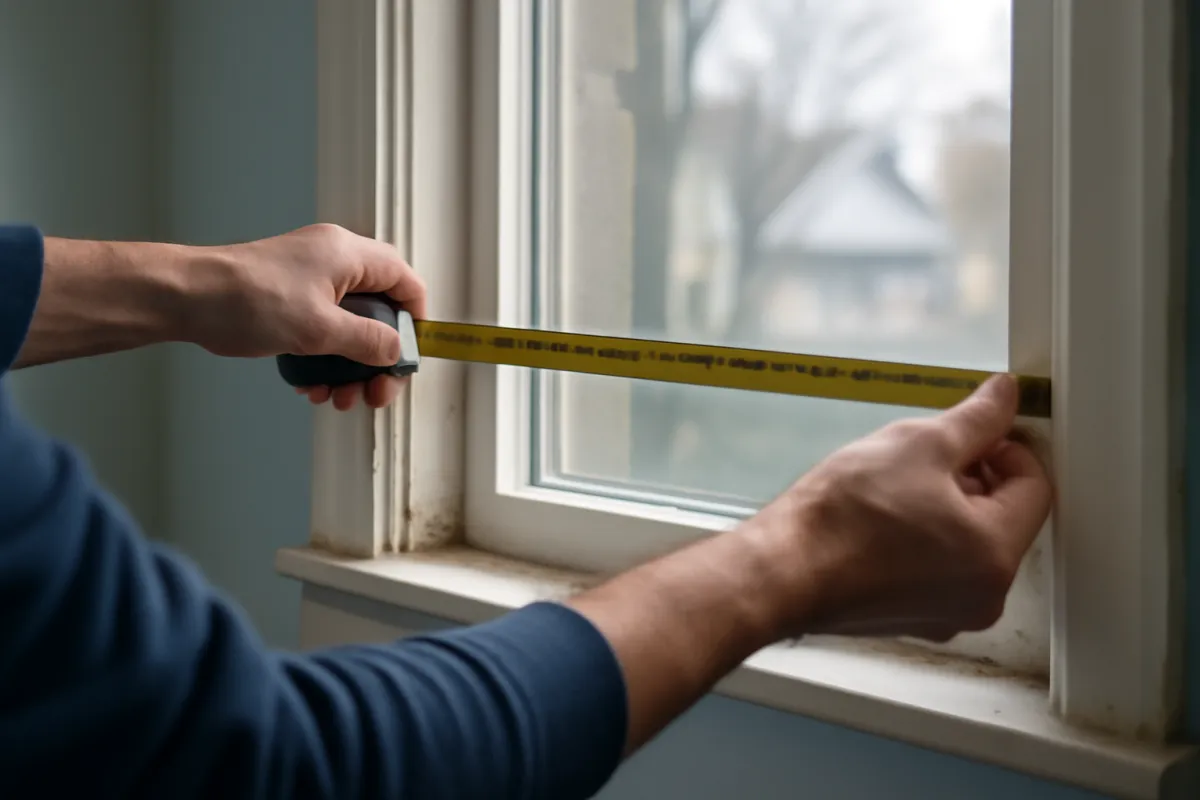
If climbing around to measure is not practical, a quick desk estimate is to take your home’s footprint perimeter and adjust upward for how many separate roof sections drain, since a home with dormers, a porch roof, and multiple levels has more eave length than a simple rectangle of the same footprint. Then count the downspouts you will need, commonly one for every 30 to 40 feet of gutter, and note every inside and outside corner, because corners are extra fabrication and sealing. Those three numbers, eave length, downspout count, and corner count, are what a good bidder wants anyway.
With your measured linear feet in hand, drop it into the estimator alongside your material and your number of stories, and the per-foot ranges in this cost file turn into a rough total you can carry into quotes. It will not be a bid, but it will tell you whether the bids you receive are in the right neighborhood, which is exactly what a homeowner needs to spot a padded number.
DIY versus hiring a pro
The internet is full of weekend gutter installs, and some of them are real: sectional vinyl or aluminum gutters on an accessible single-story home are genuinely within reach of a determined homeowner with a helper, a level, a sturdy ladder, and a careful weekend, and doing it yourself can save the labor share of the budget. That is the honest high end of gutter do-it-yourself, and for the right person and the right low, simple roofline it is money well kept.
The parts that punish mistakes are the slope and the fastening. Gutters must pitch slightly toward each downspout, commonly a small drop over the run, so water actually flows to the outlets instead of standing and overflowing, and getting that pitch right by eye is harder than it looks. Hangers must bite into solid framing, not just the fascia skin, so a gutter full of water and ice does not pull loose. Seamless gutters are effectively not a do-it-yourself job, because the coil machine is not something most homeowners can rent and run safely. And two-story work, steep roofs, and long spans are where the ladder risk and the odds of a costly leak rise past the point most people should take on. Our note on the do-it-yourself versus hire decision walks through weighing your own time, tools, and risk tolerance. Whatever you build, get the pitch and the downspout placement right, because a gutter that does not drain is worse than no gutter at all.
Maintenance and the true cost of owning gutters
The install price is the beginning of a gutter system’s cost, not the end, and both the material and the guards you choose set the upkeep for the next two or three decades. Every gutter needs periodic clearing of leaves and debris so it drains instead of overflowing, commonly once or twice a year and more often under heavy tree cover, and that is either your own time on a ladder or a fee to a cleaning service each visit, which our gutter cleaning cost file prices per linear foot and by home size. A gutter that is never cleared clogs, overflows, and sends water exactly where the system was meant to keep it out, which is how a cheap maintenance skip turns into an expensive fascia or foundation repair.
The material choice shapes the long-run bill in a second way, through lifespan. Vinyl may need replacing in a decade or two as it cracks and sags, while aluminum commonly lasts two to three decades and copper can outlast the roof itself. Spread across the years you own the home, the premium material that lasts far longer narrows its apparent cost gap with the cheap one that needs an earlier replacement, the same lifetime-cost logic that runs through every building material.
The decision, then, is not only what gutters cost to install but what they cost to own. A homeowner staying a few years on a tight budget may rationally pick sectional aluminum and keep the upfront cash. One staying decades under heavy trees is often buying real value with seamless gutters and good guards despite the higher sticker, because the clogs they avoid and the years they add narrow the gap over the system’s life. Run both through the estimator and weigh the totals against your own timeline.
How gutters fit the roof and siding decision
Gutters rarely live alone in a homeowner’s plans, because they hang at the exact seam where the roof meets the walls, and the smart time to think about them is often when a bigger exterior project is already underway. If you are looking at a new roof, replacing the gutters at the same time is usually cheaper and cleaner than doing them separately, because the crew is already set up at the roof edge and the new gutters can be integrated with fresh drip edge and flashing. Our roof replacement cost file covers that larger job, and gutters are a natural line to fold into it.
The same logic applies to siding. New gutters and downspouts fasten through the fascia and route down the walls, so coordinating them with a siding project avoids doing the same edge twice and prevents the awkward result of shiny new siding behind tired old downspouts. Our siding replacement cost file prices that work, and a gutter refresh is a modest add on top of it that keeps the whole exterior consistent. Bundling exterior work this way often earns a better combined price than three separate crews on three separate days.
This is also why gutters belong in any whole-exterior budget conversation rather than being treated as an afterthought once everything else is done. Water management, the roof shedding into the gutters, the gutters into the downspouts, and the downspouts away from the foundation, is a single system, and planning it as one protects the far more expensive roof, siding, and foundation it serves. When you scope a roof or siding job, ask how gutters fit the sequence and the quote, and decide the timing on purpose.
How to read a gutter installation quote
Everything our quote-comparison manual teaches applies to gutter bids, which hide their differences in three specific places: the material and gauge spec, the downspout and drainage plan, and the silent exclusions. A quote that just says “install 180 feet of gutter, $2,500” is not a quote you can compare, because it has not told you the material, the gauge, whether it is seamless, how many downspouts, or whether removal and fascia work are in the number, and each of those can move the honest price by hundreds or thousands.
Make the material and system spec explicit. The bid should name the material and gauge, the gutter size and profile, whether it is seamless or sectional, the number and type of downspouts, the hanger type and spacing, and the plan for where the water discharges, because “aluminum gutters” spans a wide price range and “with downspouts” spans an even wider one. Two bids that both say seamless aluminum can be pricing different gauges and different downspout counts. Ask each bidder to quote the same named material, the same gauge, and the same downspout layout, and watch the totals converge when they do.
Then read the exclusions. The classics on gutters: removal and disposal of the old system, fascia repair if damage is found, extra downspouts or longer discharge runs, guards, and any work at added height or steep pitch. A bid that leaves those silent is not cheaper, it is early. If a low bidder reached you by knocking or storm-chasing rather than referral, our note on hiring a roofing contractor covers the same vetting that applies to anyone working at your roof edge. Hold every quote against your own sketched total from the estimator, and when one comes in far under the pack, the material spec, the downspout count, and the exclusion list are the first three places to find the missing money.
A worked example: one average home, two materials
Take one ordinary single-family home with 180 linear feet of gutter, mostly single-story with one two-story section, a straightforward roofline with a handful of corners, five downspouts, and old aluminum gutters to remove, and cost it two ways. Every figure is illustrative; the structure is the lesson.
Aluminum seamless, about $2,340. Gutter material and hangers $900; labor across hanging, pitching, and sealing $900; five downspouts with elbows and straps $300; removal and disposal of the old gutters $180; small extras and sealant $60. Total about $2,340, roughly $13 per linear foot, with labor near 38 percent on paper because the moderate material cost makes the labor share look smaller than the ladder hours really are.
Copper, about $6,140. The same labor, downspouts, and removal, because the hanging and the climbing are nearly identical: labor $960 (copper takes a touch longer to work), downspouts $600 in matching copper, removal $180. What changes is the channel itself: copper gutter material and hangers $4,400. Total about $6,140, roughly $34 per linear foot, with almost the entire premium over the aluminum build living in the copper channel and the copper downspouts, not in any extra work.
The lesson is in what did not change. The labor, the removal, and most of the downspout work cost close to the same in both jobs, because a copper gutter is a gutter hung the same way with a far pricier metal. The premium is the metal, and the case for paying it is the fifty-year life and the appearance, not any difference in how the system catches water. Run your own home through the estimator and hold your quotes against the same two-material structure.
Common gutter installation mistakes
The recurring failures, collected for prevention.
- Budgeting by length alone. Material, stories, roof complexity, and add-ons move the price far more than footage; a per-foot number from a neighbor’s single-story ranch tells you little about your two-story home.
- Ignoring the pitch. Gutters that do not slope toward the downspouts stand full and overflow; getting the small pitch right is the difference between a working system and a leaking one.
- Comparing bids without a material and gauge spec. “Aluminum” and “with downspouts” each span a wide range; make every bidder quote the same named material, gauge, and downspout layout.
- Underpricing downspouts and discharge. These are priced per piece, not per foot, and a home that needs several, each running water well clear of the foundation, carries a real cost the eave figure hides.
- Forgetting removal and disposal. Tearing out and hauling the old gutters is a real line item; ask whether it is included and whether the old fastener holes get sealed.
- Missing the fascia. A rotten fascia board behind old overflowing gutters must be repaired first; carry a contingency, especially on an older home.
- Overbuying guards on faith. Guards reduce cleaning, they do not end it; weigh the per-foot add against your tree cover and roof height rather than any never-clean-again promise.
Each mistake is cheap to avoid before signing and expensive to fix after the gutters are up and overflowing, which is the general shape of building wisdom: the leverage is all at the beginning.
The bottom line
A gutter job costs what its material, your home’s height and roofline, and your local labor market say it costs: illustratively $4 to $8 per linear foot for vinyl, $6 to $13 for aluminum, $9 to $20 for steel, and $25 to $45 for copper, which puts a typical 150 to 200-foot home somewhere between roughly $1,500 and $3,000 in aluminum seamless before downspouts, guards, removal, and any fascia repair adjust it. Labor is close to half of any of those totals, a taller and more complex roofline drives it up faster than a longer simple one, and downspouts, guards, removal, and fascia work are the lines most likely to surprise you.
Then buy the project like a professional: pick the material first, be honest about your stories and roof complexity, choose seamless or sectional on purpose, count the downspouts and corners, name the exact material and gauge in a written scope handed to every bidder, and ask directly whether removal and fascia repair are included. The homeowners who come out of a gutter job happy are not the ones who found a magic per-foot price; they are the ones who understood that gutters are a water-management system hung at the vulnerable seam between roof and wall, priced every layer on purpose, and never let a low bid thin the downspouts, the hangers, or the part behind the old gutters they could not see. That is the whole recipe, and none of it requires luck.
This cost file exists to explain how gutter pricing is built, not to price your gutters, and nothing in it replaces professional advice from a licensed gutter or roofing contractor or a qualified inspector. Every dollar figure, range, and per-linear-foot number above is illustration only: real costs shift with your region, your labor market, metal and material prices, your home’s height and roof complexity, the season, and what condition the crew finds behind your existing gutters. Because gutters protect the far more expensive roof, fascia, siding, and foundation around them, treat drainage as a system rather than a single line, insist on licensed and insured installers, ask every bidder to price the same written material and downspout spec with removal and fascia repair spelled out, and gather several detailed written quotes before you commit a dollar.
Frequently asked questions
How much does gutter installation cost?
The honest answer is a price per linear foot rather than one flat number, because the material and your home size move the total far more than anything else. As an illustrative guide, installed vinyl gutters commonly run about $4 to $8 per linear foot, aluminum about $6 to $13, steel about $9 to $20, and copper about $25 to $45. A typical single-family home carries roughly 150 to 200 linear feet of gutter, so an aluminum seamless job often lands somewhere between about $1,500 and $3,000 before guards, downspouts, and any fascia repair adjust it. Your real price shifts with local labor rates, how many stories and corners the roofline has, and whether old gutters must come off first, so treat every figure here as a starting range and gather detailed local quotes before you budget.
How much do gutters cost per linear foot?
Per linear foot installed is the most portable way to hold a gutter budget, and the figure depends almost entirely on the material. Illustratively, vinyl runs about $4 to $8 per linear foot, aluminum about $6 to $13, galvanized or galvalume steel about $9 to $20, zinc higher still, and copper anywhere from about $25 to $45 and up. Those bands assume standard five- or six-inch K-style gutters on a single or two-story home with a straightforward roofline. Extra stories, many inside and outside corners, steep roof pitch, and premium seamless work push every one of them higher. Multiply your home's total eave length by the band that matches your material to get a rough total, then add downspouts, guards, and any removal separately.
Are seamless gutters worth the extra cost over sectional?
Seamless gutters cost more up front because they are formed on site from a single coil and installed by a crew with a specialized machine, while sectional gutters come in short stock lengths that snap together and can be handled by a capable do-it-yourselfer. What the seamless premium buys is fewer joints, and joints are where gutters most often leak, clog, and eventually fail. For a home you plan to keep, many homeowners find seamless aluminum the sensible default because the reduced leaking and lower long-term maintenance offset part of the higher install price. Sectional vinyl or aluminum remains a reasonable choice for a smaller home, a tight budget, or a do-it-yourself weekend, as long as you accept that the seams will need watching over the years.
How much does it cost to add gutter guards?
Gutter guards are the single most common add-on, and they price per linear foot on top of the gutter itself. Illustratively, simple foam or brush inserts run about $2 to $4 per linear foot, screen and perforated-metal guards about $3 to $6, and premium micro-mesh or reverse-curve systems about $6 to $12 or more installed. On a home with 180 linear feet of gutter, that is a rough add of a few hundred dollars for basic screens to well over a thousand for a professional micro-mesh system. Guards do not eliminate maintenance, but they cut how often gutters need clearing and can be worth it under heavy tree cover. Price them as a separate line so you can weigh the add against the cleaning trips it saves.
What does labor cost to install gutters versus the materials?
On a typical aluminum gutter job the split lands close to even, with labor commonly running about 40 to 50 percent of the installed total once hanging, sealing, and downspout routing are all counted. Labor climbs as a share whenever the home is taller, the roofline is broken up with many corners and levels, or the pitch is steep, because all of those slow the crew and raise the risk on a ladder or lift. A cheaper material like vinyl shifts the mix toward labor, while premium copper shifts it heavily toward materials. Our contractor cost file breaks down how any trade price is assembled from labor, materials, overhead, and profit, and a gutter job follows that same anatomy exactly.
How do I measure the linear feet of gutter I need?
Measure the total length of every roof edge that sheds water, which is usually the horizontal eaves at the bottom of each roof slope, not the sloped or gable edges. Walk the perimeter with a long tape or a measuring wheel, add up each straight run, and round up to leave room for corners and waste. A quick desk estimate is to take your home's footprint perimeter and adjust for how many separate roof sections drain, since a complex roof with dormers, porches, and multiple levels has more eave length than its footprint suggests. Then count the downspouts you will need, commonly one for every 30 to 40 feet of gutter. Your measured linear feet, dropped into the job estimator, turns the per-foot ranges here into your own rough total.
How much does gutter replacement cost compared to new installation?
Replacing existing gutters usually costs a little more per linear foot than installing on a home that never had them, because the old gutters and hangers have to come down and be hauled away first. That removal and disposal commonly adds an illustrative $1 to $2 per linear foot, or a few hundred dollars on a typical home, on top of the new-gutter price. The bigger variable is what the crew finds behind the old gutters: if the fascia board or the roof edge has water damage, that repair is a separate line item that can add meaningfully to the day. Otherwise the new-gutter cost itself is the same whether it is a first installation or a replacement, so budget the removal and a fascia-repair contingency as their own lines and the two jobs price almost identically underneath.
Can I install gutters myself to save money?
Sectional vinyl or aluminum gutters on a single-story home are genuinely within reach of a determined homeowner with a helper, a level, a ladder, and a careful weekend, and doing it yourself can save the labor share of the budget. The parts that punish mistakes are the slope and the hanging: gutters must pitch slightly toward each downspout so water actually drains, and hangers must bite into solid framing so a full gutter does not pull loose. Seamless gutters are effectively not a do-it-yourself job, because they are formed by a machine most homeowners cannot rent and operate safely. Two-story work, steep roofs, and long spans are where the ladder risk and the odds of a costly leak rise past the point most people should take on. Whatever you build, get the pitch and the downspout placement right, because a gutter that does not drain is worse than no gutter at all.