What's on this page
- What fence repair actually costs
- Post repair and replacement cost
- Picket and board replacement cost
- Gate repair cost
- Full section rebuild cost
- What actually drives fence repair cost
- How material changes the price
- The line between repair and replacement
- Storm damage and multi-point repairs
- Insurance and fence repair
- Labor versus materials on a repair job
- Where a fence repair dollar goes
- Staged repair versus doing it all at once
- What you can honestly repair yourself
- How to compare fence repair quotes
- A worked example: a leaning post and a sagging gate
- A second worked example: when repair stops making sense
- Regional and seasonal variation in fence repair cost
- Permits and HOA rules for fence repair
- What a thorough contractor checks before quoting a repair
- Common mistakes
- The bottom line
Short answer: Fence repair commonly runs an illustrative $150 to $400 to reset or replace one post, $100 to $250 to replace a handful of pickets, $100 to $350 to repair a gate, and $400 to $900 to rebuild one full sagging section. A storm damaging several points at once commonly runs $500 to $2,500. The line between repair and replacement is usually drawn by the posts, not the panels.
Fence repair cost is easy to underprice from the outside, because a leaning post or a sagging gate looks like a small problem compared to building a fence from scratch, and the invoice for fixing it can still feel surprising. The reason is that repair work is priced by the piece, not by the foot, and a single post or a single gate carries most of the same labor, digging out old concrete, resetting something plumb, hanging hardware correctly, that a much longer run of new fence would spread across many feet of material.
This cost file prices fence repair the way it actually breaks down: the honest per-repair ranges for posts, pickets, gates, and full section rebuilds, how material affects the price, where the line between repair and replacement actually sits, what a typical storm damage job costs when several points fail at once, and a full worked example comparing a simple repair to a borderline replacement decision. Our fence installation cost file prices a full new fence from scratch if your situation turns out to be past the point repair can fix. Sketch your own repair in the job cost estimator as you read, and the ranges below turn into your numbers.
Key takeaways
- Illustrative per-repair ranges: one post reset or replaced $150 to $400, a handful of pickets $100 to $250, one gate $100 to $350, one full section rebuild $400 to $900.
- Repair prices by the piece, not the foot, because most of the cost is labor, digging out old concrete, resetting plumb, hanging hardware, that does not scale down with a small amount of material.
- The line between repair and replacement is usually drawn by the posts: isolated picket or gate problems with sound posts elsewhere point to repair, while heaving or rotting posts across much of the run point to replacement.
- A storm damaging several points at once commonly runs $500 to $2,500 depending on how many posts, sections, and gates failed; document damage with photos before repair for any insurance claim.
- Labor is typically 45 to 55 percent of a repair's total, higher than a new installation's share, because the labor to fix one point correctly does not shrink with the small amount of material involved.
What fence repair actually costs
Fence repair has no single price because it is not one job, it is a menu of small, specific jobs priced individually. Resetting or replacing a single leaning post commonly runs an illustrative $150 to $400. Replacing a handful of rotted or damaged pickets commonly runs $100 to $250. Rehanging or repairing a gate, new hinges, a new latch, or squaring a frame that has racked out of alignment, commonly runs $100 to $350. Rebuilding one full sagging section between two posts, the point where a repair starts to resemble a small rebuild, commonly runs $400 to $900.
A fence with several of these problems at once, most often after a storm, scales up from these per-repair figures based on how many points actually failed, and the sections below work through each repair type, what material does to the price, and the worked examples that show how the pieces add up on a real fence.
Illustrative cost by repair type
Per-repair midpoint figures before material and quantity adjustments. Every fence and market differs.
Midpoint figures for a wood fence as the baseline; vinyl and aluminum move the figure up through materials and hardware, chain-link moves it down.
Post repair and replacement cost
A fence post is the structural, buried layer holding everything else up, and it is also the repair most likely to be underestimated, because the visible work, setting one post, looks small compared to the digging and curing it actually requires. An illustrative $150 to $400 per post covers breaking out or digging around the old concrete footing, setting a new or straightened post plumb and at proper depth, and curing time for fresh concrete before the post can bear load again.

The price climbs when the old concrete footing has to be fully broken out rather than worked around, when the ground is rocky or the post sits at an awkward spot like a corner that takes bracing in two directions, or when more than one post in the same area needs attention at once, since adjacent failing posts are often a sign the whole section’s footing condition is suspect rather than one unlucky post.
Picket and board replacement cost
Replacing a handful of rotted, cracked, or storm-damaged pickets or boards is the cheapest common repair, commonly running an illustrative $100 to $250, because the posts and the structural rails underneath are intact and the job is purely cosmetic and weatherproofing work on the visible surface layer. The material itself, a handful of boards, is inexpensive; the labor is removing the damaged pieces without harming the adjacent sound ones and fastening the replacements to match the existing spacing and line.
The detail that catches people off guard is appearance, not price: new pickets set into a weathered fence do not match in color for a season or more, since the surrounding wood has already grayed while the new boards start out their natural color. Staining the repaired section, or the whole fence, closes that gap immediately rather than waiting for the new wood to weather in on its own, and that staining cost is worth budgeting alongside the repair itself if matching appearance matters to you.
Gate repair cost
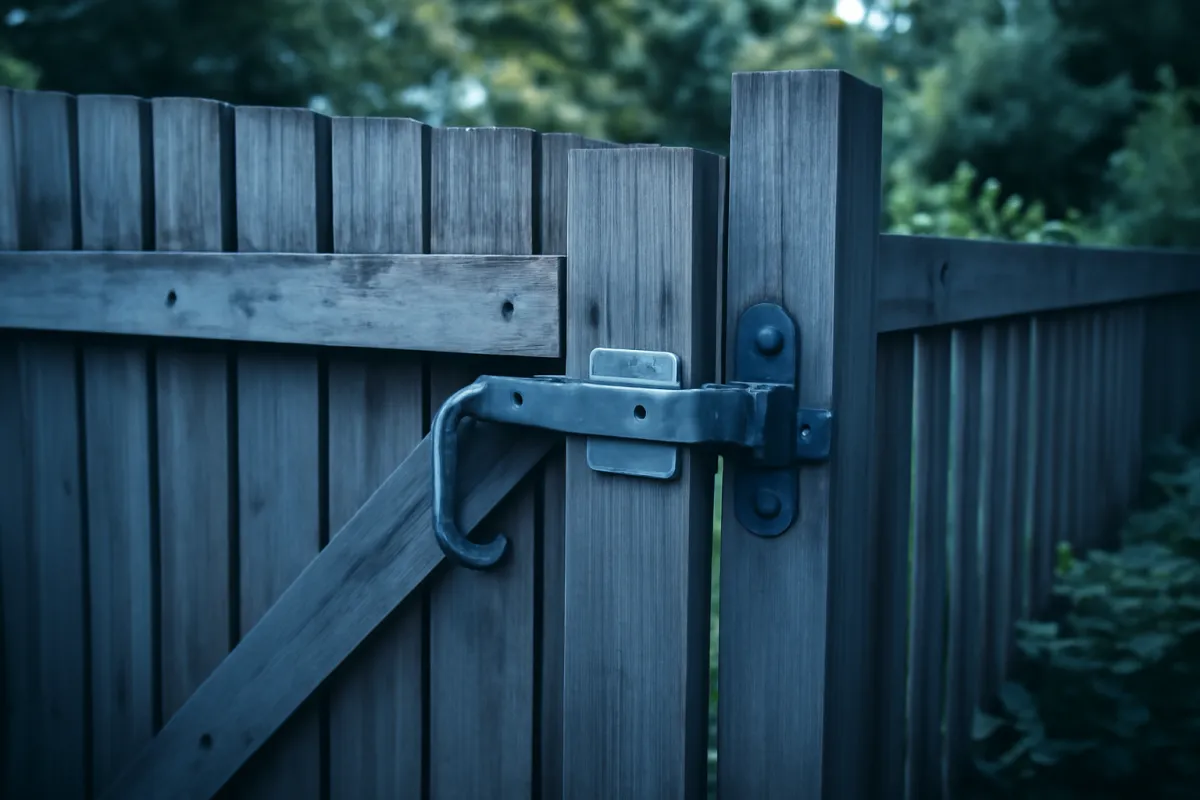
A gate takes more abuse than any other part of a fence, since it is the one part that moves every time someone uses it, and gate problems are correspondingly the most common standalone fence repair call. Rehanging a gate that has dropped and stopped latching, replacing worn or rusted hinges, installing a new latch, or squaring a frame that has racked out of true commonly runs an illustrative $100 to $350, depending on how much of the gate’s hardware needs replacing and whether the frame itself needs reinforcement rather than just new hardware.
A gate that has dropped is very often a hinge problem rather than a structural one, and the honest fix is usually cheaper than it looks from the symptom: a sagging gate commonly just needs new, properly sized hinges and sometimes a diagonal brace added to the frame to stop future racking, rather than a full gate rebuild. Ask a contractor to diagnose whether your gate is a hinge problem or a frame problem before agreeing to a price, since the two repairs differ meaningfully in cost.
Full section rebuild cost
Somewhere between a simple repair and a full replacement sits the section rebuild: tearing out and rebuilding one run of fence between two posts, commonly because that one section sagged, rotted through, or suffered concentrated storm damage while the rest of the fence remains sound. An illustrative $400 to $900 per section covers removing the failed panel material, confirming or resetting the bounding posts if needed, and building a new section to match the surrounding fence’s height and style.
This repair is worth distinguishing from post or picket repair specifically because it is the threshold where a homeowner should pause and ask whether the rest of the fence is likely to need the same treatment soon. One failed section on an otherwise sound fence is a normal, isolated repair; two or three sections failing in the same season on the same fence is a signal the whole run may be approaching the end of its life, which changes the calculus toward full replacement, priced in full in our fence installation cost file.
What actually drives fence repair cost
Several forces move the price within each repair category above, and separating them turns a confusing quote into a readable one. The repair type itself sets the starting band, as the chart shows. Material is the second force, since vinyl and aluminum hardware and matched replacement panels cost more than wood or chain-link equivalents. The number of repair points is the third, since multiple posts, sections, or gates needing attention in one visit scale the total, though often at a slightly better per-repair rate than paying for separate visits.
Ground condition is the fourth force and affects post work specifically, the same way it affects new installation, since rocky or root-filled soil slows digging out an old footing just as it slows digging a new hole. Access is the fifth, since a repair point reachable only through a narrow side yard or blocked by landscaping takes longer than one with open access. The sixth is whether old material has to be hauled away, which adds a modest disposal cost on top of any repair involving removed boards, posts, or hardware.
How material changes the price
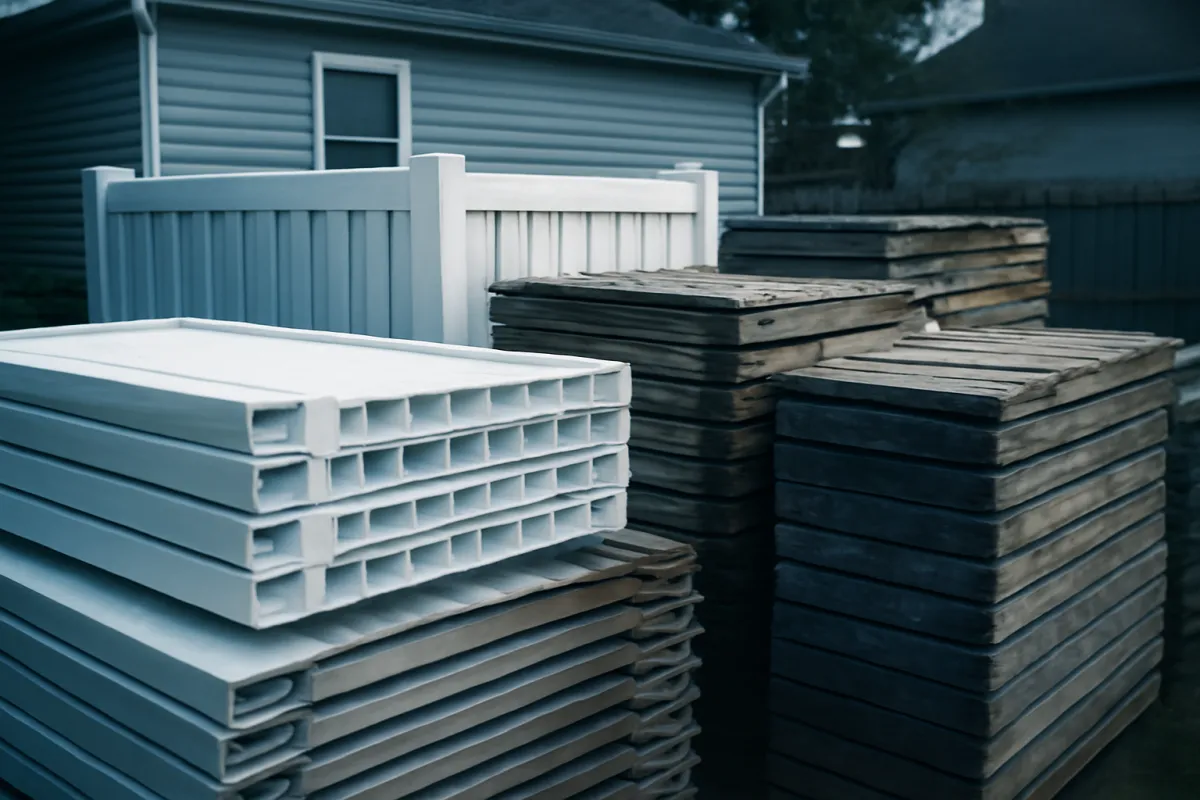
Wood is the baseline this cost file’s figures assume, since it is the most common residential fence material and the most forgiving to repair piece by piece: individual boards and posts are inexpensive and widely available in standard dimensions. Chain-link repairs, re-stretching or patching fabric and straightening or replacing a bent post, commonly price at or slightly below the wood baseline, since the fabric material itself is cheap even though post work costs the same labor regardless of what hangs on it.
Vinyl and aluminum repairs commonly run illustratively 20 to 30 percent above the wood baseline, because matched replacement panels and hardware for manufactured systems cost more than cut lumber, and matching an exact color or profile sometimes requires ordering from the original manufacturer rather than a generic lumber yard substitute. The posts underneath cost the same to reset regardless of what material sits on top, which is why the premium shows up specifically in the panel and hardware line rather than in the digging.
The line between repair and replacement
The honest question before spending money on any fence repair is whether the fence is worth repairing at all, and the answer is usually decided by the posts rather than the panels. Panels are the visible, replaceable, relatively cheap layer; posts are the structural, buried, expensive layer, and a fence whose posts are heaving, rotting at grade, or leaning across a large share of the run is a fence that will keep asking for repair money regardless of how many boards get swapped, because the underlying support keeps failing.
A workable rule of thumb: if the failures are isolated, confined to a minority of the fence’s total length, and the posts elsewhere along the run are still plumb and solid, repair is almost always the right and cheaper call. If more than roughly a third of the line is failing, or the posts themselves are the recurring problem rather than the panels, full replacement is usually cheaper per year of remaining life than a rolling series of patches that keep returning to the same structural issue. A contractor’s honest assessment of the posts specifically, walked along the whole fence rather than glanced at from one spot, is the number that should decide this, not a general feeling that the fence looks old or a single bad section that happens to catch your eye first.
Storm damage and multi-point repairs
Storm damage rarely confines itself to one point, since wind load and falling debris tend to find every already-weak spot along a fence line at once rather than politely picking a single target. A typical storm repair job addressing several leaning or snapped posts, a few damaged panel sections, and possibly a dropped gate commonly runs an illustrative $500 to $2,500 depending on how many points failed and whether any single point has crossed into full section rebuild territory rather than a simpler fix.
Document every point of damage with photos immediately after the storm and before any repair work begins, since this is exactly the kind of sudden, covered event many homeowners insurance policies address, subject to your specific policy’s language and your deductible. Ask your contractor to itemize each repair point separately on the invoice rather than quoting one lump sum, since an itemized bill is what your insurer will want to see if you file a claim, and it is also the only way to confirm you are not paying for a repair that was not actually storm related.
Act reasonably quickly once damage is documented, both because a leaning post or an open gate left unaddressed can worsen with the next rain or wind event, and because many insurers expect reasonable mitigation once damage is known rather than an open-ended delay. That does not mean skipping the documentation step to rush into repair; it means documenting first, then scheduling the repair promptly rather than letting a damaged fence sit through another season of weather.
Insurance and fence repair
Whether homeowners insurance covers a fence repair depends entirely on the cause, and the honest answer requires checking your specific policy rather than assuming either way. A sudden, covered peril, commonly wind, a fallen tree, or another named storm event depending on your policy’s exact language, is often covered subject to your deductible, while ordinary wear, rot, or age-related failure is typically excluded, since insurance is built to cover sudden events rather than gradual deterioration that a routine maintenance schedule should have caught.
The practical move after any damage that might be storm related is to photograph everything before touching anything, call your insurer to ask about your specific coverage and deductible before assuming the claim is or is not worth filing, and keep the contractor’s itemized repair invoice as the documentation your claim will need. A deductible that exceeds the repair cost makes filing pointless regardless of coverage, so do that comparison honestly before deciding whether insurance is even the relevant path for a given repair.
Labor versus materials on a repair job
Repair work skews more heavily toward labor than new fence installation does, commonly landing at 45 to 55 percent labor on a typical repair, a few points higher than the roughly even split a full installation carries. The reason is straightforward: the material for most individual repairs, one post, a handful of boards, a set of hinges, is genuinely inexpensive, while the labor to dig out an old concrete footing, reset something plumb, or carefully match hanging hardware on an existing frame takes real time regardless of how little material the job consumes.
This is the honest explanation for why a single post reset can feel expensive relative to the small pile of material involved: you are paying mostly for careful, often physically awkward labor on one specific point, not for lumber or concrete. It is also why bundling several known repairs into one visit typically costs less per repair than paying for separate visits, since the crew’s mobilization and setup cost, the part that does not scale with the number of repairs, gets spread across more work in a single trip.
Where a fence repair dollar goes
Assemble the pieces of a typical fence repair job and the shape of the budget becomes visible. The proportions below are illustrative for a standard wood fence repair involving one or two repair points.
Where a fence repair dollar goes
Illustrative shares for a standard wood fence repair.
The mix shifts with repair type: a gate repair skews toward hardware inside the materials band, while a post reset skews harder toward labor because digging out old concrete is slow work regardless of the small material involved.
Labor carrying the largest single share is the direct explanation for why a one-post repair can feel pricey relative to the small pile of material it uses: you are paying mostly for careful, time-consuming work on one specific point, not for lumber or concrete.
Staged repair versus doing it all at once
When several repairs are known but none is urgent, a homeowner has a real choice between fixing everything now or staging the work across two or more visits as budget allows. Staging makes sense when the known problems are genuinely stable rather than actively worsening, and it lets a tight budget address the most urgent or safety-relevant issue, commonly a post or a gate, immediately while deferring purely cosmetic repairs like pickets.
The tradeoff is cost: a contractor mobilizing twice for two smaller visits typically charges more in total than handling all known repairs in one trip, since a second visit means a second setup and often a second minimum job charge on top of the actual repair work. If nothing is urgent enough to require immediate attention and the budget genuinely needs to spread across two periods, staging is a reasonable choice; if the repairs can all be afforded now, bundling them into one visit is usually the lower total cost.
What you can honestly repair yourself
Some fence repairs are genuinely within reach of a confident do it yourselfer with basic tools and a free afternoon. Replacing a handful of rotted pickets on a wood fence, tightening or swapping a worn gate hinge and latch, and resetting a single post in fresh concrete are all doable jobs that a reasonably capable homeowner can complete without specialized equipment, and doing them yourself keeps the full repair cost as savings rather than paying for labor on work you can do safely.
The parts that punish a do it yourself attempt are the ones where getting it slightly wrong is expensive to discover later. A post reset too shallow or out of plumb heaves again within a winter or two, undoing the whole repair. A gate rehung without addressing the actual cause of the sag, often a frame that needs a diagonal brace rather than just new hinges, drops again within months. Multiple posts needing attention at once, rocky ground, and any repair on heavy vinyl or aluminum panel systems are where hiring out is the safer choice, both for the quality of the fix and for the time a inexperienced attempt can consume compared to a professional crew that resets posts routinely.
How to compare fence repair quotes
A fence repair quote hides its real differences in the same places a new installation quote does: exactly what is being fixed, the material and hardware being used, and what is included versus excluded. A quote that just says “fence repair, $500” has not told you how many posts, sections, or gates it covers, whether old material removal and haul away are included, or whether the hardware is matched to your existing material, and each of those can shift the real price by hundreds of dollars.
Make every bidder itemize the repair by point: which posts, which sections, which gates, and what material and hardware each line uses. Ask specifically whether haul away of old material is included, since this is a common silent exclusion on repair work the same way it is on new installation, covered in more depth in our note on comparing contractor quotes. An itemized quote is also the one that will actually hold up if you later need it for an insurance claim.
A worked example: a leaning post and a sagging gate
Take one ordinary wood privacy fence with two unrelated problems: one post near the middle of a run has started leaning after several winters of frost heave, and the walk gate near the house has dropped and stopped latching. Every figure is illustrative; the structure is the lesson.
The post, about $275. Breaking out the old concrete footing, resetting the post plumb at proper depth in fresh concrete, and reattaching the adjacent panel sections once the concrete cures. The posts on either side of this one were confirmed sound during the visit, which is the detail that kept this a repair rather than raising a replacement question.
The gate, about $200. New hinges sized correctly for the gate’s weight, a new latch, and a diagonal brace added to the frame to stop the racking that caused the drop in the first place. No frame rebuild was needed since the wood itself was sound.
Total, about $475 for one visit. Bundling both repairs into a single contractor visit avoided a second mobilization charge, and the total landed comfortably inside the illustrative bands for each repair type on its own, confirming this was a straightforward, isolated-problem repair rather than a sign of broader fence trouble.
A second worked example: when repair stops making sense
Take a different wood fence, six years old, where a homeowner called about one rotted section and the contractor’s walk-through found three additional posts along the same run showing early heave and two more sections with visible rot starting at the base. Every figure is illustrative; the structure is the lesson.
Repairing just the one known section, about $650. This addresses only the symptom the homeowner called about, leaving the other developing problems untouched and likely to surface as separate repair calls within a year or two, each carrying its own mobilization cost.
Repairing all five identified problems in one visit, about $1,900. One section rebuild, three post resets, and addressing the second early-rot section while the crew is already on site, all in a single mobilization. This is less than the roughly $2,300 that five separate future repair visits would likely total, and it also prompted the honest conversation about whether this fence, now showing trouble at multiple points after only six years, has an underlying problem, settling soil or a bad original installation, worth investigating before spending more on it.
The lesson is that an honest contractor walk-through often finds more than the one problem you called about, and the decision is not simply whether to fix what you see, it is whether what you see is isolated or a signal about the whole fence’s condition. Run your own repair type, material, and count through the job cost estimator to see how a bundled visit compares to separate ones.
Regional and seasonal variation in fence repair cost
The same repair costs noticeably more in a high labor cost metro than in a smaller market a few hours away, because the labor minutes behind a post reset or a gate rehang are priced by the local market rather than by the repair itself. Climate adds its own layer on top of region: a post set below a deep frost line in a cold climate needs a deeper hole dug back out for any reset, which takes longer than the same repair in a mild climate with a shallow or nonexistent frost line, and that extra digging time lands directly on the labor portion of the bill.
Season affects fence repair the same way it affects new installation, through both ground conditions and contractor demand. Frozen ground makes any post work slow or impossible in a true winter climate, which can push a non-urgent repair to spring regardless of price, while a contractor with open slots in the quieter fall and winter months in a milder climate may price a repair more sharply than during the busy spring rush when everyone calls at once. If a repair is not urgent, asking a local contractor when their slower season falls is a real, no-cost way to find a better price.
Permits and HOA rules for fence repair
Repair work generally faces fewer permit questions than new installation, since most jurisdictions that require a permit for building a new fence do not require one for in-kind repair of an existing, already-permitted fence, replacing the same posts, panels, or gate in the same configuration. The exception is a repair that edges into something larger, rebuilding a majority of the fence’s length, changing the height or material, or moving the line, any of which can trigger the same permit and setback questions a new installation faces. Confirm with your local building department if your repair is extensive enough to raise the question.
A homeowners association, where one applies, is the more common check point for a repair than a government permit, since many associations require written approval for a fence repair that changes the color, material, or visible style, even where the change is a forced substitution because the original exact product is no longer available. Checking the association’s architectural guidelines before ordering replacement material, particularly for vinyl or a specific stain color, avoids ordering something that then fails an approval and has to be redone.
This matters more than it sounds for a simple repair, because a discontinued vinyl panel profile or a weathered stain shade that the original manufacturer no longer sells can force a substitution that technically changes the fence’s appearance even though the homeowner’s intent was only to fix what broke. Bringing a sample or a photo of the original material to the association ahead of ordering, rather than after the repair is already visible, is the cheap way to avoid a redo over a detail nobody meant to change in the first place.
What a thorough contractor checks before quoting a repair
A contractor who quotes a fence repair properly does more than look at the one point you called about. A thorough visit checks every post along the affected run for plumb and firmness, not just the one that is visibly leaning, since a post that looks fine today but sits in the same aging footing as the one that failed is a reasonable candidate to fail next. It also checks whether the failure has an identifiable cause, water pooling against one specific footing, a downspout draining directly onto one section, a tree root that has grown into the line, since fixing the symptom without addressing a findable cause often means paying for the same repair again within a few years.
A quote that comes back naming only the single point you mentioned on the phone, with no evidence anyone actually walked the rest of the fence, is a quote worth a second opinion, the same caution our note on vetting a contractor recommends for any trade. The extra ten minutes a thorough contractor spends walking the whole line before quoting is routinely the difference between one repair bill this year and three separate repair bills over the next three. Ask directly whether the quote reflects a walk of the whole fence or just the reported problem, and treat a confident price given without ever seeing the fence in person with real skepticism.
Common mistakes
The recurring failures, collected for prevention.
- Fixing only the symptom you noticed. A thorough walk-through sometimes finds related problems nearby that are cheaper to address in the same visit than as a separate future call.
- Assuming a sagging gate needs a full rebuild. Most drop and latch problems are a hinge and bracing fix, not a frame replacement.
- Underestimating post repair because the material is cheap. The labor to dig out old concrete and reset plumb is most of the cost regardless of how little lumber or concrete is involved.
- Not photographing storm damage before repair. Documentation before work begins is what makes an insurance claim possible afterward.
- Ignoring repeated failures as a pattern. Multiple posts or sections failing within a short span on the same fence is a signal worth investigating, not a string of bad luck.
- Staging repairs that are not actually stable. Deferring a genuinely worsening problem to save money now often costs more once it has spread.
- Skipping the itemized quote. A lump sum repair price hides which specific points are covered and what material and hardware will be used.
Each mistake is cheap to avoid before signing and expensive to discover after the crew has packed up, which is the general shape of repair economics: a thorough walk-through up front is worth more than any discount decided after the fact.
The bottom line
Fence repair costs what the specific problem, the material, and the number of points needing attention say it costs: illustratively $150 to $400 for a post, $100 to $250 for pickets, $100 to $350 for a gate, and $400 to $900 for a full section rebuild, with storm damage across several points commonly running $500 to $2,500. Repair prices by the piece because the labor to fix one point correctly, not the small amount of material involved, is most of what you are paying for.
Buy the repair with that structure in mind: let a contractor walk the whole fence rather than estimating from the one problem you called about, ask directly whether the posts away from the visible problem are sound before committing to repair over replacement, bundle known repairs into one visit when none is urgent enough to require staging, and get every quote itemized by repair point with material and haul away stated explicitly. That is the whole decision, and it does not require guessing which fix your specific fence actually needs, only an honest look at the posts before deciding how much to spend on the boards.
This cost file exists to explain how fence repair pricing is structured, not to diagnose your specific fence, and nothing in it replaces an on-site assessment from a licensed fencing contractor. Every dollar figure and range above is illustration only: real costs shift with your region, your fence’s material and age, local labor rates, and how many repair points your specific fence actually has. Whether damage is covered by insurance depends on your policy’s specific language and the documented cause, so confirm coverage with your insurer before assuming either way, and gather more than one written, itemized quote before committing to any repair or replacement decision.
Frequently asked questions
How much does it cost to repair a fence?
Fence repair prices by the piece rather than by the foot, so the honest answer depends on what specifically failed. Resetting or replacing a single leaning post commonly runs an illustrative $150 to $400, replacing a handful of rotted pickets or boards commonly runs $100 to $250, rehanging or repairing a gate commonly runs $100 to $350, and rebuilding one full sagging section between two posts commonly runs $400 to $900. A fence with several of these problems at once, often after a storm, scales up from there based on how many repairs are needed. Get a contractor to walk the actual fence rather than estimating over the phone, since the honest price depends on exactly what is broken and how much of the fence it affects.
How do I know if my fence needs repair or full replacement?
The line is usually drawn by the posts, not the panels, because posts are the structural, buried, expensive layer underneath the visible boards. If the failures are isolated, a couple of bad pickets, one leaning post, a gate that will not latch, and the posts elsewhere along the run are still plumb and solid, repair is almost always the cheaper and correct choice. If more than roughly a third of the fence line is failing, or the posts themselves are heaving, rotting at grade, or leaning across the whole run, replacement is usually cheaper per year of remaining life than a rolling series of repairs that keep returning to the same underlying problem. A contractor's honest assessment of the posts specifically, not just how the fence looks, is the number that should decide this.
Why does a repaired section of fence look different from the rest?
New wood pickets or boards set into a weathered fence do not match in color for a year or more, because the existing wood has already grayed and weathered in the sun while the new material starts out its natural color. This is a cosmetic effect only, not a sign of a bad repair, and it fades on its own as the new wood ages, though staining the repaired section, or the whole fence, to match closes the gap immediately rather than waiting out a season. Vinyl and other manufactured materials generally match better right away since the color is uniform and factory applied rather than weathered, which is one reason those materials show repairs less obviously than wood does.
Can I repair a fence myself instead of hiring a contractor?
Some repairs are genuinely within reach of a confident do it yourselfer: replacing a handful of rotted pickets on a wood fence, tightening or replacing a gate hinge and latch, and resetting a single post in fresh concrete are all doable with basic tools and a weekend afternoon. What punishes a do it yourself attempt is getting the post depth or plumb wrong, since a post reset too shallow heaves again within a year or two and a post set out of line throws off every panel near it. Multiple posts, rocky ground, heavy vinyl or aluminum panel systems, and any repair where the old concrete footing has to be fully broken out and replaced are where hiring out is the safer and often cheaper choice over the life of the fix.
Does homeowners insurance cover fence repair?
It depends entirely on the cause of the damage and your specific policy, so this is a question to confirm with your insurer rather than assume either way. Damage from a covered peril, commonly wind, a fallen tree, or another named storm event depending on your policy's specific language, is often covered subject to your deductible, while ordinary wear, rot, or age related failure is typically not covered under a standard policy, since insurance covers sudden covered events rather than gradual deterioration. Document the damage with photos immediately after a storm, before any repair work begins, and call your insurer to ask about your specific coverage before assuming either that it is covered or that it is not.
How much does it cost to fix a fence after a storm?
Storm damage commonly affects several points along a fence at once rather than a single isolated spot, since wind load and falling debris tend to find the weakest existing points across the whole run. A typical storm repair job addressing a handful of leaning or snapped posts, several damaged panel sections, and possibly a gate commonly runs an illustrative $500 to $2,500 depending on how many points failed and whether any of the damage reaches the level of a near-full rebuild of one section. Document every point of damage with photos for any potential insurance claim before repair work begins, and get the contractor to itemize each repair separately so you can see which parts of the bill the insurance claim might cover.
What is the labor cost to repair a fence versus the materials?
Repair work skews more toward labor than new installation does, commonly landing labor at 45 to 55 percent of a typical repair's total, because the materials for most individual repairs, a post, a handful of boards, gate hardware, are relatively inexpensive while the labor to dig out an old concrete footing, reset a post plumb, or carefully match hanging hardware on an existing gate takes real time regardless of how little material it uses. This is part of why a single post reset can feel expensive relative to the small amount of material involved: you are paying mostly for the careful, often awkward labor of fixing one specific point correctly rather than building a long straight run from scratch.
Is it cheaper to repair a fence in stages instead of all at once?
Staged repair, fixing the worst section or the most urgent safety issue now and the rest over the following months, is a legitimate way to spread cost, and it makes the most sense when the problems are genuinely isolated and not actively getting worse while you wait. The tradeoff is that a contractor mobilizing twice for two separate smaller jobs typically charges more in total than doing all the known repairs in one visit, since a second trip means a second setup and often a second minimum job charge. If you know several repairs are needed and none is urgent enough to require immediate attention, bundling them into one visit is usually the lower total cost; stage only the repairs that are not yet needed or not yet affordable.