What's on this page
- Why bathroom quotes vary so wildly
- The three tiers: refresh, mid-range gut, high-end
- The line-item anatomy of a bathroom remodel
- Labor versus materials: where the money splits
- The layout rule: keep the plumbing where it is
- Waterproofing: the invisible layer that matters most
- Tile economics: material is half the story
- Vanities and fixtures: where a splurge shows
- Where a mid-tier budget actually goes
- The permit question
- The hidden-condition contingency
- Powder room to primary suite: how costs scale
- What you can honestly DIY
- How to read a bathroom remodel quote
- Timeline and the cost of living through it
- Resale value, kept honest
- A worked example: one 5x8 bath, three budgets
- Common bathroom remodel mistakes
- Financing and phasing a bathroom remodel
- Hiring a bath remodel contractor
- The bottom line
Short answer: A bathroom remodel illustratively runs $5,000 to $12,000 for a surface refresh, $15,000 to $35,000 for a mid-range gut remodel, and $40,000 to $80,000 or more for high-end custom work. Labor is typically 40 to 60 percent of the total, keeping the plumbing where it is saves thousands, and the invisible waterproofing layer, around $1,500, is the line to protect rather than trim. Hold a 15 to 20 percent contingency.
Ask what a bathroom remodel costs and you will get answers ranging from “a weekend and a thousand bucks” to “we spent more than our first car, twice.” Both can be true, because a bathroom remodel is not one product. It is a stack of trades, demolition, plumbing, electrical, waterproofing, tile, carpentry, working in the smallest and wettest room in the house, and the price depends entirely on how deep into that stack your project goes.
This cost file prices the cost for a bathroom remodel line by line. The honest tier ranges and what each tier actually buys, the anatomy of a quote, why the invisible waterproofing layer matters more than the visible tile, what moving a toilet really costs, and a full worked example of one 5x8 bathroom costed at three budgets. Our earlier contractor cost file explained how any trade price is built; this one applies that machinery to the bathroom specifically. Sketch your own version in the job cost estimator as you read, and the ranges below turn into your numbers.
Key takeaways
- Illustrative tiers: a surface refresh commonly runs $5,000 to $12,000, a mid-range gut remodel $15,000 to $35,000, and high-end custom work $40,000 to $80,000 or more.
- Labor is typically 40 to 60 percent of the total, which is why local rates and layout decisions move the price more than fixture shopping ever will.
- Keeping plumbing where it is saves thousands; "let's move the toilet" is the most expensive sentence in the project.
- Waterproofing is the line to protect, not trim: an invisible $1,500 layer stands between you and a five-figure repair.
- Hold a 15 to 20 percent contingency, because bathrooms hide rot, corroded pipe, and old leaks behind exactly the surfaces you are removing.
Why bathroom quotes vary so wildly
Homeowners collect three bathroom bids and find them thousands apart, then conclude that somebody is gouging. Usually nobody is. The bids differ because the bidders are pricing different bathrooms: one assumed the tub stays and gets reglazed, another assumed a full tear-out; one included a proper waterproofing system, another wrote “tile shower” and left the rest to imagination; one carried a realistic tile allowance, another a placeholder half its size.
The distinction that matters is scope clarity versus scope creep. Scope clarity means deciding, before anyone quotes, exactly which fixtures stay, which move, what grade of finishes you want, and who handles permits and disposal, then handing every bidder that same written brief. Scope creep is the opposite process running in reverse: a vague brief gets priced vaguely, the real decisions get made mid-project, and each one arrives as a change order with a price attached and no competitive pressure on it.
Every dollar figure in this cost file is illustrative, because your market, your house, and your taste set the real numbers. But the structure of the cost, what the money buys and in what proportions, is stable, and once you see the structure, a wild spread between quotes stops being a mystery and becomes a list of specific questions.
The three tiers: refresh, mid-range gut, high-end
Bathroom projects sort into three tiers, and knowing which one you are actually shopping for is half the budgeting battle.
A refresh keeps every fixture where it is and changes surfaces: paint, a new vanity and faucet, lighting, hardware, maybe new flooring and a reglazed tub. Illustratively, $5,000 to $12,000. A mid-range gut remodel takes the room to the studs, keeps the layout, and rebuilds it with quality mid-grade materials: new tub or shower, tile, waterproofing, vanity, and fixtures. Illustratively, $15,000 to $35,000 for a full bath. A high-end remodel adds custom work and premium materials: curbless showers, stone, heated floors, custom cabinetry, and often layout changes. Illustratively, $40,000 to $80,000 and up, with the ceiling set mostly by appetite.
One 5x8 full bath, three budget tiers
Illustrative totals for the same room at each tier. Every market differs.
The jumps between tiers are structural, not decorative: each tier adds trades and rebuild depth, not just nicer finishes. The worked example later in this cost file itemizes all three.
The tiers are not a quality ranking; they are a depth ranking. A well-executed refresh on a sound bathroom is money well spent, and a high-end remodel on a failing one is lipstick on rot if the tier was chosen for looks rather than condition.
The line-item anatomy of a bathroom remodel
Strip any bathroom quote to its skeleton and the same lines appear. Demolition and disposal: tearing out fixtures, tile, and sometimes subfloor, almost entirely labor, illustratively $1,000 to $2,500. Plumbing rough-in: new valves, supply lines, and drain work, heavily labor, $1,500 to $4,000 when the layout stays put. Electrical: outlets to current code, lighting, a vent fan, mostly labor, $800 to $2,500. Waterproofing and backer: the membrane system behind the wet area, labor-led, $1,000 to $2,500.
Then the visible layers. Tile: material plus an installation labor line that often exceeds it, commonly $3,000 to $8,000 combined for a full bath. Vanity, countertop, and cabinetry: the most material-weighted line, $800 to $5,000 and up by grade. Fixtures: toilet, faucets, shower set, glass, $1,000 to $5,000 across tiers. Finally paint, trim, accessories, and permits filling out the bottom of the page.
Notice the pattern in those parentheticals: the early, invisible lines are mostly labor, and the late, visible lines carry the materials. That is why two bathrooms with identical fixtures can differ by ten thousand dollars, and why judging a quote by the faucet brand is reading the wrong lines. The money lives in the rebuild, not the shopping cart.
Labor versus materials: where the money splits
Across the whole project, labor typically lands between 40 and 60 percent of a bathroom remodel’s cost, call it roughly half as a planning figure. Bathrooms sit at the labor-heavy end of home projects because the room concentrates four or five licensed trades into forty square feet, each mobilizing for a relatively small number of hours, and small skilled jobs are expensive per hour of result.
Our contractor cost file broke every price into labor, materials, overhead, and profit; the bathroom version of that lesson is that your local labor rate is the biggest lever you do not control, and your scope is the biggest one you do. In a high-rate market, the same mid-range remodel can cost half again what it does in a lower-rate one, with identical materials.
The practical consequences: first, national averages mislead, because they blend markets whose labor rates differ enormously, so anchor on local quotes and use the estimator with your local rate rather than a blended one. Second, material upgrades are cheaper than they look and layout changes are dearer, because a nicer faucet costs its price difference once, while a layout change buys hours across multiple trades. Third, when a bid seems miraculous, the labor lines are where to check what got thinned: crew skill, hours, or the licensing and insurance behind them.
The layout rule: keep the plumbing where it is
One rule saves more money than any other in bathroom budgeting: keep the fixtures where they are. When the toilet, sink, and tub stay in place, the plumber reuses existing supply and drain locations, and the plumbing line stays in the illustrative $1,500 to $4,000 range. When fixtures move, the job changes species.
Moving a sink means rerouting supply and a modest drain. Moving a shower means new drain work and valve placement. Moving the toilet is the expensive sentence: its large drain line and vent must be rerouted through the floor structure, which can mean opening the ceiling below, reframing, and hours of licensed labor before anything visible happens. An illustrative premium of $2,000 to $5,000 or more for fixture relocation is common, and difficult access pushes it higher. The same plumbing math is why a bathroom is the single biggest swing in the cost to finish a basement, where new drainage sometimes has to be cut into a concrete slab before the first fixture is set.
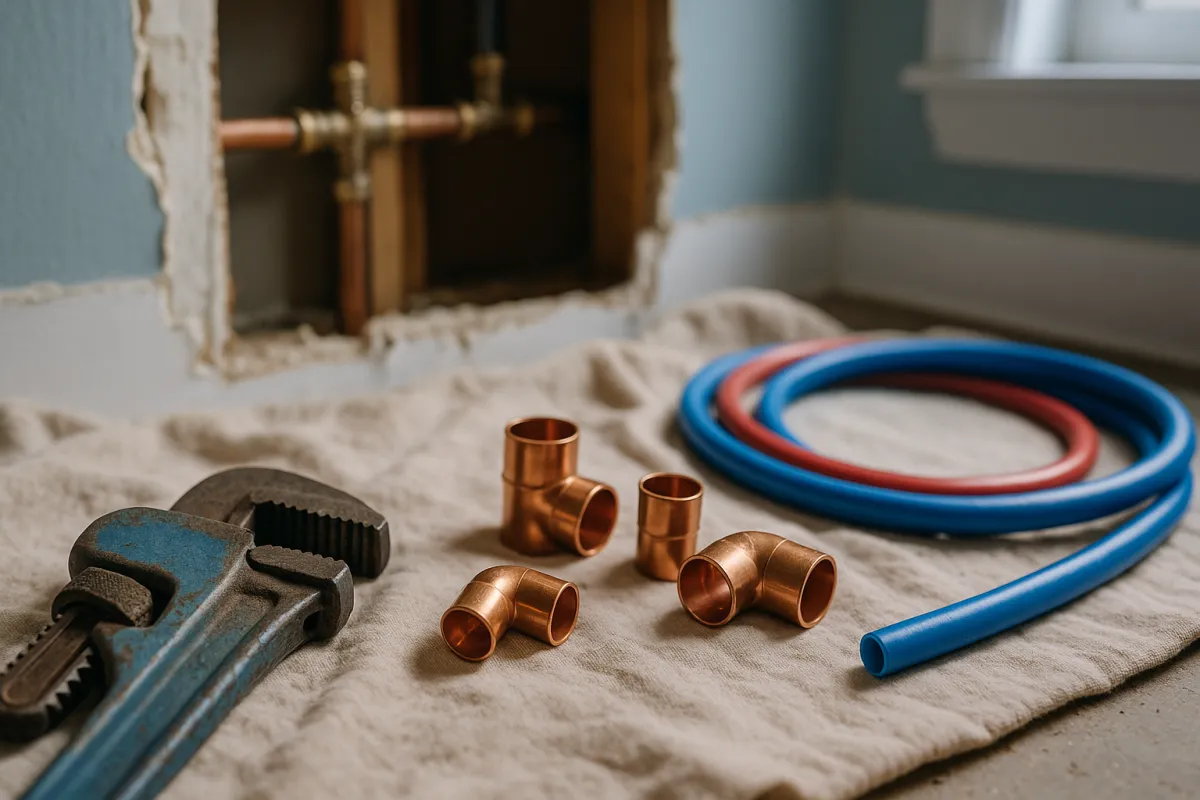
Sometimes moving plumbing is worth it: a genuinely broken layout, an awkward door swing, a shower only one hip-width wide. The rule is not “never move plumbing”; it is “know that the sentence costs thousands before you say it, and make the layout change earn its price.” If the budget is tight, this is the first place to look, because a well-designed bathroom in the existing footprint beats a compromised one that spent its finish budget on drain rerouting.
Waterproofing: the invisible layer that matters most
The least glamorous line on the quote is the one this cost file most wants you to protect. Behind the tile of every shower there is either a continuous waterproofing system, membrane on the walls, a sealed and sloped pan, treated corners and penetrations, or there is a future problem rehearsing quietly. Tile and grout are not waterproof; they are decorative armor over the layer that is.
Done properly, waterproofing adds an illustrative $1,000 to $2,500 to a shower build, and it is the easiest line for a corner-cutting bid to thin, because no buyer can see it and no photo can prove it. Now run the cheap-out math. Saving $1,500 there once, against the failure case: water migrating into framing and subfloor for a few silent years, then a repair involving demolition of the new bathroom, structural drying or replacement, possible mold remediation, and the ceiling of the room below, an illustrative $10,000 to $25,000 event that also revokes every dollar you spent on the remodel itself.
So make waterproofing a named line in every bid. Ask each contractor what system they install and where it stops, and expect a specific, confident answer. This is also the strongest argument against the too-cheap bid: of all the places a lowball hides its discount, this is the one that costs the most to discover later, precisely because discovering it requires the failure.
Tile economics: material is half the story
Tile is where bathroom budgets go to be surprised, and the surprise is usually the labor. Material spans an enormous range, illustratively $2 to $15 per square foot for common ceramic and porcelain, $15 to $40 and beyond for designer patterns, handmade tile, and natural stone. But installation commonly runs $8 to $25 per square foot on top, and for intricate work, small formats, herringbone patterns, mosaics, stone requiring sealing and careful lippage control, the labor line routinely exceeds the material line.
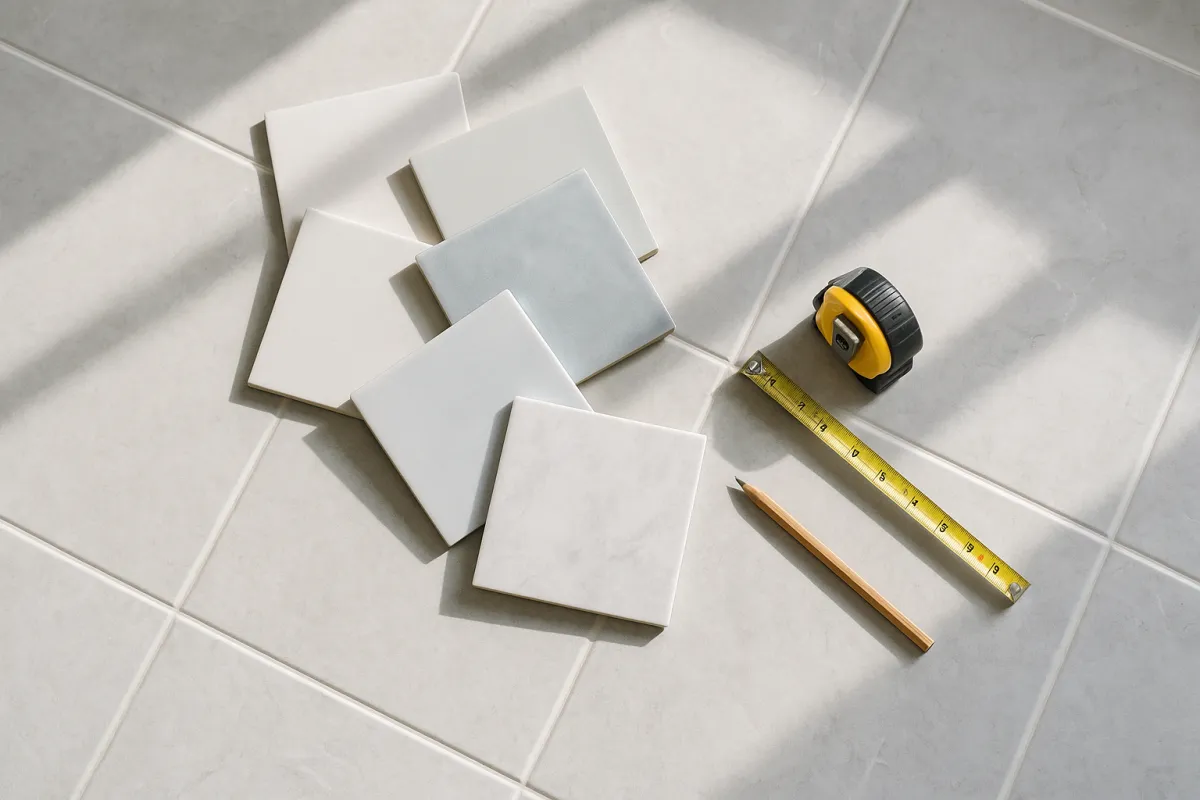
That flips the usual shopping instinct. A homeowner deciding between a $6 and a $12 tile is sweating a few hundred dollars across a typical bathroom, while the decision between a large-format layout and a mosaic feature wall can move the labor bill by thousands on identical square footage. The cost of tile is really the cost of the pattern.
The budget-smart moves follow directly. Spend pattern complexity where it shows, one feature area, and keep the big fields simple and large-format, which installs faster. Confirm whether the bid’s tile allowance covers your actual taste, because a $4 allowance under a $14 selection is a guaranteed overage. And treat the installer’s skill as part of the material: cheap installation of good tile reads worse than good installation of cheap tile, every single time.
Vanities and fixtures: where a splurge shows
Fixtures and cabinetry are the most material-weighted lines in the room, which makes them the natural tuning knobs for taste and budget. The tiering is real: a stock vanity with a prefab top might run an illustrative $400 to $900, semi-custom $1,200 to $3,000, and custom cabinetry with stone tops $3,500 to $8,000 or more. Faucets run from $80 builder-grade to $600 designer; shower sets similar; toilets from $250 workhorses to $1,500 status objects that flush no better.
Where does splurge actually show? In the pieces you touch and see at eye level daily: the vanity, its countertop, the faucet’s feel, decent lighting, and the shower glass. Where does it not show? Inside the wall, where a mid-grade pressure-balanced valve from a major brand performs like its triple-priced sibling, and in the toilet, where the middle of the market long ago solved the problem.
One warning from the quote-comparison manual belongs here: fixtures and vanities are exactly where bids hide skimpy allowances. A quote carrying $1,200 for “vanity and fixtures” under a homeowner whose taste runs to $3,500 is not cheaper, it is just early. Price your real selections before comparing bids, and make every bidder carry the same realistic figures. The splurge decisions are yours to make; the point is to make them on purpose, before signing, at showroom prices rather than mid-project change-order prices.
Where a mid-tier budget actually goes
Assemble the lines and the shape of a mid-range remodel budget becomes visible. The proportions below are illustrative for a full-bath gut remodel that keeps its layout, with labor of all trades gathered into one band.
Where a mid-tier bathroom budget goes
Illustrative shares for a mid-range gut remodel, layout unchanged.
The mix shifts with taste: premium tile grows the blue band, custom cabinetry grows the vanity band, and moving fixtures grows labor. What rarely shrinks safely is the labor share or the reserve.
Two readings matter. First, nearly half the budget is labor, which is why the same materials list prices differently across town lines, and why the estimator asks for your local rate before anything else. Second, the visible glamour, tile and fixtures together, is barely a third of the money. A homeowner who budgets by walking a tile showroom has priced about 35 percent of the project and will meet the other 65 percent later, with less negotiating room. Budget from the whole bar, not the pretty segments.
The permit question
Whether a bathroom remodel needs a permit depends on depth and jurisdiction, but the working rule is simple: cosmetic work usually does not, and anything altering plumbing, electrical, or structure usually does. Swapping a faucet or vanity in place is generally fine without one; moving a drain, adding a circuit, or reframing a wall generally is not. Rules vary by city and county, and the bidding contractors know the local answer, so ask each one directly: does this scope require permits, who pulls them, and is the fee in the bid?
The temptation to skip permits is real, they add an illustrative few hundred dollars, some scheduling friction, and inspections. But the inspection is a feature, not a tax: it is an independent set of eyes on precisely the work that gets sealed behind tile, the plumbing, wiring, and waterproofing you cannot audit later.
And skipping tends to bite at resale. Buyers’ inspectors notice a remodeled bathroom, appraisers and agents ask when it was done, and unpermitted trade work becomes a negotiation lever against you, sometimes a demand for retroactive permitting at your expense, occasionally a deal-breaker for a cautious buyer or lender. A contractor who volunteers to work without required permits is also volunteering how they behave when no one is checking, which is information worth exactly what it costs to hear.
The hidden-condition contingency
Bathrooms hide their history better than any room in the house, right up until demolition day. Behind the tile and under the floor, remodelers routinely find rotted subfloor around the toilet flange, framing softened by a slow leak that never showed, corroded galvanized supply lines crumbling at the touch, undersized wiring with no ground, and vent stacks improvised by a previous owner’s brother-in-law. None of it was visible when the job was bid, and all of it must be fixed before the new bathroom goes in, because sealing known rot behind new tile is how five-figure problems are farmed.
The defense is arithmetic, not optimism: hold a contingency of 15 to 20 percent of the project cost, separate from the bid total, and treat it as spoken for until the walls are open and proven clean. On an illustrative $25,000 remodel, that is $3,750 to $5,000 in reserve. Older homes, homes with previous DIY plumbing, and bathrooms over crawl spaces earn the top of the range.
This is also where the change-order process from our contractor cost file does its work: hidden-condition fixes should arrive as written change orders with prices, approved before the work proceeds, drawn against the reserve you already hold. The contingency does not make surprises cheaper; it makes them boring, which is the best a renovation ever offers.
Powder room to primary suite: how costs scale
Bathroom costs scale with size, but not linearly, because every bathroom regardless of size carries the same fixed overhead of trades showing up. A powder room, roughly 20 square feet with no wet area, remodels illustratively for $3,000 to $18,000 across the tiers, cheap in absolute terms but often the highest cost per square foot in the house, because the plumber and electrician mobilize for a tiny room.
The standard 5x8 full bath, about 40 square feet, is the reference case this cost file prices throughout: illustratively $5,000 to $12,000 to refresh, $15,000 to $35,000 to gut, more with layout changes. The primary suite bathroom, often 100 square feet or more, scales up on two axes at once: more square footage of tile and waterproofing, and richer scope, double vanities, separate tub and shower, more lighting circuits, sometimes a partition wall. Illustratively, $15,000 at the refresh end to $90,000 or beyond for high-end custom work.
The planning insight is that per-square-foot figures mislead in both directions: small baths look expensive per foot and cheap in total, large ones the reverse. Budget by scope and tier, not by area, and use area only to scale the tile and waterproofing lines. The estimator treats size and tier as separate questions for exactly this reason.
What you can honestly DIY
The internet will tell you a homeowner can remodel a whole bathroom in a week of evenings. This cost file will not. The honest DIY list is real but short: painting, hardware and accessory swaps, towel bars and mirrors, assembling and setting a stock vanity if the plumbing connections are straightforward, and possibly demolition, if you confirm what is behind the surfaces first, cap and protect the plumbing, and accept that disposal is part of the job. Those slices can trim an illustrative $500 to $2,500 of labor from a project.
The do-not-DIY list is the entire wet core: waterproofing, plumbing, and electrical. Not because the skills are mystical, but because the failure modes are invisible and deferred. An amateur waterproofing job looks identical to a professional one on day one and reveals the difference in year three, in the framing. Amateur plumbing announces itself at two in the morning. Amateur electrical work in a wet room is its own category of bad idea, and unpermitted trade work haunts resale besides.
Between the lists sits tile setting, honest verdict: skilled DIYers can tile a floor acceptably, while shower walls, pans, and pattern work punish inexperience visibly and permanently. The budget-smart posture is not “DIY everything” or “DIY nothing”; it is doing the forgiving work yourself and spending the saved money on the trades whose mistakes cost the most to find.
How to read a bathroom remodel quote
Everything our quote-comparison manual teaches applies with extra force here, because bathroom quotes hide their differences in two specific places: allowances and exclusions.
Allowances first. A bathroom bid almost always carries placeholder budgets for tile, vanity, and fixtures, because you have not chosen them yet. Those placeholders move the total dollar for dollar, so a bid with a $1,500 tile allowance beats a bid with a $3,000 allowance by $1,500 while promising the identical job. Price your real selections, then make every bidder carry the same realistic figures; expect the ranking of bids to reshuffle when they do.
Exclusions second. The classics in bathrooms: permits, disposal, the vent fan duct run, painting after the trades finish, shower glass (a common four-figure surprise), and any hidden-condition work, which is fair to exclude but must be named with a unit price and a process. Ask each bidder the same question, what exactly is not in this price, and get the answer on the bid.
Then compare structure, not just totals: is waterproofing a named line with a named system, is the payment schedule tied to progress milestones, is there a change-order process in writing? A bathroom quote that survives those questions is a document you can sign; one that answers with a lump sum and a smile is a story, and stories cost extra in the second act.
Timeline and the cost of living through it
A refresh commonly runs a few days to two weeks. A gut remodel of a full bath typically runs three to six weeks of calendar time, sometimes more, and the gap between “days of work” and “weeks of calendar” is where homeowners get blindsided: trades must sequence, inspections must be scheduled, tile must cure, glass is measured only after tile exists and then takes a week or two to fabricate. Nobody is loafing; the room is simply a queue of dependencies.
Living through it has costs the quote never shows. If it is your only bathroom, you are negotiating showers with neighbors or gym memberships, and some households budget for a short rental or hotel stretch during the wet-area rebuild, an illustrative few hundred to a couple thousand dollars that belongs in the plan rather than the surprise column. Dust migrates, the household routes around a construction zone, and every delayed decision, grout color, glass style, niche placement, adds days while the calendar bills you in patience.
Two protections: first, make every selection before demolition begins, since decision lag is the most preventable delay in remodeling; second, get the schedule in the contract with the payment milestones tied to progress, as the contractor cost file prescribes. A contractor who commits to a sequence on paper has usually thought the sequence through, and that thinking is worth as much as any line item.
Resale value, kept honest
Somewhere during budgeting, a voice, sometimes a contractor’s, sometimes your own, will say the remodel pays for itself at resale. It almost never does, and pretending otherwise leads to overspending. Commonly cited remodeling-value studies put bathroom cost recovery somewhere around half to two thirds of the spend at sale, with mid-range projects generally recouping a higher percentage than upscale ones, whose taste-specific choices narrow the buyer pool as fast as they raise the price.
The honest frame is this: a bathroom remodel is consumption with a partial rebate, not an investment. You are buying years of daily use, function, and comfort, and recovering a portion of the cost when you sell, and both halves of that sentence are good deals when the spend is sane relative to the house. Where remodels do punch above their weight is in fixing genuine defects: a failing, leaking, or unusable bathroom drags a sale disproportionately, so bringing a broken room to solid mid-grade condition tends to return more per dollar than pushing a good room to luxury.
The rules of thumb that keep resale math honest: match the remodel’s tier to the home’s market position rather than exceeding it; favor durable, neutral choices in the expensive layers and express personality in the cheap, changeable ones; and never justify a budget overage with resale value, because the buyer who repays your splurge is a hope, not a line item.
A worked example: one 5x8 bath, three budgets
Take one ordinary 5x8 full bath, tub against the back wall, toilet and vanity along the side, and cost it at all three tiers. Every figure is illustrative; the structure is the lesson.
Refresh, about $8,000, layout untouched. New vanity and top $1,200; faucet and hardware $500; toilet $450; lighting $450; tub and surround reglazed $700; new vinyl plank floor material $700; paint $250; disposal and sundries $450; labor across all of it $3,300. Total $8,000, roughly 40 percent labor. The room reads new; everything behind the walls is whatever it was.
Mid-range gut, about $24,700. Demolition $1,500; plumbing rough-in, same locations, $2,500; electrical with vent fan $1,800; waterproofing system $1,800; tile material $1,900; tile installation $3,600; vanity and top $2,200; fixtures $2,000; shower glass $1,300; lighting and fan units $900; paint and trim $800; permits $500; disposal $700. Subtotal $21,500, plus 15 percent contingency $3,225: call it $24,700, with labor around half once each line’s labor share is gathered.
High-end, about $55,000. The same room with the tub swapped for a curbless tiled shower with linear drain, fixtures shifted one wall (there goes an illustrative $4,000 of plumbing), heated floor, stone-topped custom vanity, designer tile with a mosaic feature, frameless glass, and the contingency scaled to match. The extra $30,000 over mid-range buys craft, materials, and layout freedom, not more bathroom in any functional sense.
Run your own room through the estimator and hold your quotes against the same structure.
Common bathroom remodel mistakes
The recurring failures, collected for prevention.
- Budgeting from the showroom. Tile and fixtures are about a third of the money; pricing the pretty layers and ignoring labor guarantees a shock.
- Saying “move the toilet” casually. Layout changes cost thousands across multiple trades; make them deliberately or not at all.
- Letting a bid thin the waterproofing. The invisible layer is the one that ruins you when it fails; make it a named line with a named system.
- Skipping the contingency. Bathrooms hide rot and bad pipe behind exactly what you are demolishing; 15 to 20 percent in reserve is the adult position.
- Comparing lump-sum totals. Allowances and exclusions make bathroom bids incomparable until normalized line by line.
- Choosing selections mid-project. Every undecided grout color and glass style adds calendar days at full disruption cost.
- Remodeling for an imaginary buyer. Resale recovers part of the spend; remodel for how you live and keep the tier matched to the house.
Each mistake is cheap to avoid before signing and expensive to fix after demolition, which is the general shape of renovation wisdom: the leverage is all at the beginning.
Financing and phasing a bathroom remodel
Not every bathroom remodel gets paid for in one lump from savings, and how you fund and stage the work shapes both the budget and the stress. The cash-and-carry approach, paying from savings as milestones complete, is the cheapest because it adds no financing cost, and it pairs naturally with the progress-based payment schedule this cost file recommends. Where savings fall short, homeowners commonly reach for a home equity line, a personal loan, or a contractor-arranged financing offer, and each carries a cost worth pricing into the total before signing, because a remodel financed at interest costs more than its sticker over the life of the loan.
Phasing is the other lever, and it works better for some tiers than others. A refresh splits cleanly into stages you can spread over months: paint and hardware now, a new vanity next, flooring later, each a self-contained slice with no wet-area risk between them. A gut remodel resists phasing, because once the room is opened to the studs the waterproofing, plumbing, and tile must proceed as a continuous sequence, and stopping midway leaves an unusable room and exposed framing. The honest rule is that cosmetic work phases well and structural work does not, so decide which tier you are funding before you plan to spread it out.
For a household on a tight budget, the smartest phasing is often to do the invisible, failure-prone work properly in one pass and defer only the cosmetic upgrades. Fix the waterproofing, the plumbing, and any hidden damage now with licensed hands, then live with builder-grade fixtures and add the designer touches later as cash allows, because the layers that fail expensively are the ones you cannot safely postpone. Our renovation budget walkthrough sets this staging inside a whole-project plan, and the estimator lets you price each phase before committing to a sequence.
Hiring a bath remodel contractor
Costing the work and choosing who does it are separate problems, and the second one moves the final number more than any material choice on this page.
Decide the scope before you call. A contractor pricing “a bathroom remodel” produces a wide, defensive quote. One pricing a defined scope, with the layout fixed and the fixtures chosen, produces a comparable one. Vagueness is expensive.
Get three itemised quotes on identical scope. Identical is the operative word: three quotes covering different work are three different projects, not a comparison. Give each contractor the same written scope.
Ask specifically who does the plumbing and electrical, whether they are licensed for it, and whether permits are included in the price or billed separately. A bathroom touches both trades, which is why it carries more permit exposure than most rooms.
Ask how change orders are priced before signing rather than after discovering rot behind a wall. Bathrooms hide more surprises than almost any other room, and the change-order policy is what decides whether that becomes a conversation or a dispute.
Check the deposit. A modest deposit is normal; a demand for a large share upfront removes your leverage over the finish.
Establish the tile and waterproofing detail in writing. This is where the difference between a bathroom that lasts twenty years and one that leaks in three actually sits, and it is invisible once the tile is on.
Our walkthroughs on comparing contractor quotes, vetting a contractor and reading a contractor estimate cover the process in general. The bathroom-specific point is that the cheapest bid on a wet room is the one most likely to be cheap on waterproofing, which is the one thing you cannot inspect afterwards.
The bottom line
A bathroom remodel costs what its tier, its layout decisions, and your local labor market say it costs: illustratively, $5,000 to $12,000 for a refresh, $15,000 to $35,000 for a mid-range gut remodel, $40,000 to $80,000 or more for high-end custom work, with roughly half of any tier’s money going to labor. The savings live where the money lives: keep the plumbing where it is, keep field tile simple and spend pattern where it shows, protect the waterproofing line from every cost-cutting instinct including your own, and hold 15 to 20 percent for what the walls are hiding.
Then buy the project like a professional: a written scope to every bidder, allowances matched to your real taste, exclusions dragged into daylight, permits pulled where required, and payments tied to progress. The homeowners who come out of a bathroom remodel happy are not the ones who found a magic price; they are the ones who understood the anatomy before the first quote arrived, decided everything before the first hammer swung, and left the invisible layers to licensed hands. That is the whole recipe, and none of it requires luck.
This cost file is published to teach the shape of bathroom remodel pricing, not to price your bathroom, and nothing in it substitutes for professional advice from a licensed contractor, plumber, or electrician. Treat every dollar figure, range, and percentage above as illustration: real costs shift with your region, your home’s condition, material markets, and the season. Wet-area work carries real stakes for your home’s structure, so confirm permit requirements with your local building department, insist on licensed and insured trades for plumbing, electrical, and waterproofing, and gather several detailed written quotes before committing a dollar.
Frequently asked questions
How much does a bathroom remodel cost?
It depends on the tier of work, and the honest way to answer is with illustrative ranges rather than one number. A cosmetic refresh that keeps every fixture in place commonly runs about $5,000 to $12,000, a mid-range gut remodel of a full bath about $15,000 to $35,000, and a high-end custom remodel $40,000 to $80,000 or more. Your actual price moves with your local labor rates, the size of the room, the materials you choose, and whether the layout changes, so treat every figure as a starting range and get detailed local quotes before budgeting.
How much does it cost to remodel a small bathroom?
A small bathroom, meaning a powder room or a compact full bath around 5x7 or 5x8, commonly costs less in total than a large one but often more per square foot, because the same trades still have to show up for a tiny room. As an illustrative guide, a cosmetic refresh of a small bathroom can run roughly $3,000 to $8,000, while a full gut remodel of the same room commonly lands about $8,000 to $20,000, with the layout and finishes doing most of the moving. Keeping the toilet, sink, and tub where they are is the single biggest saving, since relocating fixtures buys hours of licensed plumbing labor. Every figure varies by region and scope, so treat these as starting ranges and get several detailed local quotes before you budget.
Why do bathroom remodel quotes vary so much?
Mostly because the bids are pricing different jobs. One contractor assumes the tub stays and gets reglazed, another assumes it comes out; one includes waterproofing membrane and permits, another leaves them silent; one carries a realistic tile allowance, another a skimpy placeholder. Genuine price differences exist, but most of a shocking spread dissolves once every bid prices the same written scope. Define exactly what you want before anyone quotes, and the numbers you get back become comparable.
Does moving the toilet or shower really cost that much more?
Yes, and it is usually the single most expensive sentence a homeowner can say. Keeping fixtures where they are lets the plumber reuse the existing supply and drain locations, while moving a toilet means rerouting a large drain line and its vent, often through the floor structure below. An illustrative premium of a few thousand dollars, commonly around $2,000 to $5,000 or more depending on access, is typical for relocating fixtures. If the budget is tight, keeping the layout is the first and best saving available.
How much should I budget for surprises behind the walls?
A contingency of 15 to 20 percent of the project cost is the commonly cited cushion, and bathrooms earn it more than any other room. Behind tile and under floors, remodelers regularly find rotted subfloor around the toilet flange, corroded galvanized supply lines, undersized or damaged wiring, and old leaks that never surfaced. On an illustrative $25,000 remodel, that means holding $3,750 to $5,000 in reserve. If nothing opens up, the money stays yours; if something does, it keeps the project moving instead of stalling it.
Is bathroom waterproofing really worth the extra cost?
It is the least visible line on the quote and the most important one. A proper waterproofing system behind the tile, membrane, sealed corners, a correctly sloped pan, might add an illustrative $1,000 to $2,500 to a shower build, and nobody will ever see it. Skipping it saves that much once and risks a repair measured in the tens of thousands when water finds the framing, the subfloor, or the ceiling below. If a bid is far cheaper than the pack, the waterproofing line is one of the first places to look for the missing money.
What parts of a bathroom remodel can I do myself?
Honestly: painting, hardware swaps, accessories, and possibly demolition if you are careful and confirm what you are tearing into. Those are low-risk slices that can trim an illustrative few hundred to a couple thousand dollars of labor. Waterproofing, plumbing, and electrical are the wrong places to save, because errors there are invisible until they are expensive, and unpermitted work in those trades can bite at inspection or resale. A good middle path is doing the unskilled labor around the edges and paying professionals for everything that touches water or wiring.
Do I need a permit to remodel a bathroom?
For a cosmetic refresh, usually not; for anything that alters plumbing, electrical, or structure, usually yes, though rules vary by city and county. Permit costs are typically modest, often an illustrative few hundred dollars, and the inspection that comes with them is a second set of eyes on exactly the work you cannot see later. Skipping permits to save time tends to bite at resale, when buyers, appraisers, or their inspectors ask about unpermitted work and the negotiation turns against you. Ask each bidder who pulls the permit and confirm the answer in writing.
Will a bathroom remodel pay for itself when I sell?
No, and any pitch that says otherwise deserves skepticism. Commonly cited resale figures for bathroom remodels recover only part of the cost, often somewhere around half to two thirds, with mid-range projects generally recouping a higher percentage than luxury ones. The honest frame is that you are buying years of daily use plus a partial return at sale, not making an investment with a profit. Remodel for how you live, keep the spend sane relative to your home's value, and treat any resale bump as a bonus.