What's on this page
- How much does it cost to hire a handyman
- Handyman hourly rate by market
- Minimum charges and trip fees
- Half-day and full-day handyman rates
- What a handyman typically handles
- What a handyman should not do
- Materials: who supplies them
- Small jobs priced individually
- Emergency and after-hours handyman pricing
- Handyman versus specialty contractor: how to decide
- How to find and vet a handyman
- Getting and comparing handyman quotes
- Licensing and insurance for handyman work
- DIY versus hiring a handyman
- Where to save and where not to
- A worked example: a Saturday punch list
- Common handyman-hiring mistakes
- The bottom line
Short answer: A handyman commonly charges an illustrative $45 to $85 an hour depending on your market, with a one to two hour minimum charge on most visits. A quick single fix often lands around $90 to $170 once the minimum applies, a half day of mixed tasks commonly runs $250 to $500, and a full day often runs $400 to $700. Bundling several small jobs into one visit is the biggest lever on the total bill.
Handyman cost is one of the simpler home-services numbers to price, because it is built almost entirely from time rather than from the complex material and permit factors that drive a bigger renovation. What trips homeowners up is not the hourly rate itself, it is the minimum call-out charge most handymen apply, and the line between what a handyman can legally do and what needs a licensed electrician or plumber instead, both of which change the real bill more than the headline hourly number does.
Illustratively, a handyman commonly charges $45 to $85 an hour, with an illustrative one to two hour minimum on most visits. A short single-item fix therefore often lands around $90 to $170 all in, while a half day of mixed small tasks commonly runs $250 to $500.
This cost file prices handyman work the way it is actually billed: the hourly rate first, then the minimum that applies to nearly every visit, then the day-rate option for longer punch lists, with materials and trip fees named honestly rather than buried in one blended number. Our contractor cost file laid out how any trade’s price is built from labor, overhead, and time, and a handyman’s bill is the simplest version of that math, since there is rarely a permit or a big materials line to complicate it. Set your own job’s hours and market in the job cost estimator as you read, and the ranges below turn into a number you can plan a Saturday punch list around.
Key takeaways
- Illustratively, a handyman commonly charges $45 to $85 an hour, with your local market setting where in that band you land.
- Most handymen apply a one to two hour minimum per visit, so bundling several small tasks into one visit is the single biggest way to lower the effective cost.
- A day rate commonly beats hourly billing once a job runs past roughly four to five hours of work.
- A handyman handles general repair and maintenance; new electrical circuits, panel work, gas lines, and major plumbing typically need a licensed trade instead.
- Confirm who supplies materials before the visit, since that detail changes both the bill and whether the job can even start on schedule.
How much does it cost to hire a handyman
Priced simply, a handyman commonly charges an illustrative $45 to $85 an hour, and almost all of the spread inside that band comes down to your local market rather than the specific task. A rural or small-town market sits near the bottom, a typical suburban market sits in the middle, and a higher-cost metro area sits near the top, the same geographic pattern that moves the price of nearly every skilled trade.
What the hourly rate alone does not capture is the minimum charge, which applies to the large majority of handyman visits and matters more to the real bill than most homeowners expect. An illustrative one to two hour minimum means a genuinely fifteen-minute fix is commonly billed as a full hour or two rather than prorated down, because the handyman’s actual cost of showing up, the drive, loading the truck, and the overhead of running the day, does not shrink just because the fix itself was quick.
The practical way to think about handyman cost is therefore hours on site times the hourly rate, with a floor set by the minimum, plus whatever materials and trip charges apply. The estimator builds the number exactly that way, so you can see how the minimum, the market rate, and a longer drive each move your own total.
Handyman hourly rate by market
Local market is the single biggest lever on a handyman’s hourly rate, the same way it is for nearly every skilled trade priced in this cost file series. As an illustrative guide, the chart below prices a typical handyman’s hourly rate across three common market tiers.
Illustrative handyman hourly rate by market
General handyman labor, before any minimum charge, materials, or trip fee is applied.
Illustrative hourly labor rate only. A higher-skill task priced closer to a specialty trade, a rush visit, or an after-hours call commonly pushes any of these rates higher.
Read that chart as the shape of your local starting point, not a guaranteed quote, since an individual handyman’s rate reflects their own experience, demand, and overhead as much as the regional average. A handyman new to the trade or working solo out of a truck commonly prices below the regional figure, while an established, highly reviewed handyman with a full schedule commonly prices above it, which is a normal and reasonable reflection of demand rather than a sign something is wrong with the lower-priced option.
Minimum charges and trip fees
The minimum call-out charge is the part of a handyman’s pricing that catches the most homeowners off guard, because it is easy to budget the hourly rate and forget that a short job rarely bills for its actual short duration. As an illustrative guide, a one to two hour minimum is common, which means a five-minute fix and a ninety-minute fix often cost the same on the invoice, both billed at the minimum. This is not a markup or a trick, it reflects that the drive, the setup, and the overhead of the visit are largely fixed regardless of how quick the actual repair turns out to be.
A separate trip fee sometimes applies on top of the minimum for a longer drive outside a handyman’s normal service area, commonly an illustrative $25 to $50 added to the visit. Not every handyman charges a separate trip fee, some simply fold a longer drive into a slightly higher effective rate for distant jobs, so it is worth asking directly how a longer drive is priced before booking if you live outside a typical service radius.
The single most useful thing a homeowner can do with this information is bundle tasks into one visit. Because the minimum and any trip fee are charged once per visit rather than once per task, a punch list of five small fixes done in one afternoon visit costs dramatically less per task than booking five separate single-task visits across five different days. This is the practical lever most homeowners have the most control over, and it is worth planning around deliberately rather than calling a handyman the moment each small thing breaks.
Half-day and full-day handyman rates
Once a job runs past a handful of hours, many handymen offer a day rate instead of pure hourly billing, and it is usually worth taking. As an illustrative guide, a half day, roughly four hours, commonly runs $250 to $500, and a full day, roughly seven to eight hours, commonly runs $400 to $700, with the day rate typically pricing a little below what the same hours would cost billed purely hourly, since it removes the overhead of estimating and billing in small increments.
The day rate also removes a specific risk: a job quoted hourly that runs slightly long can tip into an extra billed hour in a way that feels frustrating even when it is entirely reasonable, while a day rate is a flat number known in advance regardless of whether the day’s tasks run a little ahead or a little behind schedule. For a genuinely long punch list, a hung door here, a leaky faucet there, several pieces of furniture to assemble, mounting a handful of shelves and a television, a day rate converts what would be a stressful hourly clock into a predictable number.
The practical decision point is roughly four to five hours of actual work. Below that, the hourly rate with the minimum applied is usually the better and more natural fit; above it, ask directly whether a day rate is available, since most handymen who offer one will quote it automatically once a punch list crosses that threshold.
What a handyman typically handles
A handyman’s scope is broad by design, covering the general repair and maintenance tasks that are too small or too varied to justify calling a specialty trade for each one individually. Common handyman work includes fixture swaps, a new faucet, a light fixture, a ceiling fan, or a toilet, carpentry touch-ups, a sticking door, a loose cabinet hinge, trim repair, or a squeaky stair, drywall patching for small holes and cracks, furniture assembly and mounting, flat-pack furniture, a television, shelves, or curtain rods, and general punch-list items, caulking, weatherstripping, minor painting touch-up, and small outdoor repairs like a loose fence board or gate hardware.

The common thread across this list is that each task alone is too small to justify the minimum call-out fee of a specialty contractor, but a handyman’s broader skill set and lower hourly rate make tackling several of them in one visit genuinely efficient. A homeowner who called a plumber for the faucet, a carpenter for the door, and a painter for the touch-up would pay three separate minimum charges at three separate, often much higher, specialty rates for work a single handyman visit handles in an afternoon.
Seasonal maintenance is another category that fits a handyman well, since it is usually a list of several small, unrelated items rather than one big project. Resetting storm windows, touching up exterior caulk before winter, adjusting a door that has swollen with humidity, or doing the small outdoor repairs that surface every spring are all classic handyman-visit material. Our fall home maintenance checklist lays out the broader seasonal list, and a good share of the items on it are exactly the kind of bundled, mixed-task visit this file prices throughout.
What a handyman should not do
Just as important as knowing what a handyman handles is knowing where the legal and practical line sits, because crossing it is not just a quality risk, it can be a licensing and insurance problem if something goes wrong. In most jurisdictions, new electrical circuits and panel work require a licensed electrician, since miswired electrical work is a genuine fire and shock hazard and is regulated accordingly. Our electrician cost file prices that licensed work separately, and the line is usually simple in practice: a handyman can typically swap a light fixture or an outlet cover using the existing wiring, but adding a new circuit or opening the breaker panel crosses into licensed territory.
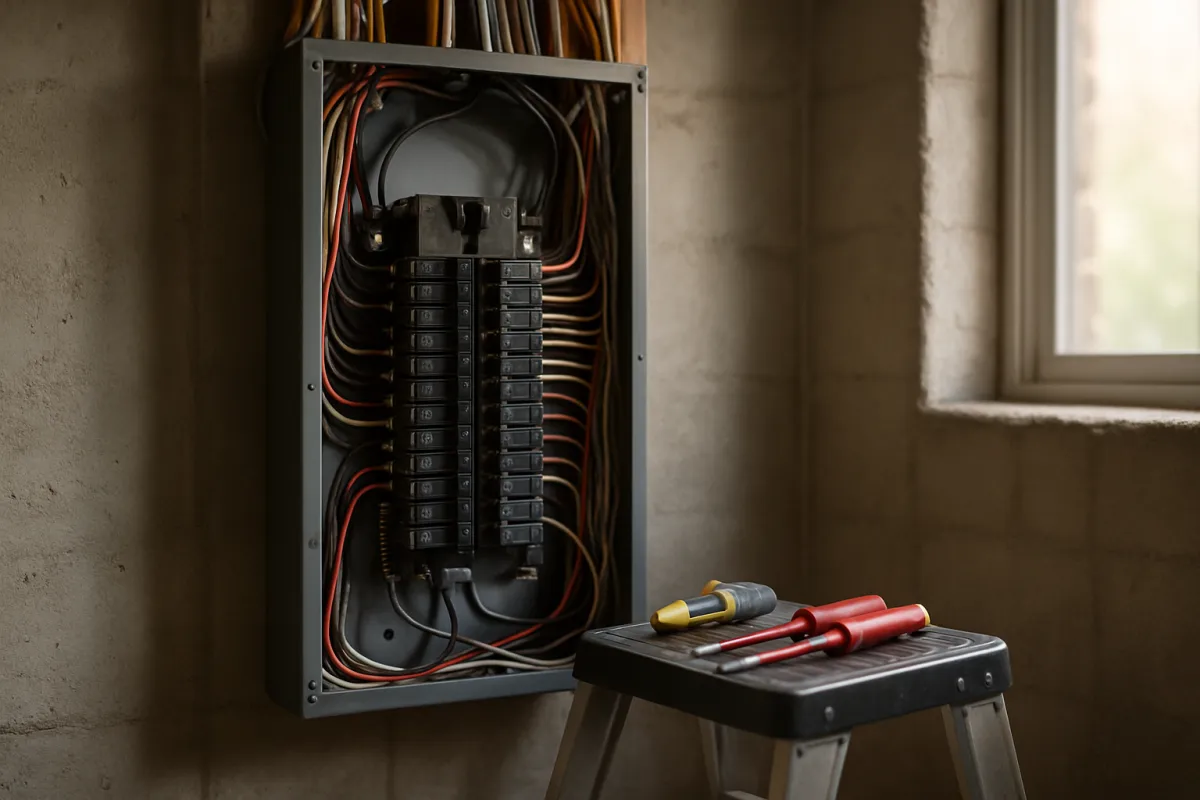
Gas line work of any kind is squarely licensed-trade territory given the safety stakes, and significant plumbing, a repipe, a new drain line, or anything requiring permits, typically needs a licensed plumber rather than a handyman, even though a handyman can usually handle a simple fixture swap on existing lines. Structural work, anything touching a load-bearing wall or the home’s framing, also sits outside a general handyman’s scope, and our load-bearing wall removal cost file covers what that licensed, engineered work actually involves. The exact legal line varies by state and sometimes by the dollar value of the job, so when a task feels like it might cross into licensed territory, the safest move is asking directly rather than assuming a handyman’s broad skill set covers it.
Materials: who supplies them
Materials are a detail worth settling before the visit, not during it, because getting it wrong either wastes a trip or produces a surprise line on the invoice. For specific items, the new faucet you picked out, a particular light fixture, a replacement blind in your exact size, most homeowners supply the part themselves, which avoids any markup and guarantees the exact item arrives rather than whatever the handyman happened to have on the truck.
For small consumables, screws, anchors, caulk, wood filler, basic hardware, a handyman commonly supplies these as part of the visit, sometimes itemized as a modest materials charge, sometimes folded quietly into the hourly rate. As an illustrative guide, a small materials allowance commonly adds somewhere around $15 to $40 to a visit when the handyman is sourcing miscellaneous small parts rather than the homeowner having everything on hand.
The practical move is a short conversation before the visit: confirm exactly what you are expected to supply versus what the handyman will bring, and have your own items on hand and unpacked before they arrive. A visit that starts with the handyman discovering the faucet was never purchased, or discovering it is the wrong size, commonly either burns billed time waiting or turns into a second trip, neither of which is a good outcome for either side.
Small jobs priced individually
Some homeowners want a feel for individual task pricing rather than a pure hourly estimate, and while every job still ultimately bills by time against the minimum, a few common tasks have a fairly predictable illustrative range once the minimum is folded in. A single fixture swap, a faucet or a light fixture, commonly lands around $90 to $170. Hanging a television or mounting a set of shelves commonly runs a similar $90 to $180, depending on the wall type and whether anchors or blocking are needed. Assembling a piece of flat-pack furniture commonly runs $60 to $150 depending on its complexity. A small drywall patch or two commonly lands around $100 to $200.
These figures are illustrative starting points built from a typical one to two hour minimum at a mid-range hourly rate, not fixed prices, and the honest caveat is that the same task can cost more if it turns out to be more involved than it looked, a stripped screw, hidden damage behind a wall, or a wall type that needs special anchors all add real time. The more reliable way to estimate any individual task is still hours times rate against the minimum floor, which the estimator calculates directly rather than relying on a flat per-task number that cannot see your specific situation.
Emergency and after-hours handyman pricing
Most of the figures in this file assume a scheduled daytime visit booked a few days out, and it is worth naming what changes when the job cannot wait. Same-day or rush requests, squeezing a visit into an already-booked schedule, commonly carry an illustrative premium on top of the standard hourly rate, since the handyman is reshuffling other commitments or working through a lunch break to fit you in. Evening and weekend calls follow a similar pattern at many businesses, with some handymen pricing Saturday work at their standard rate and others treating it as a modest premium tier, so it is worth asking directly rather than assuming either way.
True after-hours emergencies, a flooding fixture at midnight or a door that will not lock after a break-in attempt, are the most expensive tier, and they are also the tier where most general handymen are honest about their own limits. A significant plumbing emergency is often better routed directly to an emergency plumber rather than a handyman, both because the handyman’s rate advantage mostly disappears once an emergency premium applies, and because a true emergency plumbing failure, a burst pipe actively flooding a room, is exactly the kind of major plumbing work that sits past a handyman’s typical scope regardless of the hour.
The practical takeaway is to reserve the premium-rate call for genuine emergencies and plan everything else as a normal scheduled visit. A loose cabinet door or a squeaky hinge noticed on a Tuesday evening can comfortably wait for Saturday’s scheduled, standard-rate visit, and treating it as an emergency only pays a premium for urgency the task itself does not actually need.
Handyman versus specialty contractor: how to decide
Choosing between a handyman and a specialty contractor comes down to two questions: is the task within a handyman’s legal scope, and is a handyman’s general skill level actually suited to the job’s complexity. A handyman is the right call for general repair and maintenance, the broad list covered earlier, especially when several small tasks can be bundled into one visit to spread the minimum charge efficiently.
A specialty contractor, electrician, plumber, roofer, or similar, is the right call whenever the task legally requires their license, when the job involves real structural, electrical, or plumbing risk, or when the task is complex enough that a general handyman’s broader but shallower skill set is a worse fit than a specialist’s deeper expertise in that one trade. Our DIY or hire a pro file covers the same decision from the angle of doing it yourself versus hiring anyone at all, and the handyman-versus-specialist question sits one step further down that same ladder, after you have already decided professional help makes sense.
A useful rule of thumb: if the task is on the common handyman list and does not touch wiring beyond a simple swap, gas, major plumbing, or structure, default to a handyman for the lower rate and the convenience of bundling tasks. If it touches any of those four areas, or if getting it wrong carries real safety or code consequences, default to the licensed specialist even if it costs more per hour, because the license exists precisely because the risk justifies it.
How to find and vet a handyman
Finding a reliable handyman follows much the same discipline as finding any home-services professional, scaled to match the smaller size of a typical job. Ask neighbors and friends for a direct recommendation, since a handyman who has done good, honest work in your immediate area is one of the strongest signals available. Read reviews that mention the specific kind of work you need, since a handyman praised for furniture assembly and one praised for carpentry repair are not necessarily equally strong at both.
Our how to find a good contractor and how to vet a contractor files cover licensing checks, insurance verification, and reference questions in detail, and nearly all of that discipline applies directly here, scaled down. Confirm general liability insurance before anyone starts work in your home regardless of whether a license is legally required for a job of that size, since insurance protects you if something is damaged during the work, separate from any licensing question. A short trial task, one small job booked before committing to a longer punch list, is a reasonable, low-risk way to judge quality, punctuality, and communication before a bigger booking.
Getting and comparing handyman quotes
Handyman quotes are simpler to gather than a full renovation bid, but the same discipline applies: get the scope in writing, even if it is informal, listing each task on the punch list so nothing gets quietly dropped or added mid-visit. Ask directly about the hourly rate, the minimum, and whether a trip fee applies to your address, since those three numbers together, not the hourly rate alone, determine what a short visit actually costs.
For a longer punch list, ask whether a day rate is available and at what point it becomes worth it, since the answer varies by handyman and is worth knowing before you decide how to book the visit. Our quote-comparison manual covers reading and comparing estimates in general, and the version of that discipline that matters most here is simply making sure every handyman you call is quoting the same understanding of rate, minimum, and trip fee, since those three line items, not a single bottom-line number, are what actually varies between two otherwise similar handymen.
Licensing and insurance for handyman work
Handyman work sits in a genuinely less regulated space than a licensed trade, and the honest framing is that requirements vary meaningfully by state and sometimes by the dollar value of the specific job. Many states require a general contractor license only once a project’s value crosses a set threshold, which means a handyman working under that threshold on a given job may legally operate without the broader licensing a remodeling contractor needs for a larger project, even in the same state.
Insurance is a separate question worth asking regardless of the licensing threshold. General liability insurance protects you if something in your home is damaged during the work, and it is entirely reasonable to ask any handyman for proof of coverage before they start, the same way our how to vet a contractor file recommends for any trade. A handyman who bristles at a simple insurance question, or cannot produce any proof of coverage at all, is a reasonable reason to look elsewhere, even for a small job.
It is worth checking your own homeowners insurance policy as a second layer here, since some policies address work performed by an uninsured contractor differently than work performed by an insured one, particularly if a problem the handyman caused leads to a larger claim later. None of this needs to turn a small job into a legal project, but a two-minute question before the visit starts is cheap insurance against a much costlier conversation afterward, and a handyman confident in their own coverage will usually answer it without hesitation.
DIY versus hiring a handyman
A genuinely large share of handyman-scope tasks are within reach of a reasonably confident homeowner with basic tools, and it is worth being honest about where the real trade-off sits. Tasks that favor DIY are usually ones with a low consequence for a mistake and a short learning curve: hanging a picture, basic caulking, assembling simple furniture, or a minor paint touch-up. Tasks that favor hiring are the ones where a mistake is costly to fix, where the job needs a tool you do not own and would rarely use again, or where your own time is worth more than the hourly rate you would be saving.
The honest middle ground is a punch list that mixes both: do the simple, low-stakes items yourself over a weekend, and book a handyman for the handful of tasks that need a specific tool, a second pair of hands, or a skill you genuinely do not have, like hanging a heavy door or mounting a television securely into blocking rather than drywall alone. Bundling the hired portion into one efficient visit, after you have already knocked out what you comfortably can yourself, is usually the most cost-effective split.
Where to save and where not to
Once you understand the pricing structure, a few deliberate choices keep a handyman budget efficient without sacrificing quality. The clearest way to save is bundling tasks into one visit, since the minimum charge is billed once per visit rather than once per task, and a longer, well-planned punch list spreads that fixed cost across far more work. Supplying your own materials for specific items also saves the modest markup a handyman commonly adds when sourcing parts themselves.
The place not to save is skipping the insurance question to shave a small amount off the rate, since an uninsured handyman who damages something in your home during the work leaves you with no recourse beyond a difficult conversation. It is also not the place to save by handing a licensed-trade task to a handyman because their rate is lower, since the license exists because the risk and the consequences of a mistake are genuinely higher on that specific class of work, electrical, gas, major plumbing, and structural work chief among them.
The general shape of handyman wisdom is that the leverage is almost entirely in planning: bundle the visit, confirm materials and insurance up front, and keep licensed-trade tasks routed to the trade that is actually licensed for them. Spend the small amount of planning time before you call, and the hourly rate itself rarely becomes the frustrating part of the experience.
A worked example: a Saturday punch list
Take one realistic visit and cost it the way a homeowner actually experiences it, so the structure of this cost file becomes concrete. Every figure is illustrative; the structure is the lesson. A homeowner in a typical suburban market books a handyman for a Saturday punch list: fixing a sticking interior door, swapping a worn kitchen faucet already purchased by the homeowner, patching two small drywall dings from moved furniture, and mounting a set of floating shelves in the living room.
At an illustrative $65 an hour suburban rate, the full list takes the handyman about four hours on site, which lands comfortably past the one to two hour minimum, so the visit bills for the actual four hours worked rather than the floor. Four hours at $65 comes to $260 for labor. The homeowner supplied the faucet and the shelf brackets themselves, so the only materials line is a small allowance for drywall compound, screws, and anchors, an illustrative $20. The total for the visit lands around $280 at the midpoint, with a realistic range of about $240 to $335 depending on exactly how smoothly each task goes.
Compare that to booking the same four tasks as four separate single-task visits, each hitting its own one to two hour minimum: the same work could easily run $400 to $600 or more across four separate call-out charges, which is the arithmetic that makes bundling the single most valuable habit in this entire cost file. Run your own punch list’s hours and market through the estimator, and the same comparison prices itself around your actual Saturday instead of this illustrative one.
Common handyman-hiring mistakes
The recurring failures, collected for prevention.
- Booking single-task visits instead of bundling. The minimum charge is billed per visit, not per task, so spreading five small fixes across five separate calls multiplies the fixed cost needlessly.
- Forgetting the minimum when budgeting. A fifteen-minute fix is still commonly billed at the one to two hour minimum, so a headline hourly rate alone understates a short visit’s real cost.
- Handing a licensed-trade task to a handyman to save money. New circuits, gas lines, major plumbing, and structural work carry real safety stakes that the licensing requirement exists to address.
- Not confirming materials in advance. A visit that starts with the wrong part on hand, or no part at all, commonly wastes billed time or turns into a second trip.
- Skipping the insurance question. An uninsured handyman who damages something during the work leaves the homeowner with no real recourse afterward.
- Not asking about a day rate for a long list. Past roughly four to five hours of work, a day rate commonly beats hourly billing and removes the risk of the job tipping into an extra hour.
- Treating every job as a handyman job. A task that is more complex than it looks, or that legally requires a license, is better routed to a specialist even at a higher rate.
Each mistake is cheap to avoid with a little planning before the visit and mildly annoying to discover mid-visit, which is the general shape of handyman wisdom: the leverage is almost entirely in bundling, confirming scope, and routing the right task to the right person.
The bottom line
Handyman cost is built from an hourly rate, an illustrative $45 to $85 depending on your market, a minimum charge that applies to most visits, and whatever materials or trip fee your specific job needs. A quick single fix commonly lands around $90 to $170 once the minimum applies, a half day of mixed tasks commonly runs $250 to $500, and a day rate commonly beats hourly billing once a job runs past four or five hours.
Then book like it pays to: bundle several small tasks into one visit rather than calling separately for each, confirm materials and insurance before the handyman arrives, and route anything touching wiring beyond a simple swap, gas, major plumbing, or structure to a licensed specialist instead. The homeowners who get the most value from handyman work are not the ones who found the single lowest hourly rate; they are the ones who planned a real punch list, bundled it into one efficient visit, and knew exactly which tasks belonged to the handyman and which belonged to a licensed trade. That is the whole recipe, and none of it requires luck.
This cost file exists to explain how handyman prices are built, not to price your specific job, and nothing in it replaces a written quote from the handyman or contractor you actually hire. Every dollar figure above is illustration only: your real cost shifts with your local market, the specific tasks on your list, materials, travel distance, and the individual handyman’s own rate and demand. Licensing and insurance requirements for general handyman work vary by state and by the dollar value of a given job, so confirm your local rules directly rather than assuming they match what is described here in general terms. Always confirm insurance before work begins, and route any task you are unsure about to a licensed specialist rather than guessing at the legal line.
Frequently asked questions
How much does a handyman cost?
As an illustrative guide, a handyman commonly charges an hourly rate of about $45 to $85, with the figure set mainly by your local market, plus a minimum call-out charge, often an illustrative one to two hours' worth even for a quick job. A short single-item fix might land around $90 to $170 all in once the minimum is applied, while a half day of mixed small tasks commonly runs $250 to $500. The honest way to budget is by the job's real time, not a single national average, since a handyman's bill is built from hours on site plus any materials and trip charges, not a flat per-project price the way a specialty contractor often quotes.
What is a typical handyman hourly rate?
Illustratively, a handyman's hourly rate commonly runs about $45 to $85, with smaller towns and rural markets near the bottom of that band and higher-cost metro areas near the top. Some handymen price by the half day or full day instead of a strict hourly rate once a job runs past a few hours, since a day rate can work out cheaper than hours billed individually for a long punch list. The rate itself usually reflects general skilled labor rather than a licensed trade's rate, which is part of why a handyman commonly costs less per hour than an electrician or a plumber for the tasks that do not require that license.
Do handymen charge a minimum fee?
Most do, and it is one of the most commonly overlooked parts of a handyman budget. An illustrative one to two hour minimum is common, meaning even a job that genuinely takes fifteen minutes to fix is commonly billed at the minimum rather than prorated down to the actual time worked. The minimum exists because travel, loading the truck, and the overhead of showing up are real costs regardless of how quick the fix turns out to be. The practical takeaway is to bundle several small tasks into one visit whenever you can, since the minimum is charged once per visit, not once per task, which is usually the single biggest lever a homeowner has over the total bill.
What tasks can a handyman legally not do?
In most jurisdictions, a handyman can legally perform general repair and maintenance work but cannot perform work that legally requires a specific trade license, most commonly new electrical circuits or panel work, gas line work, and significant plumbing beyond a simple fixture swap, and the exact line varies by state and sometimes by project value. A handyman can typically replace a light fixture or an outlet cover, but installing a new circuit or opening a breaker panel usually crosses into licensed electrician territory. The safest approach is to ask directly whether a specific task is within a handyman's legal scope in your area before you book it, rather than assuming.
Is it cheaper to hire a handyman for a full day instead of by the hour?
Often yes, once a job runs past roughly four to five hours of work, because a day rate is usually priced a little below what the same hours would cost billed individually, and it removes the risk of the job running slightly long and tipping into another billed hour. For a short job under a couple of hours, the hourly rate with the minimum applied is usually the cheaper and more natural fit. The practical move is to total up your punch list honestly before booking: a handful of quick fixes that add up to five or six hours is usually a day-rate conversation, while one or two small items is an hourly conversation.
Do I need to supply materials for a handyman?
It depends on the handyman and the job, and it is worth asking up front rather than assuming either way. Many handymen prefer the homeowner to supply the actual parts, the new faucet, the replacement blind, the specific hardware, since it avoids a markup on materials and guarantees you get the exact item you wanted. Small consumables, like screws, anchors, caulk, or wood filler, are commonly supplied by the handyman as part of the visit, sometimes with a modest materials charge added to the bill. Confirming this before the visit avoids a wasted trip if the handyman shows up expecting you to have the part, or a surprise materials line on the invoice.
Is a handyman licensed or insured?
Requirements vary significantly by state and sometimes by city, and the honest answer is that general handyman work is less regulated than a licensed trade like electrical or plumbing. Many states require a contractor license only once a job's value crosses a certain dollar threshold, so a handyman working under that threshold may legally operate without the same licensing a larger remodeling contractor needs. Insurance is a separate question from licensing, and it is reasonable and common to ask any handyman for proof of general liability insurance before they start work in your home, regardless of whether a license is legally required for the job's size.
How do I find a reliable handyman?
The same discipline that works for finding any home-services professional works for a handyman: ask neighbors and friends for a direct recommendation, read reviews that mention the specific kind of work you need done, and confirm insurance before anyone starts. Our how-to-find-a-good-contractor and how-to-vet-a-contractor files cover licensing checks, insurance verification, and reference questions in detail, and nearly all of that discipline applies directly to a handyman, scaled down to match the smaller size of the job. A short trial task, one small job before a longer punch list, is also a reasonable way to judge reliability and quality before committing to a bigger booking.