What's on this page
- Before you start
- How the complaint process escalates
- Step 1: Document the problem with photos, dates, and records
- Step 2: Review your contract and what was promised
- Step 3: Send a formal written demand letter
- Step 4: File a complaint with the state licensing board
- Step 5: File with the BBB and consumer protection agencies
- Step 6: File a claim against the contractor’s license bond
- Step 7: Take the dispute to small claims court
- Step 8: Know when to hire a lawyer
- A worked example: a botched bathroom remodel
- Common mistakes that weaken a contractor complaint
- Troubleshooting: when a complaint stalls
- The contractor complaint checklist
- The bottom line
Short answer: There is no single office that handles a bad contractor, so filing a complaint is a ladder. Document everything with dated photos, the contract, invoices, payment records and messages, then send a formal written demand letter, where a large share of disputes resolve. If that fails, file with the state licensing board and consumer protection office, pursue a bond claim, and use small claims court to recover money.
A job that goes wrong rarely announces itself. The crew slows down, then stops returning calls. The tile is crooked, the drywall bows, the invoice arrives for work that was never finished, or the whole project simply stalls with your deposit already spent. What most homeowners feel first is not anger but paralysis, because it is genuinely unclear what to do next. There is no single office that handles a bad contractor, no one phone number, and the advice online tends to be either “call a lawyer” or “leave a bad review,” neither of which is a plan.
This walkthrough gives you the actual plan: the ordered set of steps that turns a frustrating situation into a documented complaint the right agency can act on, and often into money recovered or work corrected. You will learn how to build your evidence, use your contract, send a demand that gets taken seriously, and escalate through the licensing board, consumer protection channels, a bond claim, and small claims court, in the sequence that keeps your leverage intact. To avoid ever needing this in the first place, pair it with our guide to hiring a contractor and the red flags that signal a scam; to size up what corrective work should cost, run the numbers through the job cost estimator.
Key takeaways
- There is no single place to report a bad contractor: the process is a ladder from a written demand to the licensing board, consumer protection, a bond claim, and small claims court.
- Documentation is everything. Dated photos, your contract, invoices, payment records, and messages are what turn a complaint into something an agency can act on.
- Start with a formal written demand letter. A large share of disputes resolve here, before any agency or court is involved, because it signals you are organized and serious.
- A licensing board complaint pressures the license and builds the record, but recovering money usually runs through a bond claim or small claims court.
- Confirm your local rules: small claims limits, bond requirements, deadlines, and the agencies that handle complaints all vary by state, so verify before you rely on any figure.
Before you start
Filing a complaint that actually goes somewhere is less about anger and more about organization. Before you contact anyone, take an afternoon to assemble the raw material, because a complaint backed by a clean file carries many times the weight of a verbal grievance, and every stage below draws on the same evidence. Have these things in reach:
- Your contract and any written agreement. The signed contract is the spine of every complaint. If all you have is texts, emails, or an estimate, gather those instead, because even an informal paper trail beats memory.
- Proof of what you paid. Bank statements, canceled checks, card records, receipts, and any deposit slips. The dollar figures anchor your demand and any court claim.
- Dated photos and a written timeline. Photograph every defect and the state of the work, and write down what happened and when, from the first contact through the breakdown.
- The contractor’s details. Legal business name, license number if any, address, and phone. You will need these to look them up on the licensing board and to name them in any filing.
- An illustrative repair cost. A rough number for what it will take to fix or finish the work, from the estimator or a second contractor’s quote, so your claim has a defensible figure behind it.
Time and difficulty: assembling the file takes an afternoon, a demand letter an hour, and each agency complaint another hour or so, most of it spread across weeks of waiting for responses. None of it is hard, and none of it requires a lawyer at the start. The steps below run in the order you should actually work them, from documenting the problem through deciding whether a lawyer is worth it. Treat it as an escalation ladder: you climb only as far as you need to, and most disputes are settled well before the top rung.

How the complaint process escalates
It helps to see the whole ladder before you start climbing it, because the single most common mistake is jumping straight to the most drastic step and skipping the ones that actually resolve most disputes. The process runs from cheapest and fastest to most expensive and slowest, and each rung strengthens the one above it. The first rung is a direct written demand to the contractor, which costs you nothing but an hour and a stamp and settles a surprising share of cases. Above that sit the licensing board and consumer protection complaints, which apply official pressure and build a public record. Higher still are a claim against the contractor’s license bond and, finally, small claims court or a lawyer for the largest disputes.
Complaint channels ranked by cost and effort to pursue
Illustrative effort-and-cost scores. You climb the ladder only as far as your dispute requires.
The scores are illustrative and rank the effort and cost each channel demands of you. Because a written demand sits at the bottom and settles many disputes, it is almost always the right first move.
The reason to understand the ladder up front is leverage. A contractor who receives a calm, organized demand letter referencing your contract, your evidence, and the specific agencies you are prepared to contact often settles precisely because they can see the rungs above and would rather not climb them either. Skip the early steps and you lose that pressure, arriving at court with no record of having tried to resolve it, which judges notice. Climb in order, and you build an ever stronger case at each stage while giving the dispute every chance to end early.
Step 1: Document the problem with photos, dates, and records
Before you accuse anyone of anything, build the record, because the strength of every step that follows is decided here. A complaint is only as good as the evidence behind it, and the difference between a homeowner who recovers money and one who does not is almost always the quality of the file. Start by photographing every defect and the overall state of the work, from multiple angles and with something for scale where it matters. Capture the timestamp, and if your phone does not embed one, note the date in a running log as you go.

Assemble the paper next. Pull together the signed contract, the original estimate, every invoice, and proof of each payment, then collect the full thread of texts and emails, because casual messages often contain the promises and admissions that a formal record lacks. Write a plain timeline of the project: when you signed, when work started, what was promised at each point, when it went wrong, and every attempt you made to raise it. As an illustrative example, a one-page timeline noting “signed March 3, paid $6,000 deposit, work began March 20, stopped April 4, no response since April 9” does more work in a complaint than three paragraphs of frustration.
Where the problem is technical, consider an independent assessment. A second licensed contractor or a private inspector who documents that the tile was set without proper waterproofing, or that a framing detail violates code, converts your opinion into evidence a board or a judge will weight far more heavily. Watch out for the urge to rip out or repair the defective work before it is documented, because fixing it first can erase the very proof your complaint depends on. Photograph and record first, then repair. Our note on how to read a contractor estimate can help you frame the repair figure you will cite.
Step 2: Review your contract and what was promised
With the evidence gathered, turn to the document that defines the dispute, because a complaint framed around a specific broken promise is enormously stronger than a general grievance. Read your contract closely and find the exact language that was not honored. A dispute reframed from “the work is bad” into “the contract specifies X and the contractor delivered Y” is the difference between a feeling and a claim. Look for the scope of work, the completion date, the payment schedule, the warranty, and any clause covering how disputes or change orders are handled.

Match each problem to a clause. If the contract promised completion by a certain date and the job stalled, that is a schedule breach. If it specified a material or a finish that was substituted for something cheaper, that is a scope breach. If the work carries a workmanship warranty and a defect appeared within it, the warranty clause is your lever. As an illustrative example, a contract line reading “install porcelain floor tile per selection, includes waterproof membrane” gives you a precise, checkable promise, and photos showing no membrane make the breach concrete rather than arguable.
If you have no signed contract, do not assume you have no case, because a written estimate, a text agreeing to a price and scope, and your payment records can together establish the terms. It is simply harder, which is why your documentation from the first step carries more weight when the contract is thin. Watch out for clauses that cut against you as well, such as a mandatory arbitration or mediation provision, which may dictate where and how you must pursue the dispute. Knowing what your own contract says, in full, before you send a single letter keeps you from making a claim the document cannot support. For the broader skill of reading these agreements, see how we vet a contractor before the contract is ever signed.
Step 3: Send a formal written demand letter
Now make the first move that a contractor cannot ignore as easily as a phone call, because the demand letter is where a large share of disputes actually end. A written demand does three things at once: it states your case in a form that becomes evidence, it gives the contractor a clear chance to fix the problem, and it signals unmistakably that you are organized and prepared to escalate. Many contractors settle at this stage simply because the letter tells them the easy path, ignoring you, is closing.
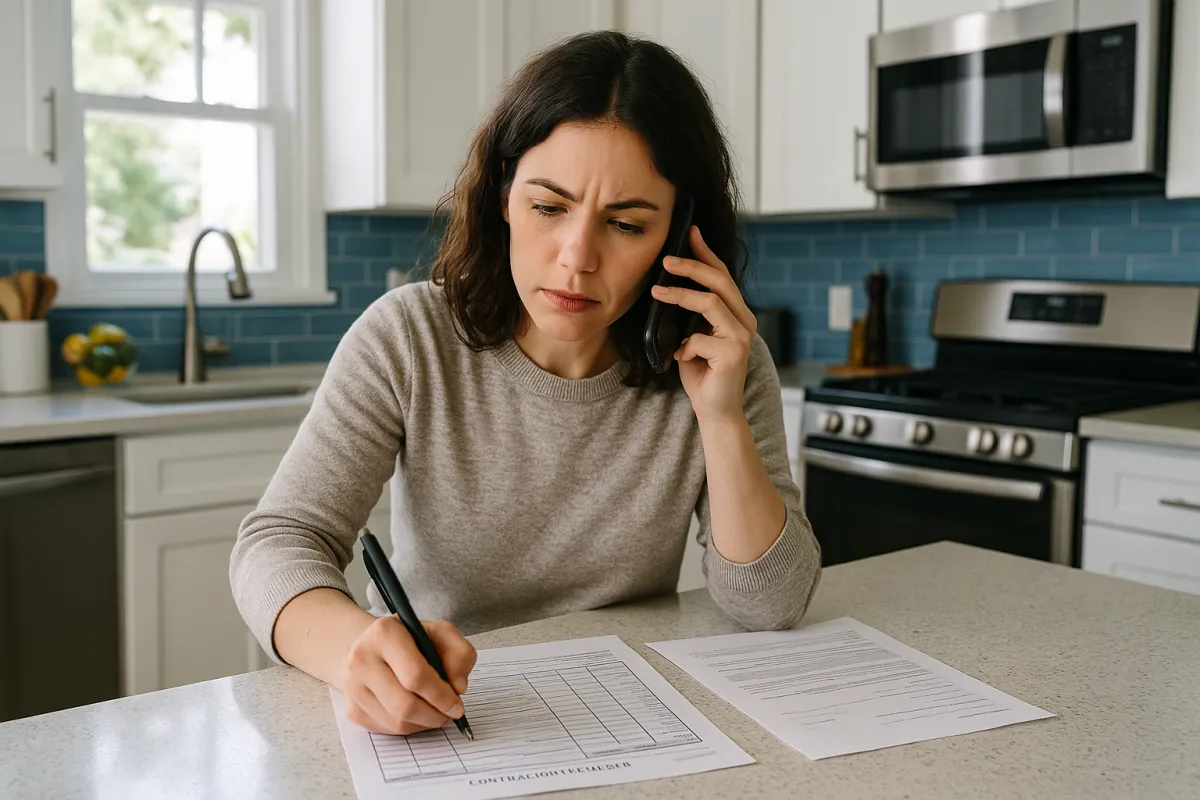
Keep the letter factual, specific, and calm. Open with who you are and the address of the work, then describe the problem plainly and tie it to the exact contract clause or scope item it violates. State precisely what you want, whether that is the work corrected, the job completed, or a refund of a specific dollar amount, and set a reasonable deadline to respond, commonly cited as somewhere around ten to fifteen days. Attach copies, never originals, of your key evidence: the relevant contract page and a few of the clearest photos. As an illustrative example, a demand might close with “please complete the waterproofing and reset the affected tile, or refund the $3,200 it will cost me to have it corrected, within fourteen days of this letter.”
Send it in a way that proves delivery, such as certified mail with a return receipt, and keep a copy along with the mailing receipt. That proof matters later, because it shows any agency or judge that you gave the contractor a fair, documented chance to make it right. Watch out for two temptations: writing in anger, which undercuts your credibility and can be quoted back at you, and making threats you are not prepared to follow through on. State your intended next steps as facts, not threats, and the letter reads as the calm, competent opening of a process rather than an outburst. Run your intended refund figure through the job cost estimator first so the number you demand is defensible.
Step 4: File a complaint with the state licensing board
If the demand letter goes unanswered or is refused, escalate to the channel with the most direct power over a licensed contractor: the state or local contractor licensing board. This is usually the single most effective complaint you can file, because it threatens the one thing a licensed contractor cannot afford to lose, their license and their livelihood. The board can investigate, order corrective action, impose fines, and in serious cases suspend or revoke the license. Even the opening of an investigation often prompts a settlement.
Find your board through your state government’s website, where most run an online complaint form. You will typically provide the contractor’s name and license number, a description of the problem, the amount in dispute, and your evidence, so the file you built in Step 1 slots directly in. Be factual and concise, describe the breach and reference your contract and demand letter, and attach the photos and records. As an illustrative example, a board complaint that reads “licensed contractor, license number on file, abandoned a $22,000 bathroom remodel after collecting $14,000, work stopped April 4, demand letter sent April 22, no response” gives an investigator everything needed to open a case.
Understand what the board can and cannot do, so your expectations are calibrated. Its role is to enforce licensing law and discipline contractors, not to act as your personal collection service, so it may not simply hand you a refund. What it does is apply real pressure, create an official record that supports every later step, and in some states connect you to a recovery fund or the contractor’s bond. Watch out for deadlines: some boards require complaints within a set window after the work, so do not sit on it. And check the contractor’s history while you are there, since a pattern of prior complaints strengthens yours and is exactly the record that gets a bad operator’s license pulled. This is also the civic half of the process, since your complaint warns the next homeowner, the same reason we urge readers to report contractor scams.
Step 5: File with the BBB and consumer protection agencies
Alongside the licensing board, widen the pressure through the consumer protection channels, because they reach contractors the board does not and add weight to your record. Two are worth filing with. The first is your state consumer protection agency or the attorney general’s office, which handles deceptive and unfair business practices. These offices generally do not resolve individual disputes for you, but they log complaints, sometimes mediate, and build the patterns that trigger investigations and enforcement actions against repeat offenders. Your complaint becomes part of a record that protects the wider public.

The second is the Better Business Bureau, which is not a government agency and has no enforcement power, but offers something surprisingly useful: a structured mediation channel that many businesses respond to because they care about their public rating and profile. Filing a BBB complaint routes your grievance to the contractor with a request to respond, and a contractor who ignored your letter will sometimes engage once a public complaint is attached to their name. As an illustrative example, a contractor unmoved by a demand letter may offer to finish the job rather than let an unanswered complaint sit visibly on their BBB profile.
File both the same way you filed the board complaint, with the same evidence and the same calm, factual framing. Keep copies of every submission and every response. Watch out for treating these as a substitute for the licensing board or a court, because on their own they rarely compel a refund; their value is added pressure and an expanding paper trail, not a guaranteed recovery. Used together with the board complaint, they surround the contractor with official records at the exact moment you are asking them to make it right, which is precisely when many decide it is easier to settle than to keep accumulating complaints.
Step 6: File a claim against the contractor’s license bond
If the contractor is licensed and the earlier steps have not produced a refund, look to their license bond, because this is one of the more direct routes to actually recovering money. Many states require a licensed contractor to secure a surety bond as a condition of licensing, a limited pool of money set aside specifically to compensate customers harmed by defective work, abandonment, or code violations. If your contractor is bonded, you may be able to file a claim against that bond for your documented losses, up to the bond amount.
Find the bond details through the licensing board, which typically lists the bond and the surety company on the contractor’s license record, or ask the board directly how to file. You generally submit a claim to the surety company or through the board, with your evidence, your demand letter, and a clear statement of your loss. As an illustrative example, if a contractor abandoned a job and left you $8,000 out of pocket, and the bond is written for $15,000, your documented claim could seek that $8,000 from the bond, subject to the surety’s review and any competing claims.
Set your expectations realistically, because a bond is a safety net, not a guarantee. The bond amount is capped and often modest relative to a large loss, several other homeowners may be claiming against the same bond, and the surety will investigate before paying, which is one more reason your documentation must be airtight. Watch out for the biggest limitation of all: an unlicensed contractor usually has no bond at all, so there is nothing to claim against, which is exactly why verifying the license before you hire, as our vetting checklist walks through, protects you long before a dispute. Where a bond exists, though, it is often faster and simpler than court, and it can be pursued alongside your other complaints rather than instead of them.
Step 7: Take the dispute to small claims court
When the complaint channels and the bond have not made you whole, and the amount is within reach, small claims court is the step designed for exactly this, a place to recover money without a lawyer. Small claims is a simplified court built for ordinary people to resolve monetary disputes themselves, with modest filing fees, relaxed procedures, and no requirement to hire an attorney. If your documented loss falls under your state’s small claims limit, this is often the most direct path to an enforceable judgment for your money.
Where a typical contractor dispute tends to get resolved
Illustrative distribution across the ladder. Most disputes settle well before a courtroom.
The shares are illustrative, not measured, and they make one point: the great majority of disputes settle on the lower rungs, which is why the early steps deserve your full effort.
Check the limit first, because it decides your route. Small claims caps vary widely by state and are commonly cited anywhere from a few thousand dollars to around ten thousand or more, and because they change, treat any figure as illustrative and confirm the current number with your local court. If your loss fits, you file a claim naming the contractor, pay the filing fee, and serve the contractor with notice. You then present your case to a judge with the file you have been building all along: the contract, the photos, the demand letter, the proof of payment, and ideally the independent assessment of the defect. As an illustrative example, a $6,500 claim for corrective work, presented with a clear timeline and a second contractor’s repair quote, is exactly the kind of well-documented case small claims exists to decide.
If your loss exceeds the limit, you have choices: sue for the maximum and waive the excess, which keeps it simple, or file in regular civil court, where a lawyer usually becomes worthwhile. Watch out for the gap between winning and collecting, because a judgment is not a check. If the contractor has no money or has vanished, even a win can be hard to collect on, so weigh the filing fee and your time against the realistic odds of recovery. For most well-documented disputes within the limit, though, small claims is the practical end of the road, and the paper trail you built at every earlier step is precisely what wins it.
Step 8: Know when to hire a lawyer
The top rung is a lawyer, and the skill is knowing when you actually need one rather than defaulting to it out of frustration or avoiding it out of cost fear. For a straightforward claim under the small claims limit, the process is deliberately built for self-representation, and a lawyer is usually unnecessary. The calculus changes when the stakes or the complexity rise. A consultation becomes worth its cost when the amount at issue is large, when the contractor has retained their own lawyer, when a mechanic’s lien has been filed against your home, when the contract language is genuinely ambiguous, or when the dispute involves serious property damage or injury.
A lien in particular deserves fast attention, because a subcontractor or supplier your contractor failed to pay can, in many states, place a claim against your property even if you paid the contractor in full. That is a situation where professional advice early can save you from paying twice, and where the deadlines are unforgiving. As an illustrative example, a homeowner facing a $30,000 dispute with a lien attached and a contractor who has lawyered up is well past the do-it-yourself zone, and a consultation is not an indulgence but a safeguard.
Use lawyers efficiently even when you engage one. Many offer a paid initial consultation where you can learn whether your case is strong, what recovery is realistic, and what it will cost to pursue, all before committing to full representation. Even if you intend to handle the matter yourself in small claims, a single consultation can sharpen your demand letter, confirm which clauses actually support you, and flag deadlines you might miss. Watch out for letting legal cost fear freeze you entirely, because the consultation itself is often modest and the clarity it buys, on a dispute measured in thousands, is frequently worth far more than it costs.
A worked example: a botched bathroom remodel
Walk one illustrative dispute through the whole ladder to see how the steps connect. A homeowner hires a licensed contractor for a $22,000 bathroom remodel, pays a $6,000 deposit and a $8,000 progress payment, and the work stops at the tile stage. The shower was tiled without a waterproof membrane the contract specified, and after three unanswered calls, the crew has not returned in two weeks. The homeowner is $14,000 in and staring at a shower that will leak into the subfloor the first time it is used.
They start by documenting: photos of the membrane-less tile, the signed contract highlighting the “includes waterproof membrane” line, the two payment records, and a one-page timeline. A second licensed contractor inspects and quotes $4,800 to tear out and redo the shower correctly, and puts the waterproofing failure in writing. With that file, the homeowner sends a certified demand letter citing the exact clause, attaching the photos, and asking the contractor to correct the work or refund $4,800 within fourteen days. When the deadline passes in silence, they file a licensing board complaint with the same evidence, a BBB complaint, and, learning the contractor carries a $15,000 bond, a bond claim for the $4,800.
Here is how it tends to resolve. Somewhere in that sequence, most contractors engage, because an ignored demand has now become an open board investigation, a public BBB complaint, and a bond claim against their license, all at once. If this contractor still refuses, the $4,800 sits comfortably under a typical small claims limit, so the homeowner files, serves the contractor, and presents the same organized file to a judge: contract, photos, demand letter, payment proof, and the independent repair quote. Every figure here is illustrative, but the shape is the lesson. The homeowner never needed a lawyer, and the reason the case was winnable at every stage is that the documentation from Step 1 fed directly into all seven steps above it.
Common mistakes that weaken a contractor complaint
Most complaints that go nowhere fail for the same avoidable reasons, and every one of them is something the homeowner controlled.
- Repairing the defect before documenting it. Fixing the problem first can erase the evidence your entire complaint depends on. Photograph and record everything, then repair.
- Complaining verbally instead of in writing. A phone call leaves no record. Put the demand and every complaint in writing, so each step becomes evidence for the next.
- Skipping straight to court or a lawyer. Arriving at court with no demand letter and no agency complaints looks unreasonable and forfeits the pressure that settles most disputes early. Climb the ladder in order.
- Writing in anger. An emotional, threatening letter undercuts your credibility and can be quoted back at you. Keep every communication factual, specific, and calm.
- Missing deadlines. Some boards and courts require action within a set window, and liens carry short fuses. Note every deadline and act well inside it.
- Vague demands. “Make it right” gives a contractor nothing to act on. Name the exact fix or the exact dollar amount, tied to a specific clause and a specific date.
Every one of these is prevented by the same discipline: document first, communicate in writing, stay factual, and be specific about what you want and by when. A contractor hoping to wait you out needs you to skip exactly one of these, so skip none.
Troubleshooting: when a complaint stalls
Even a well-run complaint can hit walls, and most of them have a next move. Here is how to handle the common ones.
What if the contractor is unlicensed? You lose the two license-based channels, the board’s disciplinary power and the bond, but you gain others. Report the unlicensed activity itself to your state board and consumer protection office, since operating without a license is often its own violation, and lean on documentation, the demand letter, and small claims court, where an unlicensed contractor’s status can actually work against them.
What if the contractor has disappeared? Document your attempts to reach them in writing, then proceed with the board complaint, the bond claim if one exists, and a small claims filing, serving them at their last known or registered business address. A default judgment is possible if they fail to appear, though collecting on it can be the harder half, so weigh the effort against the odds.
What if a lien has been placed on my home? Treat this as the signal to get professional advice quickly. Lien deadlines are short and the consequences are serious, so a consultation with an attorney early, rather than after the deadline, is where the money is saved.
What if my loss is larger than the small claims limit? You can sue for the maximum and waive the rest to keep it simple, or file in regular civil court with a lawyer. Weigh the extra cost and complexity of civil court against the amount you would otherwise leave on the table.
What if I signed a contract with a mandatory arbitration clause? Read it closely, because it may require you to resolve the dispute through arbitration or mediation rather than court. That does not block the board complaint or the bond claim, but it can change where the monetary claim is heard, so factor it in before you file.
The contractor complaint checklist
Save this and work it in order. You climb only as far as the dispute requires.
- Evidence assembled: dated photos, the signed contract, invoices, payment proof, the full message thread, and a written timeline.
- Contract reviewed and the exact broken clause identified, with an illustrative repair figure behind your claim.
- Formal demand letter sent by certified mail: factual, specific, naming the fix or refund and a reasonable deadline, with copies of evidence attached.
- Licensing board complaint filed with the same evidence, and the contractor’s complaint history checked.
- Consumer protection and BBB complaints filed to widen the pressure and expand the record.
- License bond claim filed where the contractor is licensed and bonded, for your documented loss up to the bond amount.
- Small claims court considered if the loss fits the limit, with the full file ready to present to a judge.
- A lawyer consulted if the amount is large, a lien is attached, the contractor has counsel, or the terms are genuinely ambiguous.
Run your repair or refund figure through the job cost estimator first, so every letter and filing rests on a number you can defend.
The bottom line
Reporting a bad contractor is not one dramatic action but a ladder of ordered steps, and the homeowners who recover money are the ones who climb it deliberately rather than lunging at the top. Document the problem before you touch it, anchor your complaint to the exact clause your contract promised, and open with a calm, specific written demand, because that single letter settles more disputes than any courtroom. When it does not, escalate through the licensing board, consumer protection, a bond claim, and small claims court, in that order, letting each rung build the record the next one stands on.
Above all, let the paper do the work. The file you assemble in the first step, the photos, the contract, the payments, the timeline, is what turns a frustrating story into a complaint an agency can act on and a case a judge can decide. Stay factual, be specific about the fix you want, honor every deadline, and climb only as high as you must. Do that, and a contractor counting on your paralysis meets an organized homeowner instead, which is exactly the position from which bad work gets corrected and lost money comes back.
ProsNook publishes this walkthrough to help homeowners resolve disputes with confidence, not to serve as legal advice. Every dollar figure above is illustrative, and the agencies that handle complaints, small claims limits, bond requirements, filing deadlines, and lien rules all vary by state and locality, so confirm what applies where you live before you act. If you are facing a significant loss, a lien on your home, or a contractor who has retained counsel, preserve your records and consult a qualified attorney licensed in your state.
Frequently asked questions
How do I report a bad contractor?
Start by documenting the problem thoroughly with dated photos, your contract, invoices, payment records, and every message you exchanged. Then send a formal written demand letter that describes the issue and the fix you want, and give a reasonable deadline. If that does not resolve it, escalate to your state or local contractor licensing board, your state consumer protection office or attorney general, and, for licensed contractors, a possible claim against their license bond. For a monetary loss you cannot recover any other way, small claims court is the next step. The order matters because each stage builds the paper trail the next one relies on.
Where do I file a complaint against a contractor?
There are several channels, and most people use more than one. The state or local contractor licensing board can investigate and discipline a licensed contractor, and it is usually the most powerful complaint because it threatens the license. Your state consumer protection agency or attorney general's office handles deceptive business practices, and the Better Business Bureau offers a mediation channel that many businesses respond to for reputation reasons. For a licensed contractor, the licensing board can also tell you how to claim against their bond. Which one fits depends on whether the contractor is licensed, how much money is involved, and what outcome you want.
Can I sue a contractor for bad work?
Yes, if a contractor breached your contract or performed negligent work, you can generally sue to recover your losses, and for amounts under your state's small claims limit you can often do it yourself without a lawyer. Small claims limits vary widely by state, commonly cited somewhere in the range of a few thousand dollars up to around ten thousand or more, so confirm your local cap. You will need your contract, evidence of the defect, and a clear dollar figure for what it will cost to fix or finish the work. For larger or more complex disputes, consulting an attorney before you file is usually worth the cost. This is general information, not legal advice, so confirm the rules where you live.
What is a contractor license bond and how do I claim against it?
A license bond, sometimes called a surety bond, is a sum a licensed contractor must secure as a condition of licensing in many states, set aside as a limited pool to compensate customers harmed by defective work, abandonment, or code violations. If your contractor is licensed and bonded, you may be able to file a claim against that bond for your documented losses, up to the bond amount, which is often a few thousand to tens of thousands of dollars depending on the state and license class. You typically file through the licensing board or directly with the surety company named on the bond, with your evidence attached. The bond will not always cover your full loss, and an unlicensed contractor usually has no bond at all, which is one more reason verifying the license before hiring matters so much.
How do I write a demand letter to a contractor?
Keep it factual, specific, and calm. State who you are and the address of the work, describe the problem plainly with reference to the exact contract clause or scope item that was not met, and attach copies of your evidence such as photos and the contract. Then state exactly what you want, whether that is the work corrected, the job finished, or a refund of a specific dollar amount, and give a reasonable deadline to respond, commonly cited as around ten to fifteen days. Send it in a way that proves delivery, such as certified mail with a return receipt, and keep a copy for your records. A written demand often resolves the dispute on its own because it signals you are organized and prepared to escalate.
Does filing a complaint with the licensing board get my money back?
Not directly in most cases. A licensing board's job is to enforce licensing law and discipline contractors, so it can investigate, order corrective action, impose fines, suspend or revoke a license, and in some states help you access a recovery fund or the contractor's bond. What it usually cannot do is act as your personal collection agency and simply hand you a refund. That said, a board complaint creates real pressure, builds an official record, and sometimes prompts a contractor to settle to make the complaint go away. To actually recover money, a bond claim or small claims court is often the more direct route, with the board complaint strengthening your position.
What is the small claims court limit for contractor disputes?
Small claims limits are set by each state and vary widely, commonly cited anywhere from a few thousand dollars to around ten thousand or more, with some states higher. Because the figure changes by state and is updated periodically, treat any specific number you read as illustrative and confirm your current local limit with the court itself. If your loss is under the limit, small claims is designed to be used without a lawyer, with modest filing fees and a simplified process. If your loss exceeds the limit, you can sometimes sue for the maximum and waive the rest, or file in regular civil court, where an attorney usually becomes worthwhile.
Should I hire a lawyer for a contractor dispute?
It depends on the size and complexity of the dispute. For a straightforward claim under your state's small claims limit, the process is designed for people to represent themselves, so a lawyer is often unnecessary. A consultation becomes worth the cost when the amount is large, the contractor has a lawyer, there is a lien on your home, the contract terms are genuinely ambiguous, or the case involves significant property damage or injury. Many attorneys offer a paid initial consultation where you can learn whether your case is strong and what recovery is realistic before committing. Even when you plan to handle it yourself, one consultation can sharpen your demand letter and your evidence.