
What's on this page
- Before you start: what to gather
- Step 1: Decide what is actually changing
- Step 2: Work out who you actually need
- Step 3: Build a shortlist from the right sources
- Step 4: Verify the license, insurance and history yourself
- Step 5: Get three itemized bids on one identical scope
- Step 6: Read the estimate line by line
- Step 7: Get the contract, payments and warranty right
- Step 8: Manage the job without managing the crew
- Bathroom remodel red flags, ranked
- Questions worth asking at the site visit
- A worked example: two bids on one bathroom
- Common mistakes when hiring a bathroom remodeler
- Troubleshooting: the situations that actually come up
- Where a bathroom differs from every other remodel
- Living without the bathroom, and how it shapes the hire
- Accessibility and future-proofing, if that is part of the job
- What the money is actually buying
- Your bathroom remodel hiring checklist
- The bottom line
Short answer: Hire a bathroom remodel contractor by first deciding what is actually changing, since a layout that stays put and one that moves are two different hires, then writing the scope down once and handing the identical document to every candidate. Verify the license and insurance yourself from the source, get three itemized written bids, and tie payments to visible milestones with the final payment held until the punch list and inspection are done.
Hiring a bath remodel contractor is where most bathroom projects are decided, long before anyone picks a tile. The room itself is small, which fools people into treating it as a small job, but a bathroom packs plumbing, electrical, waterproofing, ventilation, tile and carpentry into a small footprint, all of it behind surfaces that are expensive to open again. Getting the wrong person in there is not a cosmetic problem. It is a leak inside a wall that shows up as a stain on a ceiling eighteen months later.
The short version
- Decide what is actually changing before you call anyone. A layout that stays put and one that moves are two different hires.
- Write the scope down once and hand the identical document to every contractor. Quotes on different scopes are not comparable.
- Verify the license and the insurance yourself, from the source, not from a photo on a phone.
- Three itemized written bids is the working standard. The cheapest is usually cheapest because something is excluded.
- Tie payments to visible milestones and hold back a final payment until the punch list and any inspection are done.
This is a hiring playbook rather than a design guide. Our bathroom remodel cost review covers what the work runs, and our master bathroom remodel ideas covers what to do with the space. This one covers the person you let into it, which is the decision that determines whether the other two matter.
Before you start: what to gather
Five things, none of which take long, all of which change the conversation.
A rough scope in writing, even if it is five lines on a phone. What stays, what goes, whether the layout moves.
Photographs of the room as it is, including the ceiling below it if that is accessible, because a stain down there changes the job.
Your budget range, held privately at first. You will share it eventually, but not in the first two minutes.
Your building department’s contact details, so you can ask about permits yourself rather than relying on a contractor’s summary.
A rough timeline with any hard dates, such as a period when the household genuinely cannot lose the only bathroom.

Step 1: Decide what is actually changing
The single question that sorts the whole hire is whether the layout moves.
A surface remodel keeps every fixture where it is. New tile, new vanity in the old position, new toilet on the existing flange, new taps, paint, lighting in the existing boxes. The plumbing rough-in is untouched. This is the job a specialist bathroom remodeler does most efficiently, and it is often the one where a general contractor’s overhead buys you the least.
A layout change moves the toilet, the shower drain, the vanity plumbing, or takes out a wall. Now you are into rough plumbing, possibly framing, possibly a structural question, and almost certainly a permit and inspections. This is general contractor territory, or a specialist who genuinely runs permitted work rather than one who avoids it.
A conversion, most commonly tub to walk-in shower, sits in between and is more variable than people expect. If the new shower drain lands where the tub drain was, the plumbing may be modest. If it does not, or if the shower needs a different waste size, the floor is coming up.
Deciding this before you call has a practical payoff beyond clarity. It stops you from collecting quotes from three people who each assumed a different job, which is the most common reason a set of bathroom bids looks incomprehensible.
Step 2: Work out who you actually need
There are three realistic routes, and the right one depends on Step 1.
A specialist bathroom remodeler. Someone who does bathrooms week in and week out. Their advantage is pattern recognition: they have opened a hundred walls of your era and they know what is usually behind them. Their tile work is normally their strongest skill because it is most of what they do. Their limitation is that anything crossing outside the room, structural work, a second space, an extension, is not their core business.
A general contractor. Broader, coordinates the trades, pulls the permit, and manages sequencing. Costs more in overhead and is worth it when the job is genuinely multi-trade or structural. Our general contractor cost review covers what that management layer runs.
Individual trades hired directly. A plumber, an electrician, a tiler, a carpenter, each booked by you. This can be cheaper and it is entirely legitimate, but it makes you the project manager. You own the sequence, the site access, the moment when the tiler arrives and the plumbing is not ready, and anything that falls between two trades. It suits people with time and some construction literacy, and punishes people without either. Our DIY versus hire guide covers where that line usually sits.
There is no universally better answer here. There is a better answer for your specific job, and Step 1 is what tells you which.
Step 3: Build a shortlist from the right sources
Where the names come from predicts the quality of the list more than any subsequent filtering does.
Referrals from people who had the same job done, recently, locally, and who will let you look at the result, are the strongest source by some distance. Ask what went wrong, not what went right; every job has something, and how the contractor handled it is the useful information.
Local trade suppliers, tile shops and plumbing merchants know who buys quality materials and who pays their accounts. They will rarely give you a ranking, but they will often give you two or three names.
Reviews are worth reading in bulk rather than individually. One furious review tells you almost nothing. Four reviews mentioning the same specific problem, communication, cleanup, a job left unfinished for weeks, tells you a great deal.
Your local licensing board or registry, where one exists, lets you check a name before you ever call it, and sometimes lets you browse licensed contractors in your area.
Sources to treat with more caution: a door-knock, an unsolicited call, and anyone whose entire online presence is a lead-generation profile with no independent trace. Our contractor scams guide covers the patterns in detail, and the bathroom versions are the same as the roofing versions.
Aim to end this step with four or five names, expecting to lose one or two to unavailability.
Step 4: Verify the license, insurance and history yourself
This is the step people skip because it feels adversarial. It is not adversarial; it is the ordinary due diligence any professional expects, and a contractor who takes offence at it has told you something useful for free.
License. Where your jurisdiction requires one for this type of work, ask for the number and look it up on the issuing board yourself. Check it is current, check the name matches the business you are dealing with, and check for disciplinary history if the board publishes it. Requirements vary widely by location and by job value, so establish what applies to you rather than assuming.
General liability insurance. Ask for a certificate sent directly from the insurer or broker, not a photograph of a document. The direct route is what confirms the policy is live today rather than live on the day the photo was taken.
Workers’ compensation. If the contractor has employees, this protects you from a claim if someone is injured in your home. If they genuinely work alone, ask how injuries on your property would be handled, and get the answer in writing.
Trading history. How long at this address, under this name. A business that has changed names repeatedly is not automatically a problem, but it is worth a question, because it is also how a poor reputation is shed.

Step 5: Get three itemized bids on one identical scope
The word doing the work in that sentence is identical.
Write the scope once. List what is being removed, what is being installed, who supplies which materials, and what is explicitly excluded. Name model numbers where you have chosen products, and say plainly where you have not. Hand the same document to every contractor and ask them to price that scope.
Then insist the bid is itemized. A single number for a bathroom remodel is not a quote; it is a mood. An itemized bid separates demolition, plumbing, electrical, waterproofing, tile, fixtures, fittings, finishes, disposal and labor, and it lets you see where two contractors genuinely differ rather than guessing.
Three is the working number. Fewer and you cannot see the range. More than about five adds confusion and wastes the time of people who took the visit seriously.
What to weight when choosing a bathroom remodeler
Illustrative weighting, applied only after the gates (license, insurance, written scope) are passed.
Price sits last deliberately. It is the only factor that cannot be assessed at all until the scopes are identical, and once they are, the spread between competent bidders is usually smaller than people expect.
Step 6: Read the estimate line by line
An estimate is a document about what is included. Reading it well means reading for absence.
Waterproofing. In a bathroom this is the line that matters most and the one most often vague. Ask what system is being used behind the tile in the wet area and get the answer written into the estimate. Tile is not waterproofing; the layer behind it is.
Demolition and disposal. Who removes the old material and who pays for the skip or tip fees. This is a common and irritating omission.
Materials supplied by whom. A remodel where you supply the tile and the contractor supplies everything else is fine, but it must be written down, because a missing tile allowance is one of the largest single gaps a bid can hide.
The allowance trap. Where a bid names an allowance for fixtures or tile, check what that allowance actually buys at local prices. An unrealistically low allowance makes a bid look competitive and converts into a change order the moment you choose anything real.
Contingency for the unknown. Bathrooms hide their surprises behind waterproof surfaces. Rot in a subfloor, a drain in the wrong place, old pipework that cannot be reconnected as it stands, and a vent that goes nowhere are all common. A bid that pretends none of these exist is not more accurate than one that names a contingency; it is just quieter about the risk.
Permit responsibility and cost. Who pulls it, who pays for it, and whether the estimate includes it.
Our reading a contractor estimate guide goes deeper on the document itself, and our comparing quotes guide covers the side-by-side.
Step 7: Get the contract, payments and warranty right
The contract is where the hire becomes real, and it is the last point at which changing anything is easy.
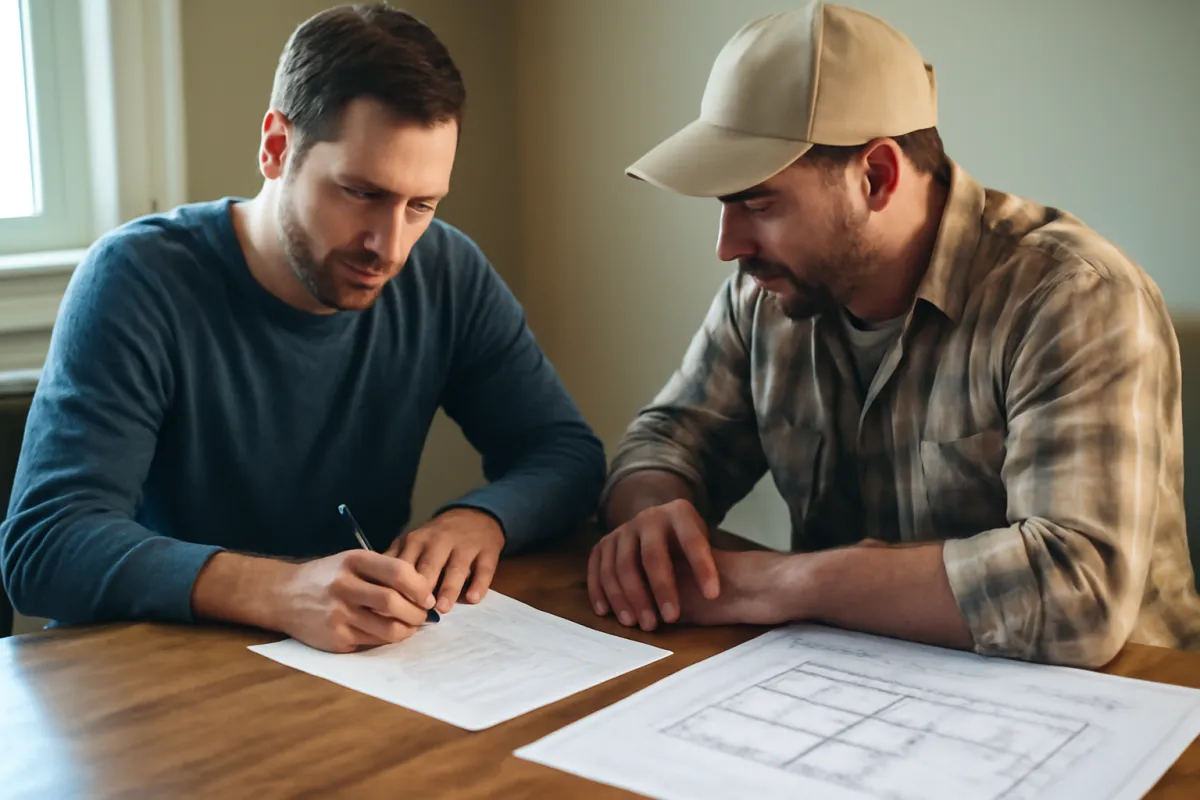
Scope, restated. The contract should describe the work specifically, not by reference to a conversation. Surface by surface, fixture by fixture.
Payment schedule tied to milestones. Deposit, then payments tied to demolition complete, rough-in inspection passed, tile set, and a final payment on completion of the punch list. Milestones you can see beat dates on a calendar, because dates arrive whether or not the work did.
A modest deposit. Some jurisdictions cap what a home improvement contractor may take upfront. Check your own. Regardless of the cap, a large deposit removes your leverage on day one, which is precisely when you have the most of it.
A written change order process. No extra work proceeds without a signed change describing the work and its price. This single clause prevents the most common bathroom remodel dispute, which is not fraud but drift: a series of small verbal agreements that arrive as one large final invoice.
Two warranties, named separately. The manufacturer’s warranty covers the products. The contractor’s workmanship warranty covers the installation, and it is the one that matters when a shower leaks. Get its length in writing and get what it excludes in writing too.
Lien waivers, where they apply in your jurisdiction, protecting you from a subcontractor claim on a bill the main contractor was already paid for.
Step 8: Manage the job without managing the crew
Once work starts, your job is narrow and worth doing well.
Be reachable for decisions. A remodel stalls on questions more often than on materials, and a homeowner who answers within the hour is worth real money to the schedule.
Walk the site at the end of each phase rather than hovering during it. Demolition complete, rough-in before it is covered, waterproofing before tile, and tile before grout are the four moments where looking costs nothing and not looking can cost a great deal. Photograph the walls before they close.
Keep every change in writing, including the ones you initiate. The homeowner who verbally asks for a niche in the shower and then disputes the charge for it has undermined their own position.
Do not pay ahead of the work. This is the most common way homeowners lose money on remodels, and it is entirely self-inflicted.
Build the punch list in one pass at the end, in daylight, with the contractor present, and agree it in writing before the final payment.
Bathroom remodel red flags, ranked
Bathroom remodel red flags by severity
Illustrative severity ranking. Any one is worth a pause; two together is a walk-away signal.
Notice that none of these require construction knowledge to spot. That is the point: the most reliable filter available to a homeowner is entirely procedural.
The waterproofing flag deserves a note of its own, because it is the bathroom-specific one. Everything else on this list applies to any trade. Vague waterproofing is where a bathroom differs, because it is the failure that is invisible on handover day and expensive on the day it appears.
Questions worth asking at the site visit
The point of these is not to catch anyone out. It is to see how they think.
How many bathrooms like this have you done in the last year, and can I see one?
What waterproofing system do you use behind the tile, and why that one?
What do you usually find behind the walls in houses of this age around here?
Who does your plumbing and electrical work, and are they your own people or subcontractors?
Who pulls the permit, and what inspections will this job need?
What is your workmanship warranty, in writing, and what does it exclude?
What is the realistic worst case on the schedule, and what causes it?
How do you handle a change once work has started?
The answers matter less than the manner. A contractor who answers the waterproofing question with a specific method and a reason has told you a great deal. One who says the tile will keep the water out has told you more.
A worked example: two bids on one bathroom
A homeowner wants a tub-to-shower conversion, new vanity in the same position, new toilet, tiled floor and shower walls, and a new extractor fan. The drain has to move a couple of feet for the shower.
Bid A comes in noticeably lower. Reading it line by line: no permit line, no disposal line, a tile allowance that would buy the cheapest option in the local shop, and the waterproofing described in one word. Demolition is included but “make good” is not. The fan is listed but no electrical work appears anywhere.
Bid B is higher. It itemises demolition and disposal, names the waterproofing system, lists the drain relocation as its own line, includes the permit and the electrical work for the fan, and states a contingency for subfloor repair if demolition reveals damage, with an hourly rate attached.
Bid A is not cheaper. It is priced for a different job. Once the missing items are added, the two land close together, and the remaining gap is smaller than the original difference by a wide margin.
The homeowner goes back to contractor A with the same list of omissions. A revised bid arrives, now within a small margin of B. That conversation cost one email and produced the only genuine comparison available.
This is the ordinary outcome of insisting on identical scopes, and it is why the exercise is worth the effort. The cheapest bid usually is not, and the way to find out is arithmetic rather than instinct.
Common mistakes when hiring a bathroom remodeler
Comparing prices before comparing scopes. The most expensive mistake on this list, and the most common. Two numbers for two different jobs contain no information.
Choosing on price after the scopes match. Once the scopes are genuinely identical, the spread between competent contractors is usually modest, and the lowest bid is more likely to reflect a thin margin than a bargain. A thin margin is what turns into corner-cutting or an abandoned job.
Paying a large deposit. You will never have more leverage than you do before work starts, and a large deposit spends it.
Skipping the permit to save time. It surfaces at resale, on an insurance claim, or when the next owner’s inspector finds it. The saving is borrowed, not earned.
Not looking before the walls close. Rough-in and waterproofing are visible for a few days and then never again without demolition. Photograph them.
Letting changes accumulate verbally. Every one feels small. The invoice at the end does not.
Hiring the person who can start tomorrow. Sometimes that is a genuine gap in a schedule. Often it is the market’s opinion of them, expressed as availability.
Treating the site visit as a formality. It is the interview, and the contractor who spends forty minutes in the room asking about the ceiling below is not being slow.
Troubleshooting: the situations that actually come up
Every contractor is booked for months. This is common and it is usually a good sign about the local market. The options are to wait, to widen the geographic search, or to book ahead for a later window. What you should not do is take the only person who is free without applying the same checks.
Demolition reveals rot or a plumbing problem. Expected often enough to plan for. Ask for the finding to be photographed, the remedy quoted as a written change order, and the price agreed before the work proceeds. This is exactly what the change order clause exists for.
The job stalls. Find out whether the cause is materials, a subcontractor, an inspection, or the contractor’s own scheduling, because the remedies differ. Put the question in writing, ask for a revised date in writing, and remember that the unpaid balance is your leverage.
A dispute about quality. Raise it in writing immediately, with photographs, referring to the contract scope. Most quality disputes in bathrooms concern tile alignment, grout finish or fixture positioning, and most are resolvable if raised before the final payment. Our contractor complaint guide covers the escalation route where it does not resolve.
You lose confidence mid-job. Stop paying ahead, document the current state thoroughly with photographs, get an independent opinion on the work completed, and read your contract’s termination clause before you say anything final. Ending a contract badly is expensive; ending it carefully is often recoverable.
The only bathroom in the house is out of action. Say this at the quoting stage, not after. It changes sequencing, it sometimes changes the price, and a contractor who knows about it will usually plan the toilet reinstatement differently.
Where a bathroom differs from every other remodel
It is worth naming the reasons this room is its own category, because they explain most of the advice above.
Water is always present. Every other room fails gradually. A bathroom fails through a waterproofing defect that stays invisible until it has damaged something below it.
Everything is concentrated. Supply plumbing, waste plumbing, ventilation, electrical, and a heavy tiled floor, in a small footprint. There is very little room for a mistake to be worked around.
Access is unforgiving. Two trades genuinely cannot work in a small bathroom at once, which is why sequencing dominates the schedule and why a single missing material stops everything rather than slowing it.
The finishes are permanent. Tile is not repainted. A tiling error is a demolition job, not a touch-up, which is why the quality of the tile work carries more weight in this room than a similar surface would anywhere else.
Ventilation is part of the build. An extractor fan venting into a loft rather than outside is a common legacy fault, and a remodel is the moment to fix it. Ask specifically where the fan discharges.
Living without the bathroom, and how it shapes the hire
This is the practical constraint that most changes a household’s experience of the job, and it belongs in the hiring conversation rather than in a surprise on day three.
If the house has a second bathroom, the disruption is manageable and the schedule is mostly the contractor’s problem. If it does not, the sequencing changes materially, and so does what you should be asking for.
Ask each contractor, at the quoting stage, how they handle a single-bathroom household. The good answers are specific: the toilet goes back in temporarily at the end of each phase where that is possible, the tiling and curing days are grouped so the out-of-action window is one continuous block rather than several, and materials are all on site before demolition starts so no phase stalls with the room unusable.
The bad answer is a shrug and an assurance that it will be fine.
You should also decide in advance what your own fallback is, whether that is a neighbor, a relative nearby, a gym membership, or a portable arrangement for a few days. Deciding it while the floor is up is worse than deciding it now, and knowing your own tolerance changes which bid you should accept. A contractor who is a week slower but keeps the toilet functional for most of that week may be the better choice for you and the worse choice for someone with a second bathroom.
Say all of this at the site visit. It costs nothing, it separates contractors who plan from contractors who improvise, and it is the single piece of information most likely to change how the job is sequenced.
Accessibility and future-proofing, if that is part of the job
A meaningful share of bathroom remodels are motivated by accessibility rather than aesthetics, and that changes the hire in specific ways.
The work involved is genuinely different: blocking inside the walls for grab rails that will actually hold weight, a level or low-threshold shower entry which is a floor and drainage question rather than a fitting choice, door widths, turning space, and fixture heights. None of that is exotic, but not every remodeler does it regularly, and the difference shows.
Ask directly whether they have done accessible bathrooms, and ask what they install as backing for grab rails. The answer to the second question is diagnostic: solid blocking inside the wall before it is closed is the right answer, and anything involving fixing to tile afterwards is not.
If a level-entry shower is the goal, ask early how the floor build-up and the drain will be handled, because on some floor constructions this is straightforward and on others it is the largest single item in the job. It is far better to learn which you have during the quoting stage.
Two further points worth raising. Blocking for future grab rails costs very little to install while the walls are open, even if nothing is being fitted now, and it is the cheapest future-proofing available in this room. And where the work is being done for a specific person’s needs, an occupational therapist’s assessment before the design is fixed is usually worth more than any amount of contractor opinion, because it starts from what the person actually needs rather than from what is commonly installed.
What the money is actually buying
It helps to understand the shape of a bathroom remodel bill, because it explains why the cheap bid is usually cheap and why a small room costs what it does.
Labor is the largest component in most bathroom remodels, typically by a wide margin. That is a function of the trades involved and the sequencing rather than of anyone being expensive: a small room needing a plumber, an electrician, a tiler and a carpenter in a specific order carries a lot of mobilisations for a modest amount of floor area.
Materials vary enormously and are the part you control most directly. Tile, fixtures and the vanity can each swing by a multiple depending on choice, which is why allowances in bids need checking against real local prices.
The invisible work, waterproofing, rough plumbing, blocking, ventilation, is a smaller share of the total than people expect, and it is the worst possible place to economise, because it is the part that cannot be redone without demolishing the part you can see.
Permits, disposal and contingency are individually small and collectively significant, and they are the lines most often absent from an optimistic bid.
Understanding that shape is what lets you read a low number correctly. A bid that is meaningfully cheaper than the others has usually either excluded something, assumed a cheaper material tier, or thinned the labor, and the third is the one that hurts most because it is the hardest to see on the page. Our bathroom remodel cost review covers the ranges themselves in detail.
Your bathroom remodel hiring checklist
Scope decided and written down before any calls.
Four or five names from referrals, suppliers, reviews read in bulk, and the licensing registry.
License verified on the issuing board, by you.
Liability and workers’ compensation certificates received directly from the insurer.
Recent, comparable bathroom work seen in person or in photographs you trust.
Three itemized written bids on the identical written scope.
Every bid read for absence: waterproofing, disposal, permit, allowances, electrical, contingency.
Contract in hand with scope, milestone payments, change order clause, and both warranties.
Deposit modest and within any local cap.
Permit responsibility named in writing.
Site walks planned at demolition, rough-in, waterproofing and pre-grout, with photographs.
Punch list agreed in writing before the final payment is released.
The bottom line
Hiring a bathroom remodel contractor rewards process over instinct. Decide what is changing, write the scope once, verify credentials from the source, collect three itemized bids on that identical scope, read each one for what is missing rather than what is priced, and put the whole agreement including both warranties on paper before any money moves.
Almost every bad bathroom remodel story traces back to one of those steps being skipped, and almost none of them require construction knowledge to avoid. The homeowner who does the procedural work well ends up with a better result than the one who knows more about tile, because the procedural work is what determines who is holding the trowel.
And when the bids come back, resist the pull of the low number until the scopes genuinely match. Once they do, the spread is usually small, and the decision becomes what it should have been from the start: which of these people do you want in your house for a month.
ProsNook publishes this checklist to help homeowners hire a bathroom remodel contractor with confidence, not as legal, insurance, or professional advice. Every figure and weighting above is illustrative, and licensing, insurance, deposit limits, permit requirements, and building code vary by state, locality, and jurisdiction, so treat your local licensing board and building department as the authority for your situation. Before you sign or pay anything, verify each contractor’s current license and insurance yourself, read the full contract and both warranties, confirm what your own project requires by way of permits and inspections, and consult a qualified professional where your project or your local rules warrant it.
Frequently asked questions
What kind of contractor do I need for a bathroom remodel?
It depends on how much of the room is changing. If the layout stays put and you are replacing finishes, fixtures in their existing positions, a vanity and tile, a specialist bathroom remodeler or a competent general contractor handles it, subcontracting the plumbing and electrical work as needed. If you are moving the toilet, shower or drains, taking out a wall, or converting a tub to a walk-in shower with a new drain position, you want a general contractor who will pull the permit and coordinate the trades, because that job now involves rough plumbing, framing and electrical inspection. Hiring individual trades yourself is possible and sometimes cheaper, but it makes you the project manager, responsible for sequencing and for anything that falls between two trades.
How many bathroom remodel quotes should I get?
Three itemized written quotes on one identical written scope is the working standard. Fewer than three and you cannot see the fair local range, so you have no way to tell whether a number is high, low or normal. More than about five tends to add confusion rather than information, and it wastes the time of contractors who took the visit seriously. The word that matters more than the number is identical: quotes on different scopes are not comparable, and the single most common reason a bathroom remodel bid looks cheap is that it excludes something the others included. Write the scope down once, hand the same document to everyone, and ask each of them to price that.
Should I pay a deposit to a bathroom remodel contractor?
A modest deposit is normal and reasonable, because a remodeler orders materials and reserves crew time before any work happens. What is not reasonable is a demand for a large share of the total before the job starts, or any request for cash. Some jurisdictions cap the deposit a home improvement contractor may collect, so it is worth checking your own rules rather than assuming. The safer structure ties later payments to visible milestones such as demolition complete, rough-in inspection passed, tile set, and a final payment held back until the punch list is finished and any required inspection has been signed off. The final holdback is the part homeowners give away most easily and miss most.
Do I need a permit for a bathroom remodel?
Usually yes if anything structural, electrical or plumbing changes, and usually no for a purely cosmetic refresh such as paint, a mirror or a like-for-like vanity swap. Moving a drain, adding a circuit, relocating fixtures, altering framing or converting a tub to a shower with a new drain position all typically require one. Requirements are set locally and vary considerably, so the authority to ask is your own building department, not a contractor's opinion. Two practical points. The permit is normally pulled by the contractor doing the work, and a contractor who suggests skipping it to save time is telling you something about how they work. Unpermitted work also surfaces later, at resale or on an insurance claim.
How long does a bathroom remodel take?
For a straightforward remodel that keeps the existing layout, a few weeks of actual work is a common expectation, with the calendar time usually longer than the working time because of inspection scheduling, tile curing, and waiting on a single back-ordered item. A larger job that moves plumbing, changes the framing or extends into an adjacent space runs longer. The honest version is that the schedule is decided by three things outside the crew's control: how long your building department takes to inspect, whether the demolition reveals anything unexpected behind the walls, and whether every material is on site before work starts. Contractors who quote a fast finish are usually assuming all three go perfectly.
What are the red flags when hiring a bathroom remodeler?
The strongest single signal is a demand for a large cash payment before work starts. Close behind it: no verifiable license where one is required, no proof of liability and workers' compensation insurance sent directly by the insurer, refusal to put the scope in writing, pressure to decide today, a suggestion that you skip the permit, a price far below the others with no explanation of what is excluded, and no fixed address or local trading history. Any one of these deserves a pause and a question. Two together is a walk-away. None of them are subtle, and none of them require expertise to spot, which is why they remain the most useful filter a homeowner has.
What should be in a bathroom remodel contract?
A specific scope describing exactly what is being removed, installed and finished, room by room and surface by surface. The total price and a payment schedule tied to milestones rather than dates. Who supplies which materials, with model numbers where they matter. Who pulls the permit. A start date and an expected duration. A written change order process, saying that no extra work proceeds without a signed change describing the work and its price. Waterproofing method and warranty for the wet areas. A workmanship warranty from the contractor, separate from any manufacturer warranty on the products. Lien waivers on payment where they apply. And the contractor's license number and insurance details on the document itself.
Is a specialist bathroom remodeler better than a general contractor?
Neither is better in general; they suit different jobs. A specialist who does bathrooms all week brings pattern recognition: they have seen your era of plumbing, they know where the rot usually is, and their tile work is typically their strongest skill because it is most of what they do. A general contractor brings breadth and coordination, which matters when the job crosses into framing, structural work, or a second room. For a straightforward bathroom that keeps its layout, the specialist is often the better fit. For anything that changes the shape of the room or touches structure, the general contractor usually is. What matters more than the label is whether the person in front of you has done your specific job repeatedly and can show you it.