What's on this page
- What a septic system costs, honestly
- Why the soil, not the tank, sets the installation price
- The site evaluation and the perc test
- Conventional gravity systems: the cheap case
- When the site forces an engineered system
- Mound systems and why they cost what they cost
- Aerobic treatment units and drip distribution
- Chamber and gravelless drainfields
- Tank material: concrete, plastic, and fiberglass
- Tank size and how bedrooms decide it
- Permits, inspections, and who actually approves the work
- What a septic installation quote should contain
- Routine pumping: what it costs and how often
- What pumping does not include, and the add-ons that matter
- Risers, lids, and a safety warning worth reading twice
- What actually kills a drainfield
- Warning signs your system is failing
- Component repairs and what they cost
- Drainfield replacement: the expensive outcome
- Repair or replace: how the decision is actually made
- The maintenance economics: why pumping is the best money in the yard
- Buying a house with a septic system
- A worked example: replacing a failed system on a three bedroom house
- How to compare septic bids without guessing
- Everyday habits that extend system life
- Where septic sits among the other big house numbers
- The bottom line
Short answer: A conventional gravity septic system illustratively runs near $8,000 to $20,000 installed, while poor perc, a high water table or shallow bedrock can force a $15,000 to $40,000 engineered design, because soil sets the price rather than the tank. The site evaluation and perc test, illustratively $500 to $2,000, comes before any real number exists. Routine pumping is illustratively $300 to $700, roughly a quarter of one drainfield replacement over twenty five years.
Septic system cost is one of the widest ranges in home ownership, and the reason is not the tank. Two houses on the same road, with the same number of bedrooms and the same builder, can face bids of $9,000 and $32,000 for what looks like the same job, and neither contractor is doing anything wrong. The difference is the ground underneath them, and the ground is the one variable a homeowner cannot change, shop around, or negotiate.
This cost file splits septic work the way homeowners actually meet it: what a new or replacement system costs and what drives that number, what routine pumping costs and how often it is genuinely needed, and what repairs and drainfield replacement cost when something goes wrong. Our contractor estimate walkthrough covers how to pull a bid apart line by line, and our permit walkthrough explains the approval path that septic work always sits inside. Sketch a rough figure for your own property in the job cost estimator as you read.
Key takeaways
- Soil sets the price, not the tank. Illustratively, a conventional gravity system runs near $8,000 to $20,000 installed, while poor perc, a high water table or shallow bedrock can force a $15,000 to $40,000 engineered design.
- The site evaluation and perc test, illustratively $500 to $2,000, happens before any real number exists. Any quote given before that testing is a guess dressed as a price.
- Routine pumping is illustratively $300 to $700, and over twenty five years costs roughly a quarter of a single drainfield replacement. It is one of the highest return maintenance items a homeowner has.
- Drainfields rarely die of old age. Hydraulic overload, solids carryover from an unpumped tank, grease, roots and driving over the field do most of the killing, and a clogged soil interface does not recover.
- Never enter a septic tank. The gases inside can kill within seconds, and a cracked or unsecured lid is a fatal fall hazard that should be fixed the day it is noticed.
What a septic system costs, honestly
The honest answer is a set of bands rather than a number, because septic covers four unrelated spends that share a word. There is the routine service that keeps the system alive, the component repair that fixes one broken part, the drainfield replacement that rebuilds the half of the system that does the actual treatment, and the full installation that puts in everything from scratch.
As an illustrative framework for this cost file, treat these as the shape of the market: a routine tank pump-out near $300 to $700, an effluent filter clean or replacement near $150 to $400, a riser and secure lid fitted near $300 to $800, an inspection at purchase near $300 to $700, an effluent or lift pump replaced near $800 to $2,500, the line from the house to the tank replaced near $1,500 to $5,000, a tank replaced while keeping the existing field near $4,000 to $10,000, a conventional gravity system installed near $8,000 to $20,000, a drainfield replaced near $8,000 to $25,000, and a mound, aerobic or drip system installed near $15,000 to $40,000.
Every one of those figures is illustration rather than a quote, and the spread inside each one is real rather than sloppy. They exist so that when a contractor says a number out loud, you can tell which category it belongs to. A $26,000 proposal is alarming if you thought you were buying a tank and entirely ordinary if the county has just told you the site needs a mound.
Why the soil, not the tank, sets the installation price
Here is the thing almost every homeowner gets backwards. The septic tank is a container. It is a commodity item, it comes off a truck, and across the whole span of a residential installation it is a modest share of the bill. The expensive half of a septic system is the part that disperses and treats the effluent after it leaves the tank, and what that part has to be is decided by the soil.
A septic system is a small wastewater treatment plant that uses your dirt as the final treatment stage. Solids settle in the tank, grease and light material float to the top, and the relatively clear liquid in the middle flows out to the drainfield, where it seeps into unsaturated soil. The soil, and the biological layer that develops at the trench interface, does the final treatment before the water reaches groundwater. That is the entire mechanism, and everything about the price follows from it.
If the soil accepts water at a reasonable rate and there is enough unsaturated depth beneath the trenches before you hit groundwater or rock, gravity does the work and the design is simple. If the soil accepts water too slowly, or too quickly to treat it, or if the water table or bedrock is too close to the surface, gravity alone will not produce safe treatment. The design then has to compensate, and every method of compensating costs money: pumping the effluent, dosing it in timed batches, building an elevated sand bed, pre-treating it with oxygen, or spreading it through a large field of small emitters.
The site evaluation and the perc test
Nothing meaningful can be priced until the ground has been tested, and this is the step homeowners most often want to skip. A site evaluation typically involves digging soil pits or drilling borings to look at the soil profile, identify the texture and structure of each layer, find the depth to seasonal high groundwater by reading soil mottling, and find the depth to bedrock or any restrictive layer. A percolation test measures how fast water drops in a pre-soaked hole, giving a rate that designs are built around.
Illustratively, that evaluation and testing commonly runs somewhere around $500 to $2,000, depending on how many pits or borings are required, whether an engineer or a licensed soil professional has to be present, and whether the county sends its own inspector to witness. Some jurisdictions require the health department to observe the test. Some require a specific season, because a test run in a dry August tells you very little about where the water sits in April.
Treat that spend as the best money in the project rather than as a hurdle. Until it is done, nobody knows whether you are buying the $10,000 version or the $30,000 version, and any contractor who gives you a firm price before the soil results exist is quoting a hope. If you are buying land with the intention of building, the perc result is arguably the single most important thing you can learn about the parcel, because a lot that will not support an approvable system is a lot you cannot build a house on at any reasonable price.
Conventional gravity systems: the cheap case
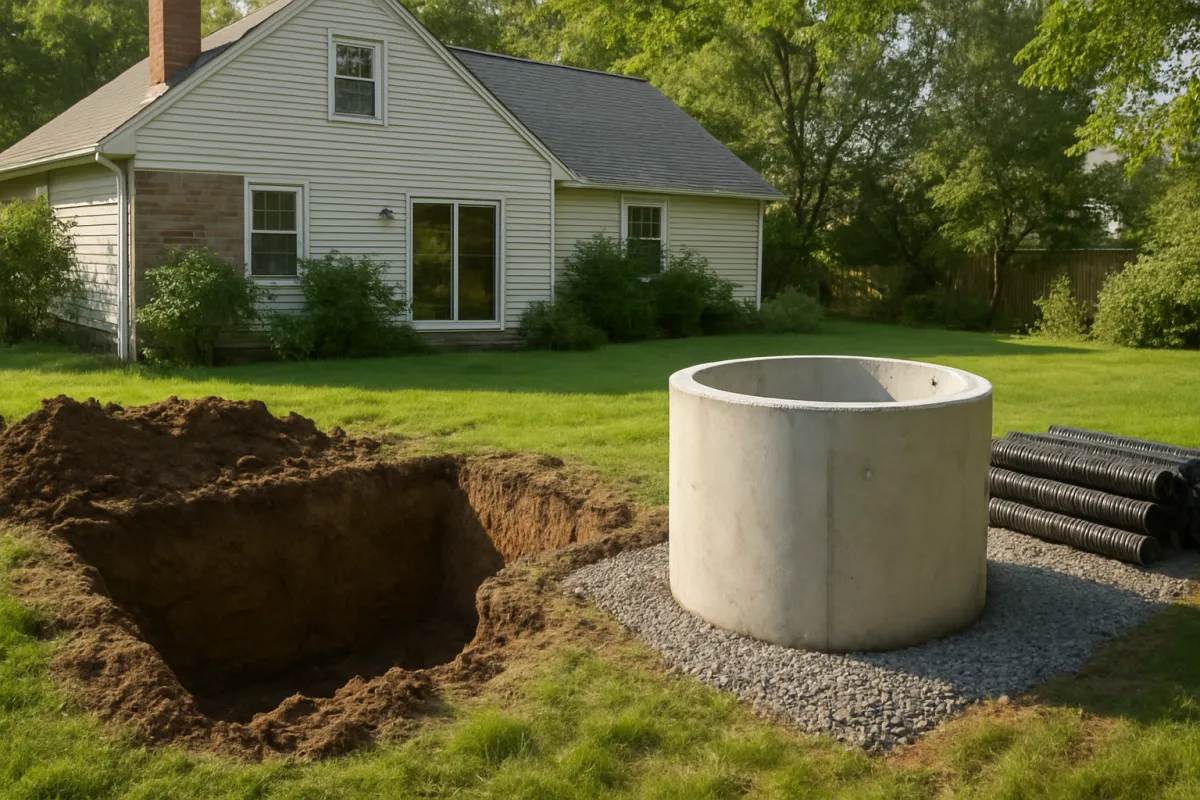
The conventional gravity system is the baseline, and it is the outcome you want the soil test to allow. Wastewater flows by gravity from the house to a tank, solids settle, and effluent flows by gravity again out to a distribution box and then into a set of trenches filled with gravel or chamber units, laid level in native soil. There are no pumps, no electricity, no controls, and almost nothing that can break.
Illustratively, a conventional gravity system for a typical three bedroom house commonly lands somewhere around $8,000 to $20,000 installed, covering excavation, the tank supplied and set, the distribution components, the trench material, the pipe, backfill and basic restoration. Where the site is open, the soil is good, the trenches are shallow, and the truck can drive to the work, you sit toward the lower half of that band. Where access is tight, spoil has to be hauled away, or the field has to run a long way from the house, you climb.
The other thing a conventional system gives you is the cheapest life afterward. No pump means no pump replacement, no control panel, no alarm float, and no electricity bill attributable to the wastewater system. Over decades that difference compounds quietly, and it is worth weighing when a site could take either a gravity design or a pressurised one.
When the site forces an engineered system
The moment the soil report says the simple version will not work, you are in a different market. Regulators do not approve a conventional trench system where treatment cannot be demonstrated, and the alternatives all add hardware, energy, or imported material. Understanding which constraint is driving your design tells you what you are actually paying for.
Slow percolation, meaning heavy clay or tight soil, is the classic problem. The soil cannot accept effluent fast enough at the trench bottom, so the design has to spread the flow over far more area, dose it in small timed batches so the soil recovers between doses, or pre-treat the effluent so a smaller area suffices. Fast percolation through coarse sand or gravel is the opposite problem and is equally disqualifying, because the water passes through too quickly for treatment to occur before it reaches groundwater.
Shallow groundwater and shallow bedrock both remove the vertical separation the design needs between the trench bottom and the water or rock below. The usual answer is to build upward, importing sand to create the missing depth, which is the origin of the mound system. Small lots create a fourth constraint that has nothing to do with soil quality: setbacks from wells, property lines, surface water, buildings and slopes can leave too little qualifying area for a full sized conventional field, which pushes the design toward something that treats effluent to a higher standard so it can use less ground.
Mound systems and why they cost what they cost
A mound system is a drainfield built above natural grade in an engineered bed of imported sand, with a pump that doses effluent up into a pressurised distribution network inside the bed. It exists to manufacture the vertical separation the site does not have naturally, and everything about its cost follows from that.
Illustratively, a mound installation commonly lands somewhere around $15,000 to $40,000, and difficult sites push past the top of that. The cost drivers are easy to see once you know what is being built: a large volume of specific sand has to be bought and hauled, sometimes many truckloads; the existing topsoil has to be prepared without compacting it; a pump tank, pump, controls and alarm have to be installed and wired; the distribution laterals are pressurised pipe with drilled orifices rather than a simple gravel trench; and the finished mound has to be capped, topsoiled and vegetated.
Mounds also carry ongoing obligations that a gravity system does not. There is a pump that will eventually fail, controls that can fault, and an alarm you should never ignore. Many jurisdictions require a service contract or periodic reporting on systems with mechanical components. Ask, before you sign, what the county requires for ongoing monitoring, because that recurring cost belongs in the comparison alongside the installation price.
Aerobic treatment units and drip distribution
An aerobic treatment unit introduces oxygen into a chamber so that aerobic bacteria break down waste far more thoroughly than the anaerobic process in a conventional tank. The result is effluent clean enough that the dispersal field can be smaller, shallower, or placed on ground that would never support a conventional system. That is the trade: you buy mechanical treatment to buy back site constraints.
Illustratively, an aerobic system commonly runs somewhere around $15,000 to $30,000 installed, and drip distribution, which spreads treated effluent through a network of small tubing with emitters just below the surface, lands in a similar band and higher on complex sites. Both are engineered designs, both require electricity, and both are typically the answer when a conventional system has been ruled out rather than a preference someone chose.
The honest part of this conversation is the ongoing cost. An aerobic unit has a blower or aerator that runs continuously or on a timer, adding to the electricity bill. It has components that wear. Many jurisdictions require a maintenance contract with a certified service provider and periodic sampling, and those requirements are conditions of the permit rather than optional extras. Before choosing between an aerobic design and a mound where both are approvable, ask each bidder to put the annual service obligation in writing, then compare the totals over ten or twenty years rather than at the point of sale.
Chamber and gravelless drainfields
Chamber systems replace the traditional gravel and pipe trench with arched plastic units that create an open void for effluent to spread through and contact the trench sidewalls and bottom. They are not exotic and they are not an upgrade in the sense of buying a better tank. They are a different way of building the same trench, and their advantages are practical.
Because there is no gravel to haul, place and screen, the truck traffic and labor drop, which matters a great deal on sites where hauling is expensive or access is poor. Many regulators allow a reduced trench area for chamber systems compared with a conventional gravel bed, which can be decisive on a lot that is short of qualifying area. The material itself typically costs more than gravel and pipe, and the net effect on your bid depends on local gravel prices, haul distance, and whatever area reduction the county allows.
Other gravelless options exist, including bundled synthetic aggregate wrapped around pipe, which serves the same purpose. The point for a homeowner comparing bids is not to have a favourite. It is to notice when two bidders have proposed different trench technologies, because the trench area, the material cost and the excavation volume all change with it, and two prices for two different designs are not comparable until you know which is which.

Tank material: concrete, plastic, and fiberglass
Tank material is the decision homeowners most enjoy researching and the one that matters least to the total. That said, the differences are real and worth knowing, because they affect installation method and long term maintenance.
Concrete is the traditional choice and remains the default in much of the country. It is heavy, which means it stays put in wet ground and resists floating, and it is durable. Its weight is also its constraint: it needs a truck with a crane or a machine that can place it, which requires access. Concrete can deteriorate over decades, particularly at the top where corrosive gases collect, and old concrete tanks with failing lids are a genuine safety issue covered later in this cost file.
Polyethylene and plastic tanks are light enough to place by hand or with a small machine, which makes them the practical option where a crane truck cannot reach. Being light, they must be installed carefully and sometimes anchored, because a light tank in saturated ground can float. Fiberglass sits between the two, light and corrosion resistant, and generally the most expensive of the three to supply.
Illustratively, the tank itself commonly represents somewhere around a sixth of a conventional installation total, which is why choosing a different material rarely moves the bid by more than a modest amount. What moves the bid is the ground, the trench area, the excavation, and whether a pump is required.
Tank size and how bedrooms decide it
Minimum tank capacity in residential work is almost always set by bedroom count rather than by how many people currently live in the house, because a house outlives its occupants and the regulator is sizing for the building. The logic is that bedrooms proxy for maximum plausible occupancy, and the code wants a system that still works when a family of five buys the house from a retired couple.
That has two practical consequences. First, adding a bedroom can trigger a septic upgrade requirement, and homeowners planning an addition are sometimes shocked to learn that the wastewater system, not the framing, is the expensive part of the project. Our renovation budgeting walkthrough covers the discipline of finding those hidden triggers before the budget is set rather than after.
Second, a bigger tank is not merely more expensive to buy. It is more expensive to pump, because pumping is priced substantially by volume removed and disposal fees, and it needs a bigger hole. On the other side, a larger tank gives solids more time to settle and lengthens the interval between pump-outs. The minimum required capacity for your bedroom count is set by your county health department or environmental authority, and it is the first thing to confirm rather than something to estimate.
Illustrative midpoint cost by septic job
Midpoints of the bands used throughout this cost file, for a typical single family house. Your figure moves with soil, access, tank size, local rates and what the county requires.
Illustrative midpoints, not quotes. Bar widths are drawn from each value against the $27,500 top of the range. The distance between the second bar and the last one is the whole argument for keeping up with maintenance.
Permits, inspections, and who actually approves the work
Septic is one of the most locally regulated things attached to a house, and that is the single most important fact to hold onto when reading anything written nationally, including this cost file. The authority is usually the county health department or a state environmental agency, sometimes a district with its own rules, and what they require differs enormously across county lines that are twenty minutes apart.
What varies is not trivia. It includes who may design a system and whether an engineer is required, who may install it and what licence they hold, which system types are approved locally at all, the minimum separation distances from wells, surface water, property lines and structures, the required tank capacity for a given bedroom count, whether an inspection is mandatory at property transfer, whether a maintenance contract is required for mechanical systems, how many inspections happen during construction, and what a permit costs.
For that reason this cost file states no permit fee, no setback distance, and no pumping interval as a universal fact, because there is no such thing. Call your county health department or environmental authority early, ask what the process is for your address, and ask what they charge. That call is free and it will reshape your budget more than any comparison shopping. Our permit walkthrough covers the general mechanics of working with a permitting office, and the septic path usually runs parallel to the building path rather than inside it.
What a septic installation quote should contain
A septic bid that is a single number on a page cannot be compared to anything, and that is often the point. The bids you can actually evaluate break the job into its parts, and asking for that breakdown is reasonable and normal.
Look for the design and who prepared it, the permit and who is responsible for obtaining it and paying for it, the tank capacity and material, whether a pump tank and pump are included and what controls come with them, the trench technology and total trench area or linear footage, the excavation and whether spoil is being hauled off or spread on site, the decommissioning of the old tank if this is a replacement, the plumbing connection from the house, the electrical work if there is a pump, and the restoration: topsoil, seed and what happens to the driveway or the lawn the machines drove across.
Two items cause most of the disputes afterward. The first is restoration, because a bid that quietly excludes it hands you a churned up yard and a separate landscaping bill. The second is rock and unsuitable material, because hitting rock at four feet is expensive and someone has to have agreed in advance who pays for it. Get the allowance or the unit rate in writing. Our quote comparison walkthrough covers the general discipline of forcing bids onto one defined scope, which matters more here than in almost any other trade.
Where the money goes on an illustrative conventional installation
Illustrative share of a gravity system installation total, summing to 100. The tank is a minority line, which is the opposite of what most homeowners expect.
Shares are illustrative and shift with haul distance, rock, whether a pump and controls are needed, and how much of the yard the machines crossed. Add a pump tank and the excavation and labor shares grow while the design share grows too.
Routine pumping: what it costs and how often
Pumping removes the accumulated sludge from the bottom of the tank and the scum layer from the top, restoring the working volume where settling happens. It is the entire maintenance programme for a conventional system, it is cheap, and it is the thing that protects the expensive half of the system from the consequences of neglect.
Illustratively, a routine pump-out of a residential tank commonly runs somewhere around $300 to $700. What moves you inside that band is tank capacity, because both the pumping time and the disposal fee scale with volume; distance from the truck to the tank, because hose runs have practical limits and long ones cost time; access, because a tank buried under a deck, a shrub bed or a parked car is a different job; and local disposal charges, which vary with what the receiving treatment facility charges.
Frequency is where honest advice gets vague, and it should. The interval that suits your tank is a function of tank capacity against the volume of wastewater and solids your household actually produces, and intervals of roughly two to six years are commonly discussed for typical residential systems. A small tank serving six people needs service far more often than a large tank serving two. Rather than adopting a rule, ask the pumper to measure and record the sludge and scum depths on each visit. After two visits you have a real accumulation rate for your own house, which beats any general guidance. Confirm the recommended interval with your county health department, since some jurisdictions publish or require one.
What pumping does not include, and the add-ons that matter
The quoted pumping price frequently covers pumping and nothing else, so it is worth knowing what the extras are before the truck is in the driveway. Locating the tank is a real service if nobody knows where it is, and probing or using a locator takes time. Uncovering the lid is genuine labor if the tank has no riser and the lid is under a foot of soil and grass, and it is the most common surprise on the invoice.
Cleaning or replacing the effluent filter is illustratively somewhere around $150 to $400 and is well worth doing on any system that has one, because a blocked filter is a common cause of a backup that looks like a catastrophic failure and is not. Inspecting the baffles, the internal structures that stop scum from leaving with the effluent, is quick while the tank is open and expensive to arrange separately.
The best value add-on is usually fitting risers to bring the access lids up to grade, illustratively $300 to $800. It converts every future visit from an excavation into a lift-and-look, it makes inspection cheap enough that it actually happens, and it pays for itself over a few service cycles. Ask for a secured, child resistant lid rather than a loose cover, for reasons the next section makes plain.
Risers, lids, and a safety warning worth reading twice
This is the part of septic ownership that is not about money at all, and it deserves a paragraph in plain language.
Never enter a septic tank, for any reason, under any circumstances. The atmosphere inside a tank can contain hydrogen sulfide and methane and can be severely depleted of oxygen. Hydrogen sulfide at high concentration overwhelms the sense of smell almost immediately and can cause collapse within seconds, which means a person who goes in does not get a chance to change their mind. The pattern that kills multiple people in a single incident is one person collapsing and others climbing in to help them. If someone has fallen into a tank, call emergency services, do not enter, and get others away from the opening. Only trained professionals with air monitoring and supplied air equipment have any business inside a tank, and even that is specialist confined space work.
An unsecured or deteriorating tank lid is a fatal fall hazard. Old concrete lids crack and corrode, particularly at the underside where gases concentrate. Thin plastic covers, plywood, or a decorative rock placed over an opening are not lids. Children and pets are the usual victims, and a lid that has failed can look intact from above right up until weight is applied. If a lid is cracked, loose, unsecured, or of unknown condition, treat it as an emergency: barricade the area, keep everyone away from it, and get it replaced or properly fastened immediately. A riser with a bolted or otherwise secured lid, illustratively in the $300 to $800 range fitted, is the cheapest life safety purchase in this entire cost file.
Two smaller points belong here as well. Do not lean over an open tank or breathe near an open access point. And if you smell sewer gas indoors persistently, that is a plumbing venting or seal issue that needs a professional, not something to live with.
What actually kills a drainfield
Drainfields rarely die of old age in the way homeowners imagine. They die from specific mechanisms, and almost all of those mechanisms trace back to something the household did or failed to do. Knowing the list is what turns septic ownership from luck into management.
Hydraulic overload is sending more water through the system than the soil can accept. A drainfield is sized to a design flow, and running a laundry marathon every Saturday, adding occupants without adding capacity, or letting a running toilet or dripping fixture pour water through the system around the clock all push past what the soil can take. Chronically saturated soil cannot treat effluent and eventually cannot accept it either.
Solids carryover is what happens when the tank is never pumped. The sludge layer grows until there is no quiet volume left for settling, and solids start leaving with the effluent. Those solids reach the trench, plug the interface between gravel and soil, and build a layer that water cannot pass. This is the mechanism that makes routine pumping worth so much: the tank is a cheap, serviceable filter protecting an expensive, unserviceable one.
Grease and non-degradables do a related job faster. Cooking fats congeal, wet wipes and hygiene products do not break down, and both contribute to blockage in the tank, the outlet, and eventually the field. Roots from trees and shrubs planted too close find the moisture and nutrients in a drainfield and grow directly into the pipe and gravel. Compaction and crushing come from driving or parking over the field, storing heavy equipment on it, letting livestock stand on it, or building a patio, shed or driveway over it, all of which crush pipe and compress the soil structure the system relies on.
Surface water is the quiet one. Downspouts, sump pump discharge, a driveway that sheds toward the field, or a poorly graded yard can keep the drainfield soil saturated from above while the system tries to push effluent into it from below. Redirecting that water is often free and is among the most effective things a homeowner can do.
Warning signs your system is failing
Septic failure announces itself, but the early signals are subtle enough to be rationalised away, and by the time the obvious ones appear the expensive outcome is often already decided. Learn the sequence.
Early signs include drains across the house running slowly at the same time, which distinguishes a system problem from a single blocked fixture; gurgling in drains or toilets; and a toilet that needs to be flushed twice when it never used to. Any of these can also be an ordinary plumbing blockage, and our plumbing rate breakdown covers what that costs to diagnose, but when they arrive together across multiple fixtures the system deserves attention first.
Middle stage signs move outdoors. Grass over the drainfield that is noticeably greener, lusher or growing faster than the rest of the lawn means effluent is reaching the surface layer. Soggy ground or standing water over the tank or field, especially when it has not rained, is effluent surfacing. Odour outdoors near the tank or field is a serious signal rather than a normal feature of owning a septic system, because a functioning system should not smell.
Late signs are unmistakable and expensive: sewage backing up into the lowest drains in the house, effluent surfacing and pooling, or an alarm sounding on a system with a pump. Treat the alarm as urgent. It usually means the pump has failed or the tank is filling faster than it can be emptied, and continuing to use water normally while it sounds turns a component repair into a mess. Call the service provider the same day and reduce water use until they arrive.

Component repairs and what they cost
Not every septic problem is a five figure problem, and the most useful thing a homeowner can do on first noticing trouble is to resist the assumption that the field has failed. A meaningful share of septic call-outs end in a repair costing hundreds rather than thousands, and a competent diagnostic visit is what separates the two.
Illustratively, common component work runs roughly like this: an effluent filter cleaned or replaced near $150 to $400; a tank lid replaced near $150 to $600 depending on size and material; risers fitted near $300 to $800; a baffle or tee repaired or replaced near $300 to $900; a blocked line jetted or rodded near $300 to $900; a float switch or control panel component replaced near $300 to $900; an effluent or lift pump replaced near $800 to $2,500 including the labor to pull and reset it; and the line from the house to the tank replaced near $1,500 to $5,000 depending on length, depth and what is on top of it.
The diagnostic sequence that avoids overspending is to rule out the cheap causes first: a blocked effluent filter, a failed pump, a collapsed or blocked line, a stuck float, or a crushed pipe under a new driveway. All of those produce symptoms that look like drainfield failure to a worried homeowner. Only when flow reaches the field and the field will not accept it are you in replacement territory.
Drainfield replacement: the expensive outcome
When the soil interface has sealed, there is no repair. That is the hardest fact in this cost file. Once the biomat has clogged the trench interface to the point that effluent will not pass, no additive, treatment, or product reliably restores it, and the honest answer is a new dispersal area. Be sceptical of anything sold as a chemical or biological cure for a failed field, and ask for the mechanism rather than the testimonial.
Illustratively, drainfield replacement commonly runs somewhere around $8,000 to $25,000 for a conventional replacement, and considerably more where current rules force an engineered design onto the site. Notice something uncomfortable: that band overlaps and can exceed the cost of a whole new installation. The reasons are practical. The old field is in the way and may have to be abandoned in place or removed. The remaining qualifying area on the lot is restricted by setbacks and by where the old system sits. The house is occupied, so the work has to be sequenced around a functioning household. Landscaping, and sometimes driveway, has to be restored. And the design, testing and permitting are repeated in full, because a replacement is generally approved under today’s rules rather than the rules that applied when the original went in.
That last point catches many homeowners. A system installed decades ago under a permissive standard does not get grandfathered into its replacement. If the current rules for your soil and lot require a mound or an aerobic system, that is what you will be replacing a simple gravel trench field with, and the price gap between those two things is the entire story of why septic bills shock people.
Repair or replace: how the decision is actually made
The repair versus replace decision has a structure, and it is not primarily financial. It runs through four questions in order.
First, what is actually failing? A pump, a filter, a line, a baffle or a lid is a repair. A tank that is structurally sound but has a broken component is a repair. A tank that is cracked, collapsing, or corroded through is a replacement of the tank, illustratively $4,000 to $10,000 installed where the field can be kept and reused. A field that will no longer accept effluent is a replacement of the field.
Second, will the regulator allow the repair? This is the question homeowners forget. Some jurisdictions treat certain work as a repair that can be done under a simple permit, and other work as a replacement that triggers a full new design under current standards. Where you sit on that line can change the cost by an order of magnitude, and only the county can tell you where the line is for your situation.
Third, is the system the right size for the house as it is now? If bedrooms have been added, or the household has grown well past what the design flow assumed, replacing like for like buys you a repeat of the same failure. Fourth, what is the remaining life of everything you are keeping? Reusing a forty year old tank to save money on a new field is a decision to do the disruptive part twice. Ask each bidder to state, in writing, what they are reusing and what condition they found it in.
The maintenance economics: why pumping is the best money in the yard
This is the section worth doing arithmetic on, because the arithmetic is unusually one sided.
Take an illustrative household pumping a tank every three years at a midpoint of $480 a visit. That is $160 a year. Over twenty five years, roughly $4,000 in total, plus perhaps a few hundred more for filter cleaning along the way. Against that, an illustrative conventional drainfield replacement sits near $16,500 at the midpoint of its band, and an engineered replacement can be double that.
So twenty five years of diligent pumping costs roughly a quarter of one drainfield replacement. Put differently, if keeping the tank pumped extends the field’s life by even a handful of years, it has paid for itself several times over, and if it prevents a premature failure it has returned something like four to one. There are very few maintenance items attached to a house with that shape. Gutter cleaning, filter changes and sprinkler winterising all protect real money, but the ratio here is exceptional because the protected asset is both expensive and unrepairable.
The reason it works is mechanical rather than magical. Pumping restores the settling volume that keeps solids inside the tank, and solids inside the tank are solids that never reach the soil interface. You are not maintaining the tank for the tank’s sake. You are maintaining the tank to protect the field, which is the part you cannot fix. Run your own version of that comparison in the job cost estimator with your tank size and household in mind.
Buying a house with a septic system
A failed septic system discovered after closing is among the most expensive surprises in home buying, and the mechanism that produces it is always the same: the buyer relied on a general home inspection that did not include the septic system, and nobody opened the tank.
A general home inspection typically does not include a septic evaluation, and where it mentions the system at all it may be a visual note that the lawn looks dry. That is not an inspection. A septic inspection, illustratively $300 to $700, should include locating the tank and the drainfield, opening the tank and measuring sludge and scum depths, examining the baffles and the inlet and outlet, checking the effluent filter, running water through the system to observe flow and confirm nothing surfaces, probing or otherwise assessing the drainfield, and testing any pump, float and alarm.
Ask for three documents alongside the inspection: the original permit and as-built drawing if the county holds one, which tells you where everything is and what was approved; the pumping and service history; and any record of repairs. A seller who cannot produce a service history is telling you something. Ask the county what it requires at transfer, because some jurisdictions mandate an inspection or a certification before a sale can close, and knowing that early avoids a scramble.
Finally, know what you are exposed to before you waive anything. The gap between a $500 inspection and a $25,000 replacement is the largest inspection-to-risk ratio in a typical house purchase. Our contractor vetting walkthrough covers how to check that whoever performs the inspection holds the licence the county recognises for that work, which is not always the same credential as a general home inspector.
A worked example: replacing a failed system on a three bedroom house
Numbers are easier to hold when they sit in a story, so here is an illustrative one. Treat every figure as illustration.
A three bedroom house on a half acre lot has a forty year old system. The lawn over the field has been soggy for two seasons, the toilets are slow, and a pumper reports that the tank empties and refills within a day, which points to effluent backing up from a field that will not accept it. The county confirms that a replacement requires a new design under current rules.
The costs stack like this. Site evaluation, soil pits and perc testing come to $1,200. Design and permit come to $900. The soil test comes back marginal but workable, so a pressure dosed conventional field is approved rather than a mound, and the installation of tank, pump tank, pump, controls and field comes to $14,000. Decommissioning the old tank, pumping and either removing or crushing and filling it to the county’s requirement, comes to $1,200. Restoration of lawn and the section of driveway the machines crossed comes to $1,500. The illustrative total is $18,800.
Now run the counterfactual. Had that household pumped every three years at $480, twenty five years of maintenance would have cost about $4,000. There is no guarantee it would have prevented this failure, since forty year old fields fail for many reasons, and claiming otherwise would be dishonest. But solids carryover from an unpumped tank is one of the most common contributors, and $4,000 of prevention against an $18,800 event is a bet worth taking every time. Build your own version of this stack in the job cost estimator.

How to compare septic bids without guessing
Septic bids are harder to compare than almost any other trade because the bidders may be proposing genuinely different systems. Before you look at a single price, establish what each one is actually building.
Start by getting the approved design first where you can. If the county has approved a specific design for your lot, every bidder is pricing the same thing and the comparison becomes almost easy. Where the design is part of what you are buying, ask each bidder to state the system type, the tank capacity and material, the trench technology, and the total trench area or linear footage. Two bids with different trench areas are not two prices for one job.
Then read the exclusions, which is where septic bids hide their differences. The recurring ones are rock or unsuitable soil, spoil removal, driveway or lawn restoration, the plumbing connection at the house, the electrical connection for a pump, decommissioning the old system, and the permit fee itself. A bid that excludes four of those against a bid that includes all seven is the cheaper number and the more expensive project.
Ask three closing questions of every bidder. Who is responsible for obtaining the permit and passing inspection, and what happens if it fails? What is warranted, for how long, and does the warranty cover the field or only the workmanship on the components? And what is the schedule, particularly whether the household will be without a functioning system at any point and for how long? Verify licence and insurance with the issuing bodies directly rather than taking a certificate at face value, exactly as our contractor vetting walkthrough sets out.
Everyday habits that extend system life
Most of what protects a septic system costs nothing, and the habits are dull enough that people abandon them. Here is the list worth taping inside a cupboard door.
Only human waste and toilet paper go down the toilet. Wet wipes, including anything labelled flushable, hygiene products, cotton buds, dental floss, cat litter and paper towel all fail to break down and accumulate. Keep fats, oils and grease out of the drain. They congeal, they float, and they contribute directly to the scum layer and to blockage.
Spread water use out. Doing six loads of laundry on a Saturday sends a hydraulic slug through a system designed for a steadier flow, and spacing them across the week costs nothing. Fix running toilets and dripping fixtures promptly, because a toilet that runs continuously can pour a remarkable volume through the system without anyone noticing.
Keep everything off the drainfield. No parking, no driving, no trailers, no sheds, no patios, no raised beds, no above ground pools. Keep trees and large shrubs well away from the tank and field, and prefer grass over the field itself. Redirect surface water away from the field: downspouts, sump discharge and driveway runoff should all go somewhere else.
Be sceptical of additives sold as tank treatments. The honest position is that a healthy tank develops its own bacterial population from ordinary use, and no additive substitutes for pumping. Avoid pouring harsh chemicals, solvents, paint or large volumes of bleach down the drain, since the biology in the tank is doing real work. Finally, know where your tank and field are and keep the paperwork, because the next owner, the next pumper and the next inspector all need it, and locating a lost tank is a billable hour every single time.
Where septic sits among the other big house numbers
It helps to place septic in context, because homeowners tend to treat it as a category apart when it is really one more major system with a maintenance curve and a replacement cost. A roof, a heating system, a foundation and a septic system all share the same structure: a long life, a maintenance regime that extends it, and a replacement number large enough to reshape a budget.
What makes septic distinctive is the unrepairable half. A roof can be patched, a furnace can be repaired repeatedly, and even structural problems have graduated interventions, as our foundation repair cost file sets out. A clogged soil interface has no equivalent middle path. That asymmetry is exactly why the maintenance ratio is so favourable and why deferring pumping is a genuinely poor trade rather than merely a delayed one.
The second distinctive feature is that failure is a health and environmental matter rather than only a property one. Surfacing effluent is a public health issue, which is why the regulator is a health authority and why enforcement exists. A failed system can generate a compliance order with a deadline, and it can become a condition on a property transfer. That is another reason to treat early warning signs as urgent, along with the water damage risk that our mold remediation cost file covers when wastewater reaches the inside of a house.
The bottom line
Septic system cost is unanswerable as one number and entirely answerable once you know three things: what the soil test says, what the county requires, and which of the four jobs you are actually buying. Illustratively, routine pumping sits near $300 to $700, component repairs near a few hundred to a few thousand, a conventional installation near $8,000 to $20,000, a drainfield replacement near $8,000 to $25,000, and an engineered system near $15,000 to $40,000. The gap between the cheapest item on that list and the dearest is almost entirely a story about ground conditions and about maintenance.
The habits that protect you are simple and unglamorous. Test the soil before you believe any price. Call the county before you call three contractors, because they set the rules that set the design. Get bids broken into lines and read the exclusions rather than the totals. Pump on an interval derived from measured sludge depth rather than from a rule you read somewhere. Keep water, roots, grease and vehicles away from the field. Never, ever open or enter a tank, and fix an unsecured lid the day you notice it. Every figure in this cost file is illustration and will move with your soil, your lot, your access and your county, so let the written bids on an approved design for your own address be the numbers you act on.
ProsNook publishes this cost file to explain how septic work is evaluated, designed, permitted, serviced and priced, and it is educational material rather than engineering, environmental, health, plumbing or regulatory advice. Nothing here diagnoses any tank, drainfield or symptom, and no figure on this page is a quote: every dollar band, midpoint, share and worked total is illustration only, and your real cost will move with soil and groundwater conditions, the system type your regulator approves, tank capacity, trench area, excavation depth, rock, access, restoration and local labor and disposal rates. Septic rules are set locally, usually by a county health department or state environmental authority, and permit requirements, approved system types, minimum tank capacities, separation distances, transfer inspection rules, service obligations and recommended pumping intervals differ sharply across jurisdictions, so that office is the only authority on what applies at your address. On safety, treat a septic tank as a confined space that can kill: never enter one, never lean into an open access point, keep children and pets away from any opening, and secure or replace a cracked, loose or unknown lid immediately. Engage licensed professionals for design, installation, pumping and inspection, verify their credentials with the issuing bodies, and obtain several detailed written bids against one approved design before authorising work.
Frequently asked questions
How much does a new septic system cost?
There is no single number, because the soil decides the system and the system decides the price. As an illustrative framework, a conventional gravity system on ground that percolates well commonly lands somewhere around $8,000 to $20,000 installed, while a mound, aerobic treatment or drip system forced by poor soil, a high water table or shallow bedrock commonly runs around $15,000 to $40,000 and can pass that on difficult sites. The tank itself is a minority of the total in every one of those cases. The only figure that matters for your property is the one on written bids drawn against an approved design for your specific lot.
How much does it cost to pump a septic tank?
Routine pumping is one of the cheapest recurring services attached to a house. Illustratively, a standard pump-out of a residential tank commonly runs somewhere around $300 to $700, with larger tanks, long hose runs, difficult access or a tank that has to be dug up to reach pushing toward the upper end and beyond. Cleaning or replacing the effluent filter is often a small add-on of roughly $150 to $400 if the system has one. Ask what is included before the truck arrives, because a quoted price sometimes covers pumping only and not locating, uncovering or inspecting anything.
How often should a septic tank be pumped?
Pumping frequency is driven by tank size against how much wastewater and solids the household actually produces, so a small tank serving a large family needs pumping far more often than a large tank serving two people. Intervals of roughly two to six years are commonly discussed for typical residential systems, but the interval that applies to your tank is the one your county health department or environmental authority recommends and the one your pumper suggests after seeing the sludge and scum depths. The honest test is measurement rather than a calendar rule. Ask the pumper to record the sludge depth each visit so the interval can be tuned to your actual house.
How much does it cost to replace a septic drain field?
Drainfield replacement is the expensive outcome in this category, illustratively somewhere around $8,000 to $25,000 for a conventional replacement and considerably more where current rules force an engineered system onto the site. It can even exceed the cost of a brand new installation on raw land, because the old system is in the way, the usable area left on the lot is restricted, an occupied house has to keep functioning, and landscaping and driveway have to be restored afterward. The design work and permitting are repeated in full. This is the number that makes routine pumping look like the bargain it is.
What does a septic inspection cost when buying a house?
A septic inspection at purchase illustratively runs somewhere around $300 to $700 depending on how thorough it is and whether the tank has to be uncovered and pumped as part of it. That is a small fraction of what a failed system discovered after closing can cost, which is why declining the inspection to save a few hundred dollars is among the poorest trades in home buying. Ask for an inspection that includes locating the tank and field, opening the tank, measuring sludge and scum, running water to observe flow, and probing the drainfield. Confirm what the county requires at transfer, because some jurisdictions mandate an inspection or a certification before a sale can close.
What is a perc test and why does it matter so much?
A percolation test, along with soil pits or borings, measures how quickly water moves through the soil on the specific area of your lot where a drainfield would go. That result, plus depth to groundwater and to bedrock, determines which system designs the regulator will approve, which in turn sets the price far more than any product choice you make. Ground that drains well can take a simple gravity trench system. Ground that drains poorly, or that has water or rock close to the surface, forces a design that treats or disperses effluent differently and costs multiples more. Illustratively, the evaluation and testing commonly runs somewhere around $500 to $2,000.
What actually causes a drainfield to fail?
Drainfields usually fail from causes the household controls rather than from age alone. The common mechanisms are hydraulic overload, meaning more water sent through than the soil can accept; solids carrying over from a tank that was never pumped and clogging the soil interface; grease and non-degradable items forming layers that water cannot pass; tree and shrub roots invading the pipe and gravel; and compaction or crushed pipe from vehicles, livestock or structures over the field. Chronic saturation from surface drainage aimed at the field does the same thing. Fixing habits is far cheaper than fixing soil, and once the soil interface is sealed it does not generally recover.
Is it ever safe to open or enter a septic tank?
Never enter a septic tank under any circumstances. The gases inside, including hydrogen sulfide and methane, can be immediately lethal and can incapacitate a person before they can climb out, and the oxygen level can be too low to sustain life. Entry attempts to rescue someone who has collapsed inside are a documented way that multiple people die in the same incident. Beyond the gas, an unsecured, cracked or deteriorating tank lid is a fatal fall hazard, particularly for children, so a lid that is broken or not properly fastened should be secured immediately and treated as an emergency rather than a maintenance item. Leave anything involving the inside of a tank to licensed professionals with the right equipment.