What's on this page
- What a private well actually costs
- Why per foot pricing is the whole problem
- What sets the depth, and why the driller cannot tell you
- Why a neighbour’s well is your best available estimate
- Mobilisation and site setup
- The drilling line, and what per foot includes
- Casing: the second largest line most people ignore
- Well screen and gravel pack in loose formations
- Grouting, the surface seal, and why they exist
- The pitless adapter and the wellhead
- The pump, the drop pipe, and the wiring
- The pressure tank and the control box
- The electrical run from the house
- The water line from the well to the house
- Dry holes, and how contracts handle the risk
- What belongs in a well drilling contract
- Yield testing and what a low flow rate means
- Water quality testing is a step, not an option
- What a standard test panel covers
- Treatment equipment as a follow on cost
- Permits, licensed drillers, and who approves the work
- A worked example: a 300 foot well on a rural lot
- How to compare well drilling bids
- The ongoing costs of owning a well
- Well abandonment, the cost nobody plans for
- Buying a house that already has a well
- Where a well sits among the other rural house numbers
- Common mistakes with a first well
- Questions to ask before you sign
- The bottom line
Short answer: A private well is priced per foot, with the footage unknown until drilling ends. Illustratively, drilling alone commonly runs $15 to $40 per foot and casing adds $10 to $30 per foot over the cased interval, and a complete system with pump, tank, electrical and house line commonly lands near $9,000 to $35,000, with drilling usually under half. The contract's caps and dry hole terms matter more than the rate.
Well drilling cost is unusual among home expenses because the contract you sign does not contain the price. It contains a rate. You are buying an unknown quantity of feet at a known cost per foot, and the quantity is decided by geology that nobody has seen, in a hole that does not exist yet. A homeowner who signs a per foot agreement without a cap, without a dry hole clause and without knowing what the rate includes has agreed to an open ended number, and that structural fact matters more than whether the rate itself is $22 or $31.
This cost file works through a private well the way it actually gets built and billed: the mobilisation charge before anything turns, the drilling line, the casing that is often the second largest item on the page, the seals and the screen, then the pump, tank, electrical work and the buried line that turn a hole into a water supply. ProsNook already covers the other half of a rural property in the septic system cost file, and the two jobs usually arrive together. Put your own depth and distance into the job cost estimator and the numbers below will have a shape you can hold onto.
Key takeaways
- A well is priced per foot but the footage is unknown until drilling ends, so the contract structure, meaning caps, dry hole terms and what the rate includes, matters more than the headline rate.
- Illustratively, drilling alone commonly runs $15 to $40 per foot and casing adds $10 to $30 per foot over the cased interval, which makes casing the second largest line on many jobs.
- A complete system including pump, tank, electrical and the line to the house commonly lands near $9,000 to $35,000 illustratively, and the drilling is usually under half of it.
- Quantity and quality are separate questions. A strong flow rate says nothing about what is dissolved in the water, so a laboratory panel is a required step rather than an optional extra.
- Ownership has a tail: periodic testing, a pump replacement on a decade-ish horizon at an illustrative $2,000 to $5,000, and an eventual regulated abandonment at an illustrative $500 to $3,000.
What a private well actually costs
The honest answer is a range with a wide mouth, because a well is four purchases stacked together and only one of them is priced per foot. There is the drilling and completion of the borehole, the pump and the pressure equipment that lift and deliver the water, the electrical and trenching work that connects everything to the house, and the testing and treatment that make the water usable.
As an illustrative framework for this cost file, treat these as the shape of the market: mobilisation and site setup near $300 to $1,500, drilling near $15 to $40 per foot, casing supplied and installed near $10 to $30 per foot of cased interval, a well screen with gravel pack where the formation needs one near $400 to $2,500, grouting, the surface seal and a sanitary cap near $400 to $1,800, well development and a yield test near $300 to $1,200, a submersible pump with drop pipe and wire near $1,200 to $4,500, a pressure tank installed near $400 to $1,800, a pitless adapter near $150 to $600, the electrical run and control box near $500 to $2,500, the buried water line to the house near $10 to $30 per foot, and a laboratory test panel near $100 to $600.
Stack a typical set of those together and a complete residential well commonly lands somewhere around $9,000 to $35,000, illustratively. None of those figures is a quote. They exist so that when a driller says a number out loud, you can tell which line it belongs to and what it silently excludes.
Why per foot pricing is the whole problem
Almost every other trade quotes you a job. A roofer measures the roof, a painter measures the walls, a concrete crew measures the pad. The quantity is visible before anyone is paid, so the number on the page is a number. Drilling is the exception, and it is worth sitting with why.
Nobody can see how deep the water is. A driller can read the public logs of surrounding wells, look at the surface geology, know the district from experience and form a very good expectation, but the expectation is not the hole. Rock is heterogeneous. A fracture system that produces well at 220 feet on one parcel may be absent 400 feet away. The formation may dip. A driller who commits to a fixed price on unknown footage is either padding heavily to cover the downside or is going to lose money on some jobs, and either way you are paying for the uncertainty in a form you cannot inspect.
So the industry prices the input instead of the output, and the consequence lands on the homeowner. Your exposure is rate multiplied by an unknown. That is not a scandal, it is a structure, but it is a structure you should engage with deliberately rather than discover afterwards. The tools for engaging with it are a cap, a dry hole clause, and a written definition of what the rate covers.
What sets the depth, and why the driller cannot tell you
Depth is a geological outcome. The drill has to pass through whatever sits above the target and then far enough into a formation that yields water at a usable rate, with enough water column above the pump for the pump to stay submerged during drawdown. Each of those requirements can move independently.
In consolidated bedrock, water usually lives in fractures rather than in the rock itself, so the hole continues until it intersects enough productive fracturing. That is why bedrock wells vary so dramatically: two neighbours can hit at very different depths because fractures are not evenly distributed. In unconsolidated ground, meaning sand and gravel formations, water lives in the pore space between grains, and the question becomes which layer is both productive and clean enough to use, and how deep that layer sits.
Overlying conditions add their own footage. Thick soil or clay above the bedrock has to be drilled through and cased. Shallow zones may be productive but too vulnerable to surface contamination to be worth using, so a driller may seal past them deliberately and continue deeper. A regulator may require a minimum casing depth or a minimum separation from known contamination, which sets a floor on the hole regardless of where water first appears.
Why a neighbour’s well is your best available estimate
Since nobody can survey water from the surface with certainty, the most useful information available before drilling is the record of what happened nearby. Many state and county authorities maintain well logs filed by licensed drillers, recording depth, casing length, the formations passed through and the yield measured at completion. Those records are frequently public, and they are the single most valuable thing you can look at before you budget.
The practical move is to ask three things. Ask the drilling contractors what depths they are hitting in your immediate area right now, because they know the district better than any database. Ask your neighbours what their wells cost and how deep they went, and how long ago, since techniques and prices move. Ask the county health department or environmental authority whether well logs for your area are available to the public and how to access them.
Treat the result as a range rather than a target. If nearby wells cluster between 180 and 320 feet, budget the top of the cluster and be pleased if you land short. Budgeting the bottom of the cluster is how a project that was affordable in the planning stage becomes a problem at the halfway mark, when the hole is open and stopping is not an option.
Mobilisation and site setup
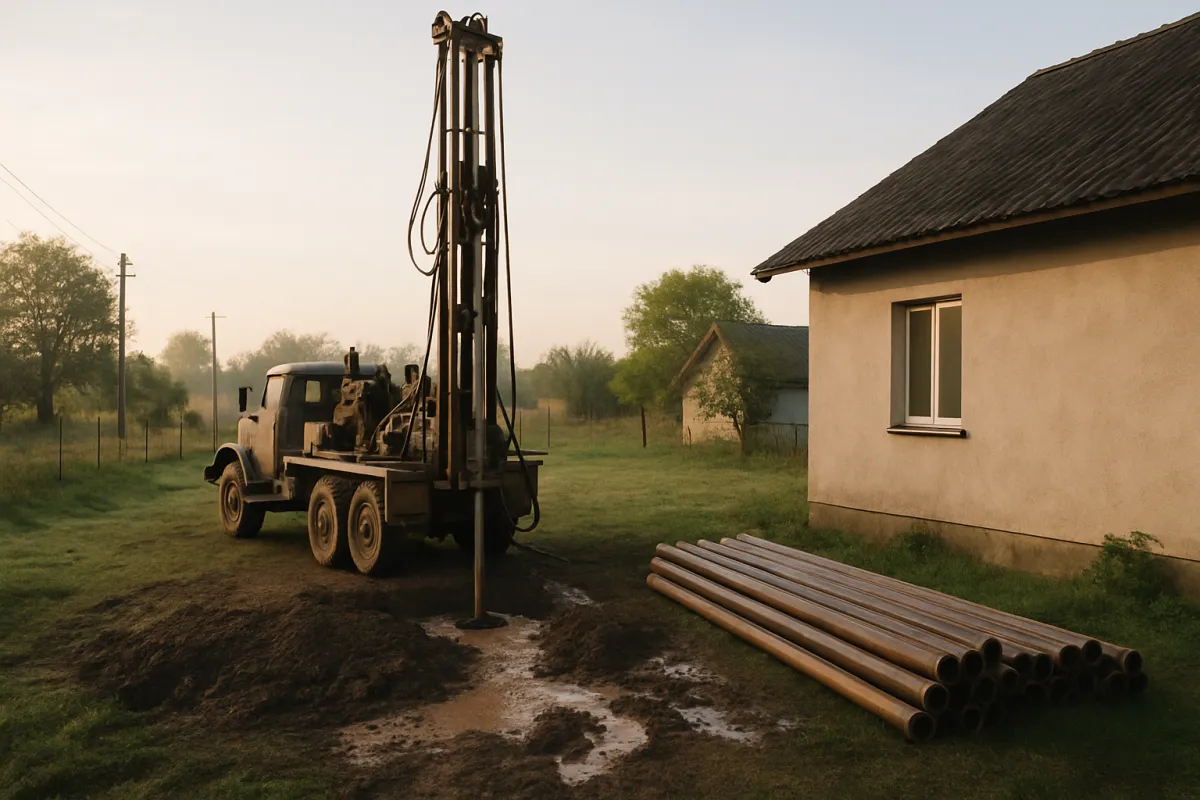
The first line on a drilling invoice usually has nothing to do with depth. Mobilisation covers getting a heavy rig, a support truck and a crew to your property, positioning them, and setting up. Illustratively it commonly runs somewhere around $300 to $1,500, and it grows with distance from the contractor’s yard and with how awkward your site is.
Access is the variable that surprises people. A drilling rig is heavy, tall and not agile. It needs a route in that will carry the weight, a working area with overhead clearance for the mast, and ground that will not swallow it. Soft ground after rain, a narrow gate, a steep drive, low branches, overhead power lines or a chosen well location behind the house rather than in front of it all cost money before a single foot is drilled.
Two practical consequences follow. First, walk the access route with each bidder rather than describing it, because a rig operator will spot problems you will not. Second, if the well location is being chosen partly for access and partly for regulatory setbacks, get both constraints on the table at the same time. Moving a well location after the permit is issued is not free, and choosing a spot the rig cannot reach is a change order waiting to happen.
The drilling line, and what per foot includes
The drilling line is footage multiplied by rate, and the rate is where bids diverge invisibly. Illustratively, drilling alone commonly runs somewhere around $15 to $40 per foot for residential work. What moves it is hole diameter, the hardness and stability of the formation, the rig and method used, how far the crew travels, and how competitive your local market is.
The critical question is what the rate bundles. Some contractors quote a drilling rate and then a separate casing rate. Others quote a single combined per foot figure that covers drilling and casing together. A $26 combined rate and a $26 drilling only rate are wildly different propositions, and a homeowner comparing two numbers on two pages will not see it unless they ask.
Ask each bidder to state, in writing, whether the rate includes casing, whether it includes grouting, whether it includes the well cap, whether development and a yield test are inside it, and whether there is any change in rate if unusual conditions are encountered such as caving ground requiring extra casing, or artesian pressure requiring control measures. Our contractor estimate walkthrough covers the general habit of reading a bid by its exclusions rather than its total, and drilling bids reward that habit more than most.
Casing: the second largest line most people ignore
Casing is the pipe that lines the borehole. It holds the hole open through loose or unstable ground, seals off shallow zones that could contaminate the well, and provides the structural path from the wellhead down to the producing formation. It is sold by the foot in its own right, and on many jobs it is the second largest line on the invoice after drilling.
Illustratively, casing supplied and installed commonly runs somewhere around $10 to $30 per foot over the cased interval, moving with diameter, wall thickness and material. Steel and thermoplastic casing are both used, with the choice driven by the formation, the depth, local practice and the regulator’s requirements rather than by preference.
The important subtlety is that the cased interval is often much shorter than the total depth. In a bedrock well, casing typically runs from the surface through the overburden and some distance into competent rock, and the rest of the hole below that may be open bedrock. In a sand and gravel formation the entire hole is usually cased and screened. That is why two wells of identical depth can carry very different casing bills, and why a bid that quotes casing footage as an allowance rather than a rate is telling you less than it appears to.
Well screen and gravel pack in loose formations
Where the producing formation is unconsolidated, meaning sand and gravel rather than rock, the well needs a screen: a section of slotted or wire wrapped pipe at the producing interval that lets water in while keeping sediment out. Around it, a graded gravel pack is often placed in the annulus to stabilise the formation and improve the filtering.
Illustratively, a screen with its gravel pack commonly adds somewhere around $400 to $2,500, driven by the length of the screened interval, the slot size and material required by the grain distribution of the formation, and the volume of pack material. In hard bedrock wells the line frequently does not appear at all, which is another reason two bids on two different assumed geologies are not directly comparable.
Screen selection is genuinely technical work rather than a catalogue choice. Slot size is matched to the formation so that fine material passes through during development and coarser material bridges outside the screen. Get it wrong and the well either produces sand, which destroys pumps and clogs plumbing, or produces less water than the formation could give. This is one of several places where hiring a licensed driller with local formation experience buys something that does not appear as a line item.
Grouting, the surface seal, and why they exist
Grouting fills the annular space between the casing and the borehole wall with an approved sealing material, typically over a specified interval from the surface down. It exists for one reason: an ungrouted annulus is a direct pipe from the surface into an aquifer, and surface water carrying whatever is on your land travels down it beautifully.
Illustratively, grouting, the surface seal and a sanitary well cap together commonly run somewhere around $400 to $1,800. Requirements are set by the regulator, and grout depth, material and method are among the most consistently specified items in well codes because the public health consequence of getting them wrong is large and long lasting.
The surface completion matters too. The casing normally terminates above grade rather than at or below it, with a vermin proof sanitary cap, and the ground is graded to shed water away from the wellhead. A wellhead sitting in a depression that ponds after rain is a contamination pathway even with everything else built correctly. When you inspect the finished job, look at the ground slope around the casing and at the cap, and ask for the grout depth to be recorded on the well log.
The pitless adapter and the wellhead
The pitless adapter is a small fitting with an outsized job. It makes a watertight connection through the wall of the casing below the frost line, so the buried water line can leave the well without any opening above ground and without a pit around the wellhead. It also lets the pump and drop pipe be pulled straight up out of the casing for service.
Illustratively, a pitless adapter commonly runs somewhere around $150 to $600 supplied and installed. It is a trivial share of the project and one of the most consequential pieces of hardware in it, because the alternative approaches are worse: an above ground connection freezes, and an old style well pit is a confined space and a contamination risk that modern codes generally do not permit for new work.
When you are reviewing a bid, check that the adapter is named. A bid that lists a pump and a water line but no pitless adapter has either bundled it silently or omitted it, and you want to know which. The same applies to the well cap, the wire, and the torque arrestor or safety rope arrangement that keeps the pump from spinning or dropping.
The pump, the drop pipe, and the wiring
Once the hole is finished, you own a hole. Turning it into water service means a pump, and for most residential wells that is a submersible pump set down inside the casing, hanging on drop pipe with a wire run alongside it. Illustratively, the pump with drop pipe and wire commonly runs somewhere around $1,200 to $4,500 installed.
Depth drives this line directly. A deeper setting means more drop pipe, more wire, a heavier column to handle, and a pump that has to lift against a taller head. That is why the pump cost is not independent of the drilling cost: a hole that comes in 150 feet deeper than expected raises two lines on the invoice, not one. In this cost file’s illustrative arithmetic, a useful rule of thumb is that the pump package cost grows by roughly a few dollars a foot on top of a base cost.
Sizing is the part homeowners cannot judge and should not try to. The pump is matched to the well’s measured yield, the setting depth, the pressure required at the house, and the household demand. Oversizing a pump relative to what the formation can deliver is a common and expensive error: the pump draws the water level down to its intake, cycles hard, and fails early. A well that has been yield tested properly gives the pump installer the number they need.
The pressure tank and the control box
Inside the house, or in a well house, sits the pressure tank and the controls. The tank holds a volume of water under air pressure so that small draws are served from storage rather than by starting the pump, which is what stops the pump from switching on and off every time somebody washes their hands. Illustratively, a pressure tank installed commonly runs somewhere around $400 to $1,800 depending on capacity and fittings.
Tank size is a real decision rather than a default. A larger tank gives a longer draw down between pump starts, which reduces cycling and is generally kind to pump life, at the cost of more money and more floor space. Undersizing to save a couple of hundred dollars on a system that has a pump many hundreds of feet down is a poor trade.
Alongside the tank sit the pressure switch, the gauge, the check valve arrangement and, for many pumps, a control box that contains the starting components. Constant pressure systems using variable speed drives are also available and cost more, delivering steadier pressure across varying demand. Whichever is used, ask for the make and the warranty terms in writing and confirm who services it locally, since the nearest competent service provider matters more on a well than on a city connection.
The electrical run from the house
A well needs power, and power has to get there. The electrical line runs from the house panel out to the wellhead, usually in the same trench as the water line, with a disconnect, appropriate conductors and a connection at the wellhead or control box. Illustratively, the electrical run and control box commonly run somewhere around $500 to $2,500.
Cost is driven by distance, by conductor sizing (which grows with distance and pump load to control voltage drop), by whether a new circuit and breaker are needed at the panel, and by local electrical code requirements for burial depth, conduit and disconnects. On a long run to a well placed far from the house, this line is not small.
There is also a resilience question worth asking early. When the power goes out on a well system, the water stops, which is not true of a house on a municipal supply. Households that lose power often may want a generator inlet and a manual transfer arrangement sized to run the pump, which is a separate project with its own cost. Our whole house generator cost file covers that side, and it is worth reading before the trench is backfilled rather than afterwards.
The water line from the well to the house
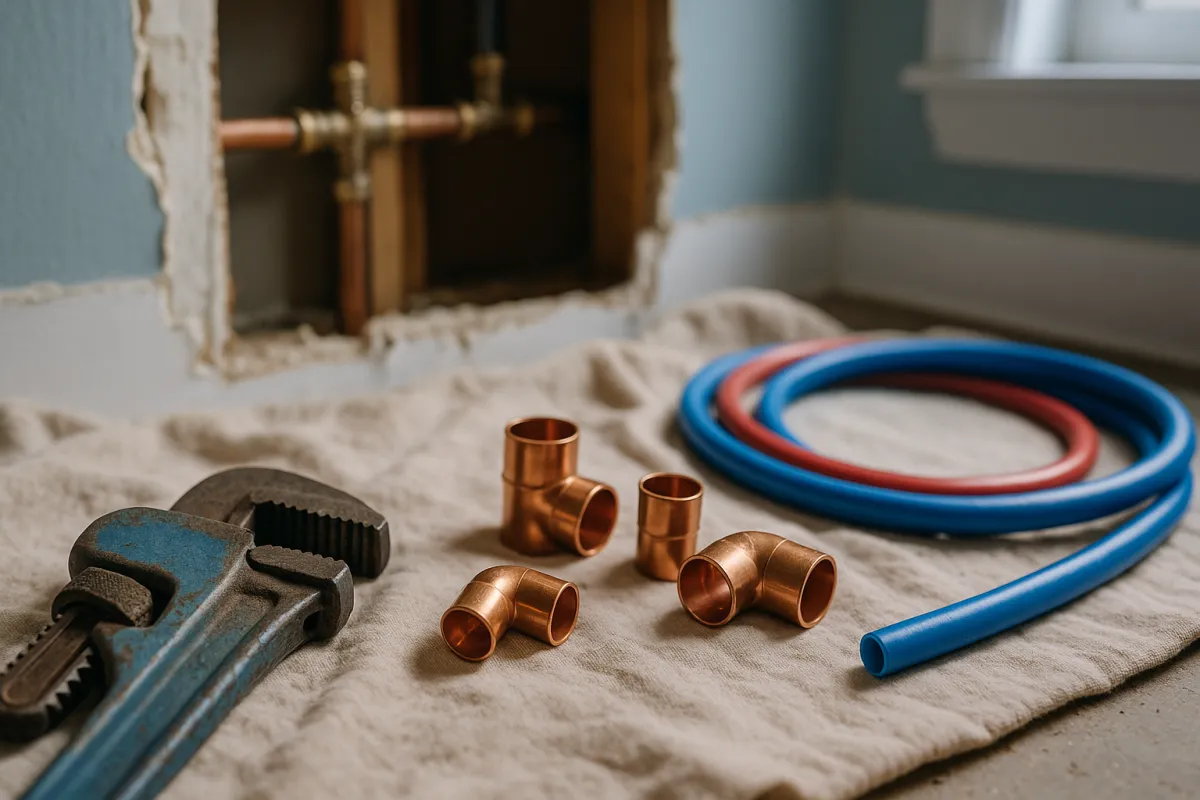
The buried line carrying water from the pitless adapter to the house is priced by the foot of trench, and it is the line that most often gets forgotten in a homeowner’s mental budget. Illustratively, trenching and the water line commonly run somewhere around $10 to $30 per foot, moving with depth of burial, ground conditions, and what is on the surface.
Depth is set by the local frost line, since the line has to sit below it. Ground conditions decide whether a trencher walks through it in an afternoon or whether rock breaking is needed. Surface conditions decide the restoration bill: a trench across an open field is cheap, a trench across a paved driveway, a mature lawn or a planted area is not, because the machine crosses it and something has to be put back.
The practical lever is well placement. A well sited 80 feet from the house rather than 300 feet saves both trench lines, water and electrical, which can be several thousand dollars illustratively. But placement is constrained by geology, by access for the rig, and by regulatory setbacks from septic components, property lines, surface water and structures. Site the well with all of those on the table at once, and ask the county what setbacks apply before you fall in love with a location.
Illustrative line items on a 300 foot well
The worked example used later in this cost file, broken into its parts. Your figures move with depth, rock, casing length, distance to the house and local rates.
Illustrative figures, not quotes. Bar widths are drawn from each value against the $8,400 drilling line. Notice that the four lines beneath drilling are all about getting water from the hole into the house, and they add up to more than the hole itself.
Dry holes, and how contracts handle the risk
A dry hole is a completed borehole that does not yield enough water to serve the house. It is not common on well characterised ground, and it is not rare enough to ignore. Because drilling is sold by the foot, the uncomfortable truth is that a dry hole has already consumed real cost by the time everyone knows it is dry.
What happens next is a contract question with no industry standard answer. Some agreements bill the full footage at the normal rate regardless of yield, on the reasoning that the work was performed as instructed. Some apply a reduced dry hole rate. Some cap total exposure at a stated dollar figure or a stated depth beyond which drilling stops unless you authorise more. Some include one relocation attempt at a discount, and some are silent, which in practice means the first reading is the driller’s.
The homeowner’s job is not to demand that a contractor absorb geological risk, which nobody can do sustainably at a fair price. It is to know which version you are signing. Ask three questions before signing: what depth are you drilling to before you stop and call me, what do I owe if that hole is dry, and what does a second attempt cost. Get the answers in the agreement. Our contractor vetting walkthrough covers the broader habit of checking licence, insurance and history, which matters here because a driller with a long local record has drilled your formation many times.
What belongs in a well drilling contract
A drilling agreement that fits on half a page is not a favour to you. The version you can actually rely on names the rate and what it includes, the anticipated depth range and the basis for it, the stop and consult depth, the dry hole terms, the casing rate and expected interval, the grouting specification, and who obtains and pays for the permit.
It should also address the boundary between trades. State explicitly whether the pump, drop pipe, wire, pitless adapter, pressure tank, control box, electrical run and buried water line are inside this contract or outside it, and if outside, who is doing them. A large share of well project disputes are not about price at all, they are about a gap between two scopes that both parties assumed the other covered.
Two more items earn their space. First, restoration: what happens to the ruts, the spoil, the drilling fluid pit and the lawn the rig crossed. Second, documentation: the well log, the grout record, the yield test result and the water test results should all be handed over, because they are the permanent record of the asset and the next owner of the house will want them.
Yield testing and what a low flow rate means
When drilling finishes, the well is developed, meaning fine material is removed from the formation around the intake so that water can move freely, and then it is tested. A yield or flow test measures how much water the well can produce sustainably, typically expressed in gallons per minute along with how far the water level draws down while pumping and how quickly it recovers.
Illustratively, development and a yield test commonly run somewhere around $300 to $1,200 and are sometimes bundled into the drilling rate. Do not let them be skipped. The result is what the pump installer sizes against, it is what tells you whether the well can meet household demand, and it is what a future buyer’s inspection will look for.
A low flow rate does not necessarily disqualify a well, and this is worth understanding before panic sets in. Household demand is peaky rather than constant: the difficulty is meeting a morning of showers and laundry, not the daily total. A modest yield can serve a house well if storage is added, either through a larger pressure tank or through a storage tank with a booster pump, so that the well refills slowly between peaks. That is an added cost and an added system to maintain, and it should be priced before you commit to the well rather than discovered when the shower runs cold.
Water quality testing is a step, not an option
Quantity and quality are entirely separate questions, and confusing them is the most common mistake homeowners make with a new well. A well can produce a beautiful flow rate of water you should not drink. Water can be clear, cold and odourless and still carry things you cannot see, taste or smell. The only way to know what is in it is a laboratory panel.
Private wells are generally outside the testing regime that applies to public water systems, which means nobody is checking on your behalf. The responsibility, the cost and the decision about what to test for all sit with the owner. Budget for it as a project line, illustratively somewhere around $100 to $600 for a residential panel depending on how many parameters are included and which laboratory runs it.
This cost file does not interpret results and cannot. What a given number means, whether it exceeds a health based limit, and what should be done about it are questions for the certified laboratory that ran the test and for your county health department or environmental authority. They know the local conditions, the parameters that matter in your area, and the standards that apply. Take the report to them rather than to a search engine, and be cautious about accepting an interpretation from a company whose business is selling treatment equipment.
What a standard test panel covers
Understanding the categories helps you ask sensible questions without pretending to expertise. A typical residential panel is built from a few groups of parameters, and which groups apply to you is a local question.
Microbiological testing looks for indicators of contamination by organisms, most commonly coliform bacteria as a general indicator and E. coli as an indicator of faecal contamination. This is the category most commonly recommended on an annual basis and after any disturbance to the well.
Chemical and inorganic parameters cover things like nitrate and nitrite, which are often tested where agriculture or septic systems are nearby, along with metals and minerals that occur naturally in some formations. Aesthetic and operational parameters, including hardness, iron, manganese, pH, total dissolved solids and sulphur compounds, are the ones that produce staining, scale, taste and smell complaints; they drive treatment decisions more often than health decisions. Location specific parameters are added because of local geology or land use history, and this is precisely where your health department’s advice is irreplaceable, since a panel that is right in one county can miss the parameter that matters most in the next one.
Treatment equipment as a follow on cost
Test results frequently lead to equipment, and this is a cost that arrives after the well is paid for, which is why so many households are unprepared for it. Treatment is chosen to address specific findings, so nothing about it can be decided in advance of a panel.
Illustratively, common outcomes look like this: a sediment filter alone is a modest few hundred dollars; a water softener addressing hardness commonly runs somewhere around $1,000 to $3,000 installed; whole house filtration for iron, manganese, taste or odour commonly runs somewhere around $1,500 to $4,000; and treatment aimed at a specific health related parameter, which may involve specialised media, oxidation, or point of use reverse osmosis, commonly runs somewhere around $2,000 to $6,000 and higher for complex cases. Every one of those systems has consumables and servicing behind it.
Two cautions are worth stating plainly. First, do not buy equipment before you have a laboratory result, because equipment sold on a free in home test is being sold, not prescribed. Second, take the recommendation from a source with no equipment to sell, ideally the laboratory or the health authority, before you take it from a vendor. The plumbing side of installing it is ordinary work, and our plumber rate file covers what that labor typically costs by the hour.
Permits, licensed drillers, and who approves the work
Well construction is one of the most locally regulated things attached to a property, which is why this cost file states no permit fee, no setback distance and no testing requirement as a universal fact. There is no national rule. The authority is usually a county health department, a state environmental or natural resources agency, or a water management district, and what they require varies sharply across boundaries that are a short drive apart.
What varies is substantial. It includes whether a permit is required before drilling and what it costs, who may legally drill a well and what licence or registration they hold, minimum separation distances from septic components, property lines, surface water, fuel storage and buildings, minimum casing depth and grouting specification, whether the well log must be filed and with whom, whether a water quality test is mandatory at completion, whether inspections occur during construction, and what must happen at property transfer.
The correct first phone call is to your county health department or environmental authority, before you call three drillers. Ask what the process is for your address, what it costs, who is permitted to do it and what documentation you will receive. That call is free and it will reshape your budget more than any comparison shopping. Our permit walkthrough covers the general mechanics of dealing with a permitting office, and well permitting usually runs on its own track alongside the building path rather than inside it.
A worked example: a 300 foot well on a rural lot
Numbers become useful when they are stacked. Here is a fully illustrative example for a bedrock well on a rural parcel, using the midpoints from this cost file. Every figure is illustration rather than a quote.
The house needs a well, and nearby well logs suggest depths clustering between 240 and 340 feet. The chosen location sits 120 feet from the house. The driller quotes $28 per foot for drilling and $22 per foot for casing, and the hole finishes at 300 feet with 60 feet of casing set through the overburden and into competent rock.
Mobilisation and setup comes to $800. Drilling 300 feet at $28 is $8,400. Casing 60 feet at $22 is $1,320. Grouting, the surface seal and the sanitary cap together are $950. Development and a yield test are $600. The submersible pump with drop pipe and wire is $2,600, reflecting the setting depth. The pitless adapter is $350. The pressure tank installed inside is $900. The electrical run and control box are $1,200. Trenching and the water line, 120 feet at $18, are $2,160. The laboratory test panel is $250.
That totals roughly $19,500 illustratively, of which drilling is about 43 percent and everything downstream of the hole is the majority. Widen it for the uncertainty that a per foot job carries and a sensible planning band for this project is something like $15,600 to $25,400. If treatment is needed after the test, add it on top: this total assumes none.
Where the money goes on the illustrative $19,500 well
Shares of the worked example above, summing to 100. Drilling is the largest single line and still a minority of the project.
Shares are illustrative and shift hard with depth, casing length and how far the well sits from the house. Double the distance to the house and the trench and power slice grows while every other slice shrinks proportionally.
How to compare well drilling bids
Well bids are unusually hard to compare because they can differ in unit, in scope and in assumed depth all at once. The discipline that fixes this is the same one that works everywhere else: force every bid onto one defined scope before you look at any total.
Build a single sheet with these rows and make each bidder fill it in: mobilisation, drilling rate per foot and what it includes, assumed depth range and the basis for it, stop and consult depth, dry hole terms, casing rate and assumed interval, grout specification and depth, screen and pack if applicable, development and yield test, permit responsibility and cost, well cap, pitless adapter, pump and drop pipe and wire, pressure tank and controls, electrical run, trenching and water line with the assumed distance, water testing, and restoration.
Then read the differences rather than the totals. Two bidders assuming different depths are not disagreeing about price, they are disagreeing about geology, and the one assuming a shallower hole may simply be more optimistic rather than cheaper. A bidder who excludes the pump entirely will look like the best value and may not be. Our quote comparison walkthrough sets out the general method, and drilling is the trade where it pays off most because so much of the variance is hidden in assumptions rather than in prices.

The ongoing costs of owning a well
A well is not a one time purchase, and the households that struggle with one are usually the households that budgeted it as though it were. There are three recurring costs, and none of them is optional in practice.
The first is testing. Annual bacteria and nitrate testing at an illustrative $100 to $300 a year, with a broader panel less often, is the baseline commonly recommended, and your health authority sets what applies locally. The second is treatment servicing, where equipment exists: media replacement, salt, cartridge filters and periodic servicing all carry a running cost that varies enormously with the system. The third is the pump, which is a wear item.
The pump is the one worth planning for now. A submersible pump has a working life often discussed in terms of a decade or so, with wide variation driven by water chemistry, sediment, cycling frequency, electrical supply quality and sizing. Illustratively, replacement commonly runs somewhere around $2,000 to $5,000, covering pulling the old unit, the new pump, drop pipe and wire, and reinstallation, with deeper settings costing more. On the worked example above, budgeting roughly $3,200 against a replacement in about a decade works out near $270 a year set aside, and adding annual testing puts realistic ownership near $420 a year before any treatment.
Well abandonment, the cost nobody plans for
Every well eventually ends, and ending one is a regulated procedure rather than a matter of filling a hole. An abandoned borehole that is not properly sealed is a direct conduit from the surface into an aquifer, and in some cases from one aquifer into another. Regulators treat it accordingly, and so should a homeowner.
The work typically involves removing the pump and any equipment, verifying the condition and depth of the hole, sealing it with an approved material over its full depth so no vertical pathway remains, cutting or removing the casing to a specified point, and filing a record with the authority. Who may perform it, what material is acceptable and what has to be documented are all set locally.
Illustratively, decommissioning commonly runs somewhere around $500 to $3,000, driven by depth, diameter, access and what has to be pulled out first. Two situations bring it forward. Drilling a replacement well often triggers an obligation to abandon the old one properly, so the cost belongs in the replacement budget rather than in a later year. And buying a rural property sometimes means inheriting an old, unused or unknown well on the parcel, which is worth identifying before closing rather than after, because the obligation transfers with the land.
Buying a house that already has a well
Most people meet a private well by purchasing a house that has one, not by drilling. That is a different exercise, and it is cheap relative to what it protects. Ask for the well log, which records depth, casing, formation and the yield measured at completion, and ask when the pump was last replaced.
Commission a well inspection and a water test as a purchase condition, and treat them as separate from the general home inspection, because most home inspectors do not perform a yield test or a laboratory panel. A useful inspection covers the wellhead and cap condition, the surface grading, the pressure tank and controls, a flow and drawdown observation, and a full laboratory panel appropriate to the area. Confirm with the county whether a test or an inspection is required at transfer, since some jurisdictions mandate one.
Two questions matter as much as the equipment. Is the well shared with a neighbouring property, and if so, what written agreement governs maintenance, repair costs and access? And is there an old well anywhere on the parcel that has not been formally abandoned? Both are ordinary situations, and both are much better resolved before closing than discovered afterwards.
Where a well sits among the other rural house numbers
A private well tends to arrive as part of a cluster of rural property costs rather than alone, and the honest way to plan is to see the whole cluster at once. On a raw parcel, a well and a septic system are usually both required before a house can be occupied, and neither is optional or deferrable.
That pairing is the single most useful budgeting insight in this cost file. Illustratively, the well lands somewhere around $9,000 to $35,000 and the septic system, as our septic system cost file sets out, commonly lands somewhere around $8,000 to $40,000 depending on soil. Two site systems, both driven by ground conditions nobody can see from the surface, both requiring regulatory approval, and both capable of doubling if the site is unkind. Budget them together and test the ground for both before committing to a parcel.
Once the house is running, the well changes the economics of everything downstream of it too. Hard or mineral rich water shortens the life of fixtures, appliances and water heaters, which is a slow cost rather than a dramatic one but a real one; our water heater repair file covers the symptoms that mineral content tends to produce. And unlike a municipal supply, the well stops when the power stops, which is why generator planning shows up on rural properties far more often than in town.
Common mistakes with a first well
A handful of errors account for most of the regret, and every one of them is avoidable at the planning stage rather than at the rig.
Signing a per foot agreement with no stop and consult depth is the biggest. It means the decision to keep drilling is being made by someone who is paid by the foot, without a scheduled conversation with the person paying. Comparing bids that quote different units is a close second, particularly a combined drilling and casing rate against a drilling only rate. Budgeting the shallow end of the neighbourhood depth range is third, and it converts an ordinary project into a crisis at the moment when stopping is impossible.
Two more are worth naming. Skipping the water test because the water looks fine treats a visual impression as a laboratory result, and the categories that matter most are the ones you cannot see. And buying treatment equipment on the recommendation of the company selling it, before any independent panel exists, is how households end up with expensive systems addressing the wrong parameter. Our contractor vetting walkthrough covers the general habit of checking who is telling you something and what they earn from it, which applies to well work as much as anywhere.
Questions to ask before you sign
The questions below are the short version of everything above, and they take one phone call each. Ask them of every bidder and write the answers down.
What depths are you currently hitting in my immediate area, and what is your expected range for my parcel? What is your rate, and does it include casing, grouting and the cap? At what depth do you stop and call me before continuing? What do I owe if the hole is dry, and what does a relocation cost? Who pulls the permit and what does it cost?
Then the scope questions. Are the pump, tank, pitless adapter, electrical run and water line inside this contract or outside it, and if outside, who is doing them and when? What yield test will you perform and will I get the result in writing? Will you file the well log and give me a copy? What restoration is included? And finally, are you licensed for well construction in this state, and can I have the licence number and proof of insurance? Sketch the resulting numbers into the job cost estimator so you can see how the answers move your own total.
The bottom line
Well drilling cost cannot be answered as a single number, and anyone who gives you one before the hole is finished is quoting a hope. What can be answered is the structure. You are buying an unknown quantity at a known rate, and the three things that protect you are a stop and consult depth, a written dry hole clause, and a clear statement of what the rate includes and where the drilling scope ends.
Illustratively, drilling runs near $15 to $40 per foot, casing near $10 to $30 per foot of cased interval, and a complete system with pump, tank, electrical work and the line to the house near $9,000 to $35,000, of which the drilling is usually under half. After that come the recurring items: periodic testing, treatment servicing if the panel calls for it, a pump replacement on a decade-ish horizon near $2,000 to $5,000, and eventual abandonment near $500 to $3,000.
The habits that matter are unglamorous. Read the nearby well logs and budget the top of the range. Call the county before you call the drillers. Force every bid onto one sheet with the same assumed depth. Never treat a good flow rate as evidence of good water, and take the laboratory result to the laboratory and the health department rather than to a salesperson. Every figure in this cost file is illustration and will move with your geology, your distance to the house, your local rates and your county’s rules, so let the written agreements on your own address be the numbers you act on.
ProsNook publishes this cost file to explain how a private water well is priced, contracted, constructed, tested and maintained, and it is educational material rather than hydrogeological, engineering, health, water quality, plumbing or regulatory advice. No figure here is a quote: every dollar band, per foot rate, midpoint, share and worked total is illustration only, and your real cost will move with depth, formation hardness, casing length, hole diameter, distance from the house, access for the rig, restoration and local labor and material rates. Nothing on this page interprets a water test result or diagnoses a supply: what a laboratory number means and what should be done about it are matters for the certified laboratory that ran the panel and for your county health department or environmental authority, and any treatment recommendation is worth taking from a source with no equipment to sell. Well rules are set locally, so permit requirements, licensing of drillers, separation distances, casing and grouting specifications, well log filing, mandatory testing and abandonment procedures all differ by jurisdiction and only that office can tell you what applies at your address. Engage licensed well contractors, verify their credentials with the issuing body, and obtain several detailed written agreements against one defined scope before authorising work.
Frequently asked questions
How much does it cost to drill a well?
There is no single figure, because a well is sold by the foot and nobody knows the footage until the hole is finished. As an illustrative framework, a complete private water well including drilling, casing, the pump, the pressure tank, the electrical work and the line to the house commonly lands somewhere around $9,000 to $35,000, with simple shallow sites falling below that and deep or difficult ground running past it. The drilling itself is usually the largest single line but rarely more than about half of the finished total. Treat any number you read nationally as a shape rather than a price, and let written bids on your own address decide.
How much does well drilling cost per foot?
Illustratively, the drilling operation alone commonly runs somewhere around $15 to $40 per foot, and casing supplied and installed commonly adds somewhere around $10 to $30 per foot over the cased interval. Some drillers quote a single combined rate that bundles the two, which is why an apparently high per foot number can be the cheaper deal once you know what it includes. Rates move with rock hardness, hole diameter, rig type, haul distance and local competition. Ask each bidder in writing whether their rate covers drilling only or drilling plus casing, because comparing a bundled rate against an unbundled one is the most common mistake homeowners make here.
What happens if the driller hits a dry hole?
A dry hole, meaning a completed borehole that does not produce a usable quantity of water, is a real and normal risk of drilling, and the contract decides who carries it. Some agreements bill the full footage drilled regardless of yield, some bill a reduced dry hole rate, some cap the total exposure, and some include one relocation attempt at a discount. None of these is standard, so the only way to know your exposure is to read the clause before signing. Ask the driller directly what happens if the first hole comes up short, and get the answer written into the agreement rather than described on the phone.
How deep does a well have to be?
Depth is set by geology rather than by preference, so it is decided by where a productive water bearing formation sits under your specific parcel and how much unsaturated ground has to be passed through to reach it. Two houses on the same road can need very different depths if the formation dips or if a fracture system runs one way and not the other. The best available estimate before drilling is the record of nearby wells, which many state or county authorities keep as public well logs. That record tells you the likely range, and it is the correct basis for a budget, but it is not a promise about your hole.
Does the well drilling price include the pump?
Often it does not, and this is where two bids stop being comparable. The drilling contract may cover mobilisation, the borehole, casing, grouting and a cap, while the pump, the drop pipe, the wiring, the pitless adapter, the pressure tank, the control box, the electrical run and the buried line to the house are a separate scope, sometimes performed by a different trade. Illustratively, that second half commonly adds somewhere around $4,000 to $10,000 on a typical residential installation. Ask each bidder to mark every one of those items as included or excluded, because a cheaper drilling number attached to an excluded pump is not a cheaper project.
How often should private well water be tested?
Private wells are generally not covered by the testing that applies to public water systems, so the responsibility sits with the owner. Annual testing for bacteria and nitrate is a commonly recommended baseline, with a broader panel run less often and additional parameters added where local conditions or the well log suggest them. Retest promptly after any flooding, after work on the well or pump, if a neighbouring well shows a problem, or if the taste, smell or appearance of the water changes. Your county health department or environmental authority is the right source for what to test for at your address, and the certified laboratory that runs the panel is the right source for interpreting the numbers it returns.
How long does a well pump last and what does replacement cost?
A submersible pump is a wear item with a working life commonly discussed in terms of a decade or so, though real service life varies widely with water chemistry, sediment, cycling frequency, electrical supply quality and how well the pump was sized for the well in the first place. Illustratively, replacing one commonly runs somewhere around $2,000 to $5,000 including pulling the old unit, the new pump, drop pipe and wire, and reinstalling. Deeper wells cost more because there is more pipe and wire and a heavier pull. Budget for this as a scheduled ownership cost rather than an emergency, because it becomes an emergency the moment the taps run dry.
What does it cost to abandon or decommission an old well?
Abandonment is a regulated procedure rather than a matter of filling a hole with dirt, because an open or improperly sealed borehole is a direct pathway from the surface into groundwater. The work typically involves removing equipment, verifying the hole, sealing it with an approved material over its full depth and filing a record with the authority. Illustratively, it commonly runs somewhere around $500 to $3,000 depending on depth, diameter, access and what has to be pulled out first. Requirements are set locally, so the county health department or state environmental agency is the only authority on what is acceptable, who may perform it and what has to be documented.