What's on this page
- Start with whether removal is necessary at all
- Asbestos removal cost by material and quantity
- Testing is the only way to know what you have
- What sampling costs and why it must be done carefully
- Asbestos pipe insulation removal cost
- Vinyl floor tile and the black mastic under it
- Popcorn and textured ceilings
- Siding and roofing
- Vermiculite attic insulation removal cost
- Illustrative prices by material and job
- Why abatement costs what it does
- Containment, negative air and the work zone
- Regulated disposal is not a dumpster
- Clearance air testing and what finished means
- Where the money goes on an abatement project
- Encapsulation and enclosure as the managed alternative
- The renovation trigger and why mid project discovery is expensive
- Licensing, notification and why homeowner removal is restricted
- Friability, access and volume: the three cost drivers
- What a homeowner should never do to suspect material
- Buying or selling a house with suspected asbestos
- How to compare asbestos abatement quotes
- What an abatement contract should include
- A worked example: an older basement with pipe wrap and a boiler jacket
- What it costs to put things back
- Health questions belong with a clinician
- Red flags and pressure selling
- Keeping managed material managed
- The bottom line
Short answer: Asbestos abatement illustratively runs from a job minimum near $1,500 for a small contained run of pipe wrap to roughly $22,500 for vermiculite attic insulation in a 1,000 square foot attic, with the material type driving the spread. Intact, undisturbed material in good condition is generally safer managed in place than removed, so the first question is whether removal is needed at all, and only a laboratory test can identify asbestos.
Asbestos removal cost is a question most homeowners ask in the wrong order, and the two materials that send people looking are almost always the same pair: wrapped pipe insulation in a basement and loose grey vermiculite poured across an attic floor. The search usually starts after somebody points at one of those, or at a textured ceiling or a stack of old floor tiles, and the instinct is to find out what it costs to get rid of it. The more useful question comes first: does this material need to be removed at all? Intact, undisturbed material in good condition is generally considered safer managed in place than torn out, which is also the position of the EPA’s guidance on asbestos in the home, because removal is the activity that puts fibres into the air in the first place.
This cost file works in that order. It covers when removal is genuinely triggered, why testing has to come before any decision, what each common material costs to abate and why they price so differently, including asbestos pipe insulation removal cost and the much larger vermiculite removal cost, what you are actually buying when you pay for containment and disposal, and where encapsulation fits as the cheaper managed alternative. Because so much of this overlaps with hazardous material work generally, our mold remediation cost file is the closest sibling for how contained work is scoped and priced. Put your own material and quantity into the job cost estimator as you read.
Key takeaways
- Intact, undisturbed material in good condition is generally safer left alone and managed than removed, so the first question is whether removal is necessary rather than what it costs.
- The usual triggers for action are damage or deterioration and a renovation that will cut, sand or demolish the material, which is why testing belongs before demolition rather than during it.
- Only a laboratory can identify asbestos, and sampling itself disturbs the material, so collection belongs with a licensed inspector rather than with a homeowner.
- Illustratively, abatement runs from a job minimum near $1,500 for a small contained run of pipe wrap to roughly $22,500 for vermiculite attic insulation in a 1,000 square foot attic, with material type driving the spread more than anything else.
- Licensing, notification and disposal rules are layered federal, state and local, homeowner removal is restricted or prohibited in many places, and the only reliable source for your address is your state or local environmental authority.
Start with whether removal is necessary at all
The single most useful thing to understand about this topic is that removal is not automatically the safe choice. Asbestos containing material that is bonded, intact, in good condition and in a spot where nothing bumps or abrades it is generally treated as a managed condition rather than an emergency. Breaking it up, cutting it out and carrying it through the house is the activity that creates airborne fibres, which is exactly why abatement is done under containment by licensed workers rather than on a Saturday afternoon.
What changes that assessment is condition and disturbance. Material that is crumbling, water damaged, delaminating, hanging loose or already broken is a different situation from material that is sound. So is material in a location where it gets knocked, walked on, rubbed by a door, or blown on by a fan. And so is any material that sits in the path of a planned renovation, because demolition is disturbance by definition.
The decision itself belongs with a licensed asbestos inspector who has looked at the material in place, not with an article and not with the contractor who would perform the removal. Ask what the recommended course of action is and why, and ask what your state or local environmental authority requires, because the rules that apply at your address are the ones that matter.
Asbestos removal cost by material and quantity
Priced honestly, asbestos removal cost is a material and quantity number rather than a flat fee, and the material matters more than almost anything else. As illustrative bands, pipe and duct insulation commonly runs somewhere around $10 to $25 per linear foot, vinyl floor tile with its adhesive around $8 to $18 per square foot, textured ceiling around $6 to $15 per square foot, siding around $6 to $12 per square foot of wall, roofing around $4 to $9 per square foot of covering, and loose fill vermiculite attic insulation around $15 to $30 per square foot.
Underneath all of those is a floor. Setting up sealed containment, running filtered negative air, suiting up a licensed crew and transporting regulated waste happens whether the job is four feet of pipe wrap or forty, so most abatement contractors carry a minimum for a contained job, illustratively somewhere around $1,500 to $2,500. Very small jobs price at that minimum rather than at the per unit rate, which is why homeowners with a tiny quantity are often surprised by the quote.
Sitting outside all of these figures are testing, the finishes you put back afterwards, and any structural or system work that removal exposes. Build the number in layers rather than looking for one figure, and the estimator will turn the bands above into something you can plan around.
Testing is the only way to know what you have
There is no way to identify asbestos by looking at it. Not by colour, not by texture, not by the age of the house, not by the pattern on a floor tile, and not by a contractor’s confident opinion on site. Identification requires a laboratory analysing a physical sample. Everything a homeowner or a tradesperson can do visually is form a suspicion, and the correct response to a suspicion is to stop disturbing the material and get it tested.
Age narrows the suspicion without settling it. Materials manufactured with asbestos were used widely in residential construction for decades, and older houses are more likely to contain them, but plenty of older materials contain none and some later materials do. Because the practical rule for anything unidentified is to treat it as if it does contain asbestos until a laboratory says otherwise, age is useful for deciding whether to test rather than for deciding what to do.
That practical rule is also the reason testing is cheap relative to the alternative. A few hundred dollars of sampling before a demolition is one of the best value line items in home renovation, because the failure mode it prevents is a stopped project and a contaminated house. Our renovation budget planner treats pre demolition testing as a planning line rather than an afterthought, and that is the right place for it.
What sampling costs and why it must be done carefully
The laboratory work is the inexpensive part. Analysis of a single collected sample illustratively runs somewhere around $50 to $100, which is why the cost of testing is dominated by the visit rather than by the science. A professional inspection, where a licensed inspector examines the property, collects several samples safely, and provides written findings, commonly runs somewhere around $300 to $800. A whole house survey ahead of a substantial renovation sits higher, because more suspect materials are identified and sampled.
The reason this is not a home project is the collection step. Taking a sample means cutting into the exact material you are worried about. Done properly it involves wetting the material first, cutting a small piece with minimal disturbance, sealing the sample, sealing the sampled spot afterwards, shutting down air movement in the room, and wearing protective equipment throughout. Done improperly it releases fibres into a house where none were airborne a moment earlier, which is the opposite of the outcome you wanted.
There is a regulatory dimension too. Many jurisdictions restrict who may collect samples, which laboratories may analyse them, and what documentation is required, particularly when the result will support a permit or a notification. Rather than assume, ask your state or local environmental authority and hire an inspector who is licensed for your area. Our contractor vetting walkthrough covers verifying a licence directly with the issuing body rather than from a website.
Asbestos pipe insulation removal cost
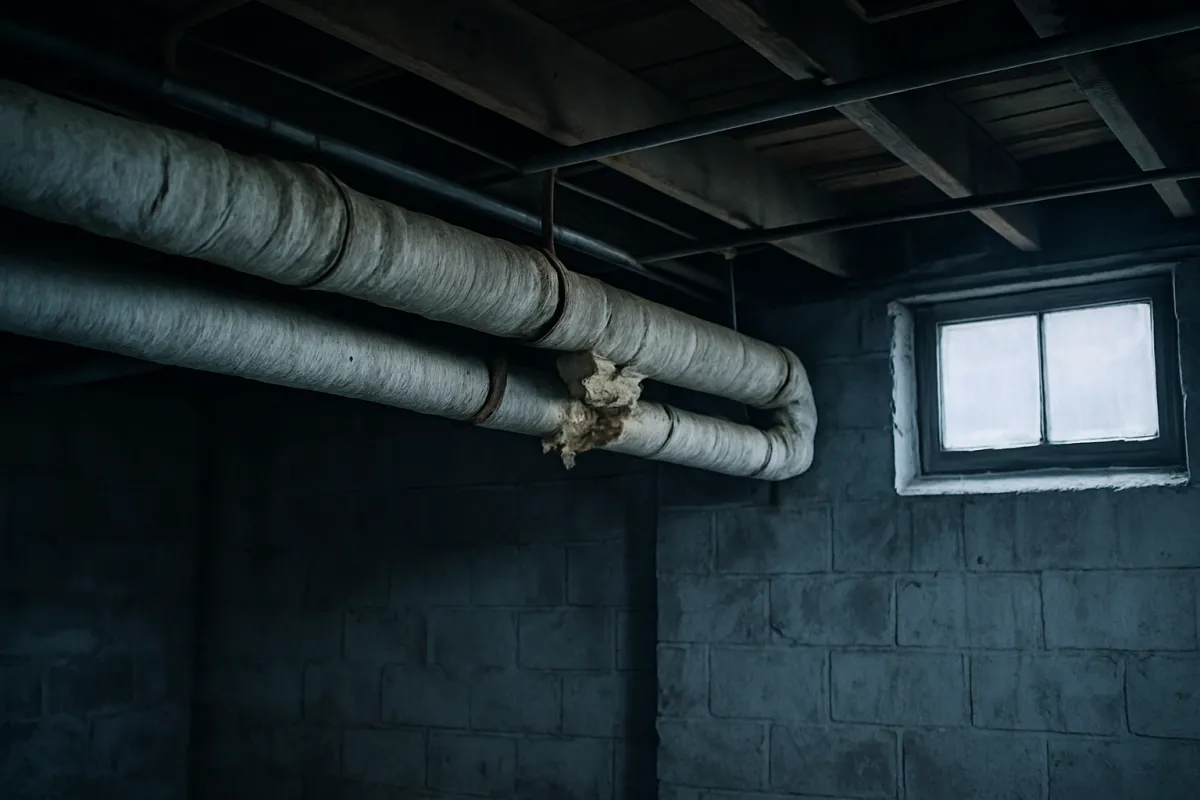
Asbestos pipe insulation removal cost is the figure most homeowners go looking for first, because this is the material that sits in plain sight in basements and utility rooms. Older heating systems commonly used a wrapped insulation on pipes and a jacket around boilers and furnaces, and the visual signature is a chalky white or grey wrapping, often with a fabric outer layer, sometimes with a plaster like coating over elbows and fittings. Where that wrapping has torn, sagged or crumbled, material can flake off, which is why condition matters so much here.
Illustratively, asbestos pipe insulation removal cost runs somewhere around $10 to $25 per linear foot, and a boiler or furnace jacket somewhere around $1,000 to $3,000 as a unit. A 50 foot run therefore prices at roughly $875 on the per foot rate, which is below the contained job minimum, so in practice it lands nearer $1,500. That mismatch is worth knowing before you get a quote, because it explains why a small run does not price proportionally.
Two features push this material up the priority list. It is often friable, meaning it can be crumbled by hand pressure when dry, so damaged wrapping releases material readily. And it is on a heating system, so it is warm, it moves, and it gets touched during service calls. Intact and undisturbed pipe wrap in a closed utility space is a different case from torn wrapping in a basement the family uses, and a licensed inspector is the one who distinguishes them.
Vinyl floor tile and the black mastic under it
Floor tile is the classic two material problem, and quotes that ignore the second half of it are not comparable. Older vinyl or asphalt floor tiles, often in a nine inch square format, can contain asbestos, and separately the dark adhesive underneath them, usually called mastic or cutback, can contain it too. It is entirely possible for the tile to test clear and the mastic not to, or the reverse, which is why both are commonly sampled.
The tile itself is a bonded material, so intact tiles sitting flat on a floor are generally the lower risk condition and are frequently managed rather than removed. What creates the problem is breaking them: prying, chipping, and above all sanding or grinding the mastic, which is the single worst thing anyone can do to this assembly. Illustratively, removal of tile and mastic together runs somewhere around $8 to $18 per square foot, which puts a 200 square foot room near $2,600 as a midpoint.
There is often a third option, which is why this material is worth a conversation rather than a reflex. In some situations intact tile can be covered with an underlayment and a new floor laid over it, leaving the original in place and recorded. Whether that is permitted and appropriate depends on condition, on the flooring system and on local rules, so it is a question for a licensed inspector rather than a flooring installer. Our luxury vinyl plank cost file covers what goes on top when a floating floor is the chosen answer.
Popcorn and textured ceilings
Sprayed and troweled ceiling textures are the material homeowners most often want gone for cosmetic reasons, which makes this the section where the message matters most. A textured ceiling that is intact, painted and not being touched is generally a managed condition. The moment somebody decides to scrape it flat for looks, that cosmetic preference becomes a hazardous material project with containment, licensed labour, regulated disposal and clearance testing attached.
Illustratively, professional abatement of a textured ceiling runs somewhere around $6 to $15 per square foot, which puts a moderate 400 square foot room near $4,200 as a midpoint. Ceiling height, fixtures, whether the room can be emptied, and how many rooms share the same texture all move that number. And because the surface removed is the finished surface, there is a refinishing bill after the abatement, which is a separate scope entirely.
The alternative most people do not consider is covering rather than scraping. Where it is permitted and the ceiling is sound, a new layer of board can be fastened over the existing texture, leaving the original in place and undisturbed. That is a carpentry job rather than an abatement job, and it prices very differently. Whether it is allowed in your situation is not a decision to make from a video, and the person to ask is a licensed inspector working with your local authority.
Siding and roofing
Exterior materials are the large area cases, and they behave differently from interior work because they are outdoors and because they are usually bonded rather than friable. Older cement based siding shingles and some roofing products were manufactured with asbestos, and in sound condition they are typically intact and hard rather than crumbly. Left alone, painted and maintained, they are commonly managed in place, and it is cutting, sanding, power washing or breaking them that creates the problem.
Illustratively, removal of siding runs somewhere around $6 to $12 per square foot of wall, which puts a whole house of roughly 1,500 square feet near $13,500 as a midpoint. Roofing removal illustratively runs somewhere around $4 to $9 per square foot of covering, putting 1,200 square feet near $7,800. Both figures cover removal and regulated disposal only, and neither includes the new siding or roof that follows, which is a full replacement project on its own.
That last point drives most of the real decisions on exteriors. Because you have to re clad or re roof afterwards anyway, the abatement is only part of a much larger number, and our siding replacement cost file and roof replacement cost file cover the other part. It is also why covering over is so often discussed on exteriors, and why a genuine assessment of condition matters more than a general preference for removal.
Vermiculite attic insulation removal cost
Vermiculite attic insulation removal cost is the largest number on this page, and the cost to remove vermiculite insulation from an attic deserves separate treatment because none of the usual assumptions transfer. It is a granular pebble like material poured into attic joist bays, sometimes silver grey, sometimes brown or gold, and it flows. That is the whole problem. It fills every bay, drifts around wiring and blocking, works its way into wall cavities through the top plate, and cannot be lifted out in one piece the way a tile or a sheet can.
Removal therefore means full attic containment, specialised vacuum equipment, a large volume of regulated waste to bag and transport, and a crew working in a confined hot space with poor footing. Illustratively, the cost of removing vermiculite from an attic runs somewhere around $15 to $30 per square foot, which puts a 1,000 square foot attic near $22,500 as a midpoint, and higher where access is through a small hatch or the roof pitch is shallow. Removing it also removes the insulation, so an insulation replacement bill follows, and our attic insulation cost file covers that second half.
Because the cost is so high and the disturbance so significant, this is the material where the leave it alone conversation is most substantive. The general posture recommended for vermiculite, set out on the EPA’s vermiculite insulation page, is not to disturb it, not to store things in the attic, not to use the attic as living space, and to seal the ceiling plane so attic air does not enter the rooms below. Whether that is the right answer for your house is a determination for a licensed inspector, and your state or local environmental authority is the source for what is required.
Illustrative prices by material and job
Set the common cases side by side and the shape of this market becomes readable. Every figure below is an illustrative midpoint for the abatement or testing work only, before the finishes that go back afterwards.
Illustrative asbestos testing and abatement midpoints
Abatement work and testing only, before new flooring, siding, roofing, ceiling finish or insulation.
Illustrative midpoints, not quotes. Bar widths are drawn from each value against the $22,500 top of this set. The pipe insulation figure reflects a contained job minimum rather than the per foot rate, because 50 feet at the illustrative rate would price below it.
Why abatement costs what it does
Homeowners frequently look at an abatement quote and see an enormous price for taking out a small amount of material, which makes sense only once you understand that you are not paying for removal. You are paying for removal performed in a way that keeps fibres out of the rest of the house and out of the crew’s lungs, and every element of that has a cost attached.
The first element is containment: sealing the work area with sheeting so that the disturbance stays inside a defined zone, often with a decontamination chamber at the entry on larger jobs. The second is negative air, running filtered machines so the work area sits at lower pressure than the surrounding rooms and air flows inward toward the filter rather than outward down the hall. The third is the crew, licensed and trained workers in fitted respirators and disposable protective clothing, which is slower and more expensive labour than general demolition.
The fourth is wet methods, keeping material damp throughout so it releases less, which slows the work down. The fifth is regulated disposal at a facility that accepts the waste, with documentation. And the sixth is clearance testing afterwards, an independent check before the containment comes down. Remove any one of those and the price drops, which is precisely why an unusually cheap quote is a scope question rather than a bargain.
Containment, negative air and the work zone
The containment line is the part homeowners most often assume is padding, and it is the part that matters most. Physical containment is built from sheeting and tape sealing off doors, windows, vents and any other opening, with the heating and cooling system shut down and its openings covered so the house is not circulating anything. On larger jobs there is an entry chamber where workers remove protective clothing before stepping back into clean space.
Negative air is the mechanical half of the same idea. A filtered machine draws air out of the contained zone, usually exhausting outside where that is practical, so the pressure inside is slightly lower than in the adjacent rooms. Any leak in the barrier then admits clean air inward rather than releasing work zone air outward. The machines run continuously through the job and often for a period afterwards, and rental time is a real line rather than a token one.
Wet methods run alongside both. Material is kept damp while it is cut, lifted or scraped, because dry work generates far more airborne material than damp work does. This slows the crew down and makes the job messier, and it is not optional. When you compare quotes, ask directly what containment, what air machines, how long, and what wetting agents each bidder has priced, because those answers explain most of the spread you will see.
Regulated disposal is not a dumpster
The disposal line is the one homeowners are most likely to imagine they can shortcut, and it is the one where doing so causes the most trouble. Asbestos containing waste is generally handled as a regulated waste stream: bagged in marked heavy duty bags, often double bagged, sealed, labelled, transported by an appropriate hauler and accepted only at a facility permitted to take it. Ordinary construction dumpsters, transfer stations and household waste collection are not that facility.
The cost consequence is that disposal scales with volume and weight rather than with the difficulty of the removal. This is a large part of why vermiculite and siding price so high: both produce a great deal of material. It is also why a tiny job can carry a disproportionate disposal charge, because minimum loads and trip fees apply regardless.
The documentation matters as much as the transport. Ask your abatement contractor what disposal documentation you will receive at the end of the job, and keep it. It is evidence of what was removed and where it went, it may be requested if you sell the house or if a dispute arises later, and its absence is a meaningful gap. Illegal dumping of this waste carries real penalties in most jurisdictions, and a quote that is cheap because disposal was priced as general debris is a quote that puts the problem back on you.
Clearance air testing and what finished means
The end of an abatement job should be a defined event rather than a feeling, and the mechanism is clearance. In practice it means an independent assessor returns after the removal and before the containment comes down, inspects the area visually for remaining debris and dust, and commonly collects air samples for laboratory analysis to confirm that the area is fit to be reoccupied. Illustratively, clearance testing runs somewhere around $300 to $800.
The important structural point is independence. When the company doing the removal is also the company confirming the removal was adequate, the incentive is not aligned, and some jurisdictions restrict that combination for exactly this reason. The cleaner arrangement is an assessor who does not perform abatement, and on any large job it is worth the fee even where it is not required.
Write the clearance requirement into the contract rather than assuming it. State that containment does not come down and reoccupation does not happen until clearance is passed, and tie final payment to that rather than to a calendar date. It is the same discipline our mold remediation cost file applies to contained work generally, and for the same reason: the work happens behind sheeting where you cannot see it, so the documented handoff is the only durable record you get.
Where the money goes on an abatement project
Break a complete abatement project into its parts and the proportions surprise most homeowners, because the actual removal is a minority of the bill. The shares below are illustrative for a mid sized interior job that includes testing, clearance and putting the surface back.
Where the money goes on a complete abatement project
Illustrative shares for a mid sized interior job including inspection, clearance and reinstatement.
Shares move with the job: an exterior siding or roofing project pushes reinstatement far higher, a small basement pipe job pushes containment and testing higher as a share, and a large volume material such as vermiculite makes disposal one of the biggest lines.
Encapsulation and enclosure as the managed alternative
Where the material is in sound condition and local rules allow it, encapsulation is a genuine option rather than a way of avoiding the problem. Encapsulation means applying a coating that penetrates or bridges the material so fibres are bound in place. Enclosure means building an airtight barrier around it, such as a boxed in chase around a pipe run or a new board layer over a ceiling. Both leave the material where it is and change the risk by preventing release.
The economics are straightforward. As an illustration, encapsulating or enclosing typically costs on the order of a third to a half of what removing the same material would, so a run of pipe insulation that would price near $1,500 to remove might price nearer $600 to encapsulate. On large area materials such as siding, the difference between covering over and full abatement plus replacement can be many thousands of dollars.
The tradeoffs are equally straightforward and should not be glossed over. The material is still there, so it has to be recorded, checked periodically and disclosed. Any future work in that area has to account for it, which means the cost was deferred rather than eliminated. Coatings can fail or be damaged. And encapsulation is not permitted for every material or every condition, particularly where the material is already deteriorating. Whether it applies to your situation is a question for a licensed inspector and your local authority, not a preference you get to choose.
The renovation trigger and why mid project discovery is expensive
Most abatement projects are not driven by a homeowner deciding to clean up their house. They are driven by a renovation that will disturb something. Opening a wall, pulling up a floor, taking down a ceiling, removing siding, replacing a boiler, running a duct: each of these is disturbance, and disturbance is the trigger. That is why the sensible order on any older house is to identify suspect materials in the planned work area before demolition is scheduled, not after it starts.
Discovering it mid project is the expensive path for four separate reasons that stack. You are paying for testing under time pressure. You are hiring an abatement contractor on short notice rather than on a planned schedule, at whatever availability exists. The trades already booked are idle or rescheduled, and rescheduling a sequence of trades is rarely free. And if material was already disturbed before anyone noticed, you may be paying for a cleanup as well as a removal.
There is also a permitting dimension. Many jurisdictions require notification before abatement begins, with a waiting period, and that pause is not something a contractor can compress. If your project needs a building permit, the abatement question often surfaces there anyway, and our building permit walkthrough covers how those approvals sequence. Testing early converts all of this from a crisis into a line item.
Licensing, notification and why homeowner removal is restricted
The regulatory picture is genuinely layered and this article will not pretend otherwise. Requirements come from federal, state and local authorities at the same time, they differ between neighbouring jurisdictions, and they change; the EPA’s asbestos laws and regulations page lists the federal layer. What is consistent across most places is the shape: abatement contractors and inspectors must be licensed or certified, notification to an authority is commonly required before work begins, disposal must go to a permitted facility, and homeowner removal is restricted or prohibited in many places.
What is not consistent is the detail. Thresholds that trigger notification, the length of any waiting period, who may collect samples, which materials are covered, whether owner occupied single family homes are treated differently, and what documentation is required all vary. Any article that states a specific threshold or notification period as universal is misleading you, and this cost file will not do that. The reliable source is your state or local environmental authority, and calling them is free.
Where homeowner removal is technically permitted, it is still a poor use of the permission. The measures that make abatement safe are not improvisable: sealed containment, filtered negative air, wet methods, fitted respiratory protection that has been tested for your face, disposable clothing, and a disposal route that will actually accept the waste. Doing a partial version of that is worse than doing nothing, because it disturbs the material without controlling what is released. Our do it yourself versus hire decision walkthrough applies here with the answer already written in.
Friability, access and volume: the three cost drivers
Beyond the material itself, three variables explain most of the price difference between two jobs on the same material. The first is friability, meaning how easily the material crumbles and releases fibres. Material that can be reduced to powder by hand pressure when dry, such as some pipe insulations and sprayed textures, requires stricter controls than bonded material such as intact floor tile or cement siding. Higher friability means more containment, more careful methods and more time.
The second is access. A basement pipe run at chest height in an empty room is a straightforward setup. The same footage running through a crawl space, above a finished ceiling, behind a boiler, in a low attic reached through a small hatch, or three storeys up requires staging, confined space work and far more labour hours for the same quantity of material. Access is also what decides how easily waste can be carried out, which feeds the disposal line.
The third is volume. Disposal is priced by what leaves the property, so a material that produces a lot of waste per square foot costs more to get rid of even where the removal itself is simple. Loose fill insulation is the extreme case, and thick multi layer assemblies are the next. When you compare two quotes, ask each bidder how they assessed friability, what access assumptions they made, and what waste volume they expect, because differing assumptions on those three points produce wildly different numbers on identical work.
What a homeowner should never do to suspect material
This section is short and it is the most important practical content in this cost file. If you suspect a material contains asbestos, do not sand it, do not scrape it, do not saw, drill or cut it, do not power wash it, do not break it up, and do not vacuum it with an ordinary household or shop vacuum, which will pass fine material straight back into the room. Do not sweep up debris dry. Do not dispose of pieces in household waste or a general dumpster.
Also avoid the softer versions of the same mistake. Do not pull up old tile to see what is underneath. Do not tear a corner of pipe wrap to look inside. Do not run a fan in the room to clear a dusty smell. Do not store or move boxes in a vermiculite attic. Do not let a general contractor start demolition in an area with unidentified suspect material because they say it is probably fine, since probably is not an identification.
What you can do is limit access to the area, avoid disturbing the material, stop any activity that is currently disturbing it, and contact a licensed asbestos inspector. If material has already been broken and you are worried about what happened, that is a conversation for a licensed professional and, for any question about health or symptoms, for a clinician. This article prices building work and does not assess exposure, illness or medical risk, and no contractor is qualified to do that either.
Buying or selling a house with suspected asbestos
Transactions are where this topic turns into money quickly, because a suspected material can affect negotiation even when nothing needs to be done. A standard home inspection is not an asbestos survey, and most general inspectors will note a suspect material and recommend evaluation rather than identify it, because identification requires laboratory analysis they are not performing. If you want to know before closing, that is a separate specialist inspection with its own fee.
The negotiation dynamic tends to be lopsided. A buyer who learns that a house has suspect pipe wrap often asks for the cost of full removal even where the material is intact and the recommended course of action is to leave it managed. A seller who has a written inspector assessment describing condition and recommended action is in a much better position than one who has only a suspicion, because the conversation moves from an imagined worst case to a documented one.
Disclosure requirements vary by jurisdiction and can be significant, so ask a qualified local professional what applies where you are transacting rather than assuming. Keep every document: inspection reports, laboratory results, abatement scopes, clearance results and disposal paperwork. On this topic the paperwork is the asset, and our estimate reading walkthrough covers how to keep abatement scopes legible enough to hand to a future buyer.
How to compare asbestos abatement quotes
Abatement quotes are unusually hard to compare because the same short description can cover very different scopes, and because most homeowners have no reference point. The fix is to stop comparing totals and start comparing definitions. Ask every bidder for the material and quantity they are pricing, in linear feet or square feet, the boundary of the removal in plain terms, and whether reinstatement of the surface is included, excluded or handled by someone else.
Then ask for the line items. A useful abatement quote separates mobilisation and containment setup, equipment and its rental duration, the removal labour itself, waste bagging, transport and facility fees, notification and permit costs, clearance testing, and reinstatement. A single lump sum is not automatically dishonest, but it is unmeasurable, and it removes your ability to see which bidder priced containment properly. Our bid comparison walkthrough covers forcing several bids onto one written scope.
Then ask the credential questions, and verify the answers with the issuing body rather than accepting a certificate photograph. Ask what licence or certification the company and the individual workers hold, who files the notification, what disposal documentation you receive, and who performs the clearance. A bidder who is meaningfully cheaper than the others is usually leaving out one of those, and the cheapest way to find out which is to ask each of them the same six questions in writing.
What an abatement contract should include
Because the work happens inside sealed containment where you cannot watch it, the contract is the durable record of what you bought. It should state the material, location and quantity to be removed, room by room, with the boundary described. It should state the containment and equipment to be used and for how long, since running an air machine for four days rather than two is a real cost that can be quietly shortened.
It should name who files any required notification, what waiting period applies, and what happens to the schedule if the authority responds slowly. It should state the disposal facility type and confirm what documentation you receive at completion. It should define completion explicitly: not the day the crew leaves, but the moment an independent clearance is passed and reoccupation is authorised, with final payment tied to that.
It should also cover the practical items that cause disputes: who moves and protects contents, whether utilities such as heat or water will be interrupted and for how long, access and working hours, daily cleanup, and what happens if additional suspect material is discovered once work starts. That last clause is the valuable one, because discovery of more material is common. A stated unit rate for additional quantity turns a nasty surprise into arithmetic, exactly as it does on any contained project.
A worked example: an older basement with pipe wrap and a boiler jacket
Take one ordinary project and cost it in layers so the structure of the number becomes concrete. Every figure is illustrative and the method is the lesson. Assume an older house with roughly 60 linear feet of wrapped heating pipe in the basement plus an insulated jacket around the boiler, where a section of the wrapping near an elbow has torn open and material has fallen onto the floor below it. The damage is what makes this a project rather than a managed condition.
Start with testing. A licensed inspector visits, collects several samples from the pipe run and the boiler jacket, and provides written findings, illustratively about $550. That document is what every subsequent quote gets priced against, and having it before you call abatement contractors is what makes their bids comparable.
Then the abatement. At the illustrative $10 to $25 per linear foot band, 60 feet of pipe insulation prices at about $600 to $1,500. The boiler jacket adds an illustrative $1,000 to $3,000 as a unit. Together that is roughly $1,600 to $4,500, comfortably above the contained job minimum, so the minimum does not bind here the way it would on a ten foot run.
Add clearance. An independent post work inspection with air sampling before the containment comes down illustratively adds about $500. Put it together and the project runs roughly $2,650 to $5,550 all in, before any new pipe insulation goes back on. Had the same wrapping been intact and the basement unused, the recommended course might have been to leave it managed and revisit it when the boiler is next replaced, at a fraction of that cost. Run your own material, quantity and condition through the estimator and the same worked example prices itself around your house.
What it costs to put things back
Abatement ends at removed and cleared. It does not end at finished, and the gap between those two is where homeowners most often find themselves short. A textured ceiling that has been abated is a bare ceiling that needs finishing. A floor stripped of tile and mastic is a subfloor that needs a new floor. A house stripped of siding needs cladding. An attic stripped of vermiculite has no insulation in it. Each of those is a full trade project with its own price.
That is why the reinstatement share on the chart above sits so high, and why on exterior work it dominates. Removing siding at an illustrative $13,500 and then installing new siding is a project where abatement is a minority of the spend. Vermiculite removal at an illustrative $22,500 leaves an uninsulated attic that has to be reinsulated before the next heating season, or you have traded one problem for a comfort and energy problem.
Plan the two together from the start and the sequencing works in your favour, because access already paid for is access you should use. If a floor is coming up anyway, that is the moment to address the subfloor. If siding is off, that is the moment to look at sheathing, flashing and any insulation upgrade. Our basement finishing cost file covers the reinstatement side when an abated basement becomes a finished one, and the estimator will let you stack the two layers into one figure.
Health questions belong with a clinician
This cost file prices building work and stops there. Asbestos is a recognised hazard, which is the reason the licensing, containment, disposal and clearance apparatus described above exists at all, and that recognition is sufficient justification for handling the material carefully without any further claim from this article. What this article will not do is describe outcomes, risks or symptoms, because that is medical territory and it is not ours.
If you are worried about a past disturbance, an exposure, or symptoms you associate with a material in your home, that conversation belongs with a clinician who knows your history and can consider it properly. It does not belong with a contractor who is quoting a job, and a sales presentation that centres on health outcomes rather than on material condition is a reason to slow down and get an independent assessment.
Keep the two conversations separate deliberately, so neither one is used to pressure the other. The building question, meaning what material is present, what condition it is in, and what should be done about it, is answered by a licensed asbestos inspector and governed by your state or local environmental authority. The health question is answered by a medical professional. Treating them as one conversation is how homeowners end up authorising large scopes of work under alarm rather than under assessment.
Red flags and pressure selling
Any topic that combines a hazard, unfamiliar terminology and a large number attracts high pressure sales, and this one is no exception. The pattern to watch for is a free inspection that produces a same day proposal for a large removal, with a discount that expires when the salesperson leaves. Legitimate abatement is very rarely so urgent that a second opinion next week changes the outcome. Our contractor scam file covers the general version of these tactics.
Specific red flags on this work. A proposal built on health claims rather than on material condition. Testing and abatement sold as a bundle by one company with no independent voice anywhere in the process. A confident identification made by eye without laboratory analysis, in either direction, since being told a material definitely does not contain asbestos without a test is just as unreliable as being told it does. No line for containment, negative air or clearance on a job that involves disturbing material. A refusal to name the disposal facility type or provide documentation. And an unusually low price, which on this work is almost always a missing control rather than an efficiency.
The counterweight is procedural. Get an independent inspection first so every bidder prices the same written finding. Get several bids on that one scope. Verify licences with the issuing authority directly. Ask your state or local environmental authority what is required before you accept anyone’s account of it. And keep any health question with a clinician, out of reach of anyone whose income depends on the size of the job.
Keeping managed material managed
If the recommended course of action is to leave material in place, that is a decision with ongoing responsibilities rather than a decision to forget about it. The core of it is simple: know what is there, know where it is, keep it in good condition, and do not disturb it. Write it down, including the inspector’s findings and any photographs, and keep that record with the house documents rather than in a drawer.
Check it periodically. The condition assessment that made leaving it appropriate was made on a particular day, and water damage, physical knocks, vibration from equipment, or a coating that has failed can change it. A quick look at pipe wrap and a textured ceiling once a year costs nothing and is the mechanism that keeps a managed condition managed. If something has changed, stop using the area and call the inspector rather than investigating yourself.
Tell anyone who works in the area. Plumbers, heating technicians, electricians, insulation installers and cable installers all cut, drill and pull things apart, and a tradesperson who does not know what is above the ceiling is the most likely source of an accidental disturbance in a house where everything is otherwise fine. Making that a standing part of how you hire, as our contractor vetting walkthrough describes, is the cheapest ongoing control available.
The bottom line
Asbestos removal cost is the wrong first question, and answering it first is how homeowners end up paying for a project they did not need. Intact, undisturbed material in good condition is generally safer managed in place than removed, because removal is the activity that releases fibres. The real triggers are damage or deterioration and a renovation that will cut into the material, and the only way to know what you are dealing with is laboratory analysis of a sample collected by someone licensed to collect it.
When removal is warranted, the price follows the material. Illustratively, a small contained pipe job lands at a job minimum near $1,500, a boiler jacket near $2,000, floor tile and mastic in a room near $2,600, a textured ceiling near $4,200, roofing near $7,800, whole house siding near $13,500 and vermiculite attic insulation near $22,500, with testing adding a few hundred at each end and reinstatement adding a full trade project afterwards. Encapsulation, where permitted, commonly costs a third to a half of removal and defers rather than eliminates the issue.
Buy the work in the right order and most of the risk drains out. Test before demolition rather than during it. Get an independent inspection so every bidder prices the same finding. Insist that containment, negative air, wet methods, licensed labour, regulated disposal and clearance appear as separate lines. Verify licences with the authority that issued them, and ask your state or local environmental authority what applies at your address rather than trusting any general account. Never sand, scrape, saw or vacuum suspect material. And keep every health question with a clinician, where it belongs.
ProsNook publishes this cost file to explain how asbestos testing and abatement work is scoped and priced, and it is educational material rather than medical, environmental, engineering, legal or regulatory advice. Nothing on this page identifies any material in your home or assesses its condition: only laboratory analysis of a properly collected sample can identify asbestos, and only a licensed asbestos inspector who has examined the material in place can recommend a course of action. Asbestos is a recognised hazard, which is why the controls described here exist, and any question about exposure, symptoms or medical risk belongs with a clinician who knows your history rather than with this article or with anyone quoting the work. Requirements for licensing, certification, sampling, notification, permitted disposal and homeowner involvement are set by federal, state and local authorities at once, differ substantially between jurisdictions and change over time, so treat nothing here as a statement of what applies at your address and contact your state or local environmental authority directly. Every dollar figure, per foot band, share and scenario total on this page is illustration only, and real pricing moves with material, condition, quantity, friability, access, waste volume, containment requirements and local rates.
Frequently asked questions
How much does asbestos removal cost?
There is no single number, because abatement is priced by material, quantity, how easily the material releases fibres, and how hard the area is to seal off. As an illustrative guide, a small contained job such as a run of pipe wrap frequently lands at a job minimum of roughly $1,500 to $2,500, a room of vinyl floor tile with its mastic near $2,600, a popcorn ceiling in a moderate room near $4,200, whole house siding near $13,500 and vermiculite attic insulation near $22,500 as typical midpoints. Those figures are illustration only and exclude the finishes you put back afterwards. The first step is not pricing removal but having a licensed asbestos inspector tell you whether removal is the right response at all.
Do I have to remove asbestos if I find it?
Often not. Material that is intact, in good condition and unlikely to be disturbed is generally considered safer left alone and managed than broken up and taken out, because removal is the activity that puts fibres into the air. The usual triggers for action are damage or deterioration, a location where the material gets knocked or abraded, and a renovation that will cut, sand or demolish it. A licensed asbestos inspector assesses condition and location and recommends a course of action, and your state or local environmental authority sets the rules that apply at your address.
How much does an asbestos test cost?
Laboratory analysis of a single collected sample is usually the cheapest part of the process, illustratively somewhere around $50 to $100 per sample. A professional inspection, where a licensed inspector collects several samples safely and writes up findings, commonly runs somewhere around $300 to $800, with a whole house pre renovation survey higher because more materials are sampled. Post work clearance air testing illustratively adds around $300 to $800. Testing is the only way to identify asbestos, because no material can be identified by sight, age or appearance alone.
Can I take my own asbestos sample?
This article does not recommend it, because taking a sample means disturbing the exact material you are worried about, and doing that badly can release fibres into a house that had none in the air a moment earlier. A licensed inspector wets material, cuts a small piece with minimal disturbance, seals the sample, seals the spot afterwards and works in protective equipment. Some jurisdictions also restrict who may collect samples and which laboratories may analyse them. Contact your state or local environmental authority for the rules that apply where you live, and hire a licensed inspector rather than improvising.
Why is vermiculite attic insulation so expensive to remove?
Vermiculite is loose granular fill rather than a bonded sheet or tile, so it flows into every joist bay, around wiring, under blocking and into wall cavities, and it cannot be lifted out in one piece. Removal generally means specialised vacuum equipment, full containment of the attic, and a large volume of regulated waste, which is why it prices well above most other residential materials. Illustratively, a 1,000 square foot attic can run near $22,500 as a midpoint, and often more where access is poor. This is also the material where leaving it undisturbed and sealing the attic off from the living space is most often discussed as an alternative, which is a decision for a licensed inspector rather than a homeowner.
Is encapsulation cheaper than removal?
Usually yes, and it is a legitimate approach for some materials in some conditions. Encapsulation means sealing the material with a coating so fibres are bound in place, and enclosure means building an airtight barrier around it. As an illustration, encapsulating pipe insulation commonly costs on the order of a third to a half of what removing the same run would cost. The tradeoffs are that the material is still there, it has to be recorded and managed, it may complicate a future sale or renovation, and it is not permitted for every material or every condition. Whether it is allowed in your situation is a question for a licensed inspector and your local authority.
What happens if a contractor finds asbestos in the middle of a renovation?
Work generally stops on that part of the project until the material is identified and handled properly, and that pause is where the money goes. You then pay for testing under time pressure, for an abatement contractor scheduled at short notice rather than planned, and for the idle time and rescheduling of the trades already booked. Discovery mid project can also mean that material has already been disturbed, which turns a planned removal into a cleanup. Testing before demolition is the cheapest insurance available on any renovation of an older house.
Can I remove asbestos myself?
In many places homeowner removal is restricted or prohibited outright, and where it is technically permitted it is still a poor idea, because the protective measures that make abatement safe are not things you can improvise. Licensed abatement uses sealed containment, negative air machines with filtration, wet methods, fitted respirators and disposal at a facility that accepts the waste, and the notification paperwork is a legal requirement in many jurisdictions. Rules are set at federal, state and local level and vary widely, so ask your state or local environmental authority what applies at your address rather than relying on any general statement, including this one. Never sand, scrape, saw, drill or vacuum material you suspect contains asbestos.